The Ghost of Christmas Past
It was Christmas Day in 1860 and Lincoln, newly elected president but yet to
be inaugurated, was at home in his reception room in Springfield, Illinois. The town was busy. Christmas was not a public holiday. He was trying to cope with a mountain of mail and a constant
flow of visitors who were mostly there for their own interests rather than his. South Carolina had seceded five days ago. Civil War loomed, although the first shot wouldn’t be fired until the
spring. Amongst the gifts he received from complete strangers this day, was a whistle fashioned from a pig-tail. The sender claimed he’d crafted it just to show it was possible. I can imagine it
appealing to Lincoln’s earthy sense of humour. It probably got more attention from him than his more expensive gifts.
The four Christmases to follow would all be in wartime and every one of them
would see fighting. Lincoln would be dead before the next peaceful Christmas, along with around 650,000 other Americans, North and South. The war to come would change many things, including Christmas. For decades, even
centuries, before the war, European Yuletide traditions had poured into America along with variant nationalities and religions. American practices at Christmas largely paralleled those in Europe.
In the same way they followed hat styles in Paris, they adopted Victorian/Germanic fashions in Christmas trees, decorations and cards. Being American, they added a flare for commercialism that
left Christmas never quite the same again.
To understand the wartime development of Christmas, you need to consider how
the Civil War more widely shaped American identity. What it means to be American has never truly been a constant. It didn’t arrive fully formed with the Declaration of Independence. At the
outbreak of war, America was just eighty-five years old. In those years it had never stopped changing and reaching westward, a constant flow of immigrants stirring the pot. Now here was its
greatest crisis, a civil war, where the question of what it meant to be American, what the Union represented was a matter of life and death. And here were men and, to a lesser extent,
women, thrown together in great armies: English, Scots, Welsh and Irish, German speakers, the Dutch, eastern Europeans; all away from home and all lonely. Any commonality in Christmas traditions
really mattered. It helped comfort them but it also gave them a seasonal rallying point in terms of what it meant to be American. The Civil War re-asserted and to some extent reconstructed
America. Christmas traditions were a brick in that reconstruction.
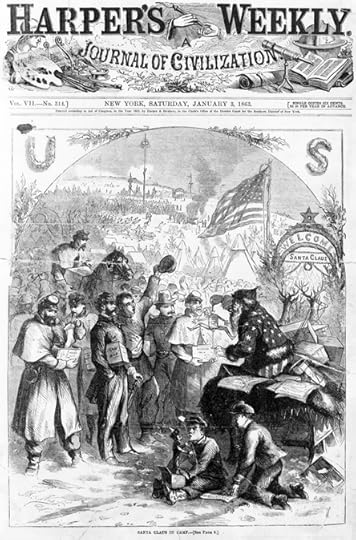
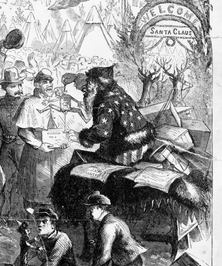
You’ll want some proof. Here goes. The first depiction of Santa Claus, as we
might recognise him today, dates from the Civil War. It’s true. During his campaign for president, Lincoln hired an illustrator to produce his posters. The artist was called Thomas Nast and, late
in 1862, he was asked by one of the most popular periodicals of the time, Harper’s Weekly, to produce their Christmas cover. Knowing Nast as he did, Lincoln himself is rumoured to have proposed
the idea of Santa Claus visiting Union troops. Santa Claus appears in the stars and stripes, but he is the same white-bearded, rotund, non-chimney-shaped old fellow that we see in shopping centre
grottos to this day. The genius of the image was that it mixed tradition with patriotism at a time the Union war effort was at a low ebb. The cover was so popular that Nast got repeat commissions
from Harper’s Weekly for many Christmases to come.
Christmas on the frontline wasn’t quite as joyous as Mr Nast was
implying. A Union army was camped to the south-east of Nashville. A Confederate army was close; just a little way down the road to Chattanooga. Battle might come soon. The weather had been clear
and mild but Christmas Day it was overcast. Santa Claus, represented by the postal service, turned up for some, usually with food parcels rather than presents, but many would get nothing at all.
Peter Cozzens, in his wonderful trilogy on the Chattanooga Campaign, describes a festive season for the officers, especially the Confederates, as they were on home turf and supported by the local
citizenry. Elaborate balls were held, the halls decorated with cedars, evergreens and captured battle flags. The Union army had to work harder for dance partners; the Fifteenth Wisconsin put two
of its soldiers in drag for a party at the local schoolhouse.
Away from the more organised festivities the soldiers played dice, held
chicken fights and the whiskey flowed freely. Food was a preoccupation every day of the year and not just at Christmas, but some made a special effort. Johnny Green of the Ninth Kentucky headed
out into the country in search of a turkey. He found eggs and onions but had to settle for a goose. He baked a poundcake and, being teetotal, settled for a quiet meal. Colonel John Beatty of the
Third Ohio did a little better. Back in Nashville he acquired a turkey for a dollar and seventy-five cents, but, he said, ‘it lacked the collaterals, and was a failure.’
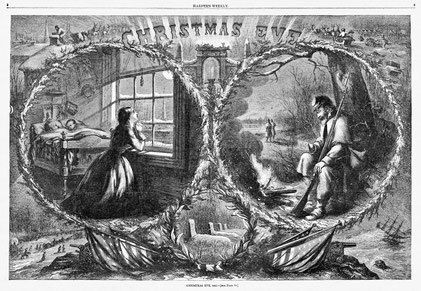
Beatty’s disappointment with his attempt to honour the day was more in line
with the general mood. Melancholy ultimately won out over Yuletide cheer. While Christmas Day offered soldiers a brief escape from the daily grind of army life, it was also a pointed reminder
that they were far from loved ones. Many chose to spend the free time they had writing letters home or, seated around the campfire, recalling earlier and happier Christmases. Many would only be
ghosts at Christmases yet to come. Over New Year three-thousand would die at the Battle of Stones River.
Things were little happier at home. In a novel written shortly after the
war, Louisa May Alcott describes how her ‘Little Women’ woke to find no stockings hung in the fireplace, but a bible under each pillow. The absence of, and concern for, Father, is a constant
through the whole day. In the South children were even harder done by. The Union Navy had blockaded all the ports, basic foodstuffs were exorbitant and most presents would be homemade. In a harsh
move to manage expectations, General Howard Cobb’s children were simply told that Santa Claus had been shot.
Lincoln spent the four wartime Christmases in the White House and for the last
received a present much larger but every bit as odd as his pigtail whistle. General Sherman, having devastated much of Georgia, telegraphed Lincoln. ‘I beg to present you as a Christmas gift the
city of Savannah…’
Nast would continue his Harper’s Weekly cover pictures long after the war.
Christmas traditions in America, solidified and somewhat unified by a new sense of what it meant to be American, would endure. But this wasn’t the most telling change in Christmas celebrations.
Before and during the war, enslaved African-Americans only enjoyed Christmas at the whim of their ‘benevolent’ masters. There may have been extra leisure time, better food, parties and even
permission to travel to visit relatives. No doubt the slaves made the best of what was granted to them. The most profound change in the celebration of Christmas brought on by the Civil War was
that in 1865, after the total Union victory, four million former slaves were free to make their own plans for Christmas.
CHRISTMAS SALE! Whirligig and The Copper Road eBooks will be on sale via Amazon from December 4th through December 11th.
This article was originally published as a guest post entitled ‘A Civil War
Christmas’ on Mary Anne Yarde’s Coffee Pot Book Club in 2017.