Goodbye to December’s Dark Days…
So, perhaps you thought this was a goodbye to 2020 blog? Not quite. But I am very happy to put it behind us. It has been a savage year.
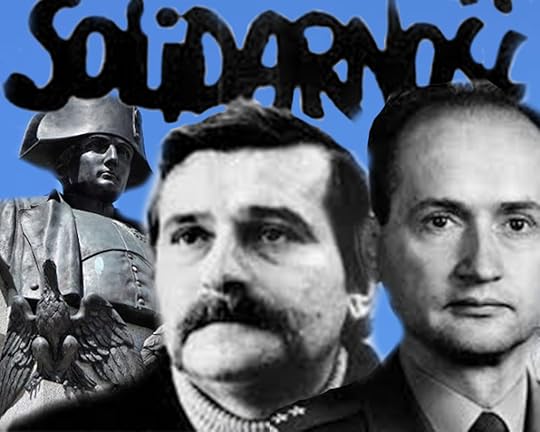
As it turns out, December has been a rather savage month in the history of Poland, so I thought on this last day of 2020, I would attempt to make a connection through three of Poland’s most eventful December days:
December 19, 1806 – Napoleon enters Warsaw. December 14, 1970 – Polish Communist Forces Fire on Striking Polish Workers in the Baltic PortsDecember 13, 1980 – Wojiec Jaruzelski declares Marshall Law in Poland
OK, let’s start with the one that seems out of place – Napoleon entering Warsaw. After the Partitions wiped Poland off the map of Europe (but not from the hearts of Poles) in 1795, Napoleon was welcomed as a liberator. Napoleon stayed in Warsaw as he prepared for the Battle of Eylau (February 1807) and the Battle of Friedland June (1807). Eylau was a militarily inconclusive battle, but The Battle of Friedland represented a major victory of the French over the Russians under Emperor Alexander I. At the negotiated peace of Tilsit (on an opulent raft in the Nieman River), Napoleon agreed to the Vistula River as being the logical border between the French Empire and Russia. In doing so, Bonaparte created the Duchy of Warsaw. While not a sovereign state of its own (it was under the Duke of Saxony as a French satellite holding), it created in the Poles a hope that Napoleon would ultimately reconstitute Poland to its historical status as a sovereign country once more. Even to the point of pressuring one of its own nobles to offer his wife (Marie Walewska) to the Emperor. The Countess became Bonaparte’s mistress and bore him a child out of wedlock. All as a service to her country.
Of course, Napoleon never did make Poland an independent entity once again. Instead, he plucked at the heartstrings of pride of Poland’s pride like a puppeteer manages the strings of a marionette. Except, Bonaparte used the fierce loyalty of his Polish troops and Lancers to a few years later invade Russia and begin his eventual downfall. Many Polish families were destroyed as their Father’s and Son’s lives were squandered not only in Russia, but also in Germany, Spain, Belgium and even Haiti, fighting and dying not for France, but directly for Napoleon.
By 1970, Poland had once again been freed from the grips of the Germans only to have Stalin once again seize its lands as a puppet state to Russia. By this time, the Polish people had learned that real freedom was not to come from emperors or other dictators outside of its borders, but from the bravery still residing in the hearts of its own citizens, where it still burned brightly.
After the Polish Communist Party raised prices dramatically on necessities, on December 14th, 1970 the shipyard workers in the coastal cities of Gdansk, Gdynia, Szczecin and Elbląg went on strike. On December 17, after First Secretary Władysław Gomułka had made the authorizing decision to do so, Polish troops and tanks fired upon workers reporting to work in these cities. The death toll was reported as 42 people with thousands wounded and maimed, although many have thought these numbers to be drastically under-reported by the communists. A young electrician named Lech Wałęsa was a member of the three member worker’s strike representation that settled the strike. While the Polish Communists did set prices back to pre-strike levels (for a period of time), the larger success was that the Russian Overlords forced out Gomułka and replaced him with Edward Gierek.
A decade later, Gierek settled the now famous August 1980 Gdansk Shipyard strike, again with Lech Wałęsa leading the negotiations that would establish the Solidarity Independent Workers Union, and which would eventually lead to the fall of Communism in the entire Eastern Bloc. But it was not until December of 1980 when the new Communist leader (Yes, Giereck was sacked after settling this strike, just as Gomułka had been a decade earlier) Wojciech Jaruzelski declared Marshal Law on the 13th. Of course, the nation would ultimately persevere, and Solidarity led the way to renewing Polish Independence.
THE MORALE of this diatribe: Seek not from the sword of foreign despots what your heart seeks, but find it only in the collective depths of those hearts that beat alongside your own!


 newest »
 Great blog. It doesn't hurt to be reminded of the cost of freedom -- and its place in our hearts!