
The Blundering Generals Leading Negrodom To Death. Part III: Black Lives Matter
‘The best in a race is not reflected through or by the action of its apes, but by its ability to create of and for itself.’
Marcus Garvey
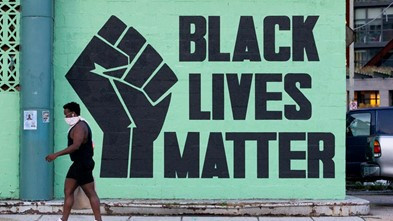
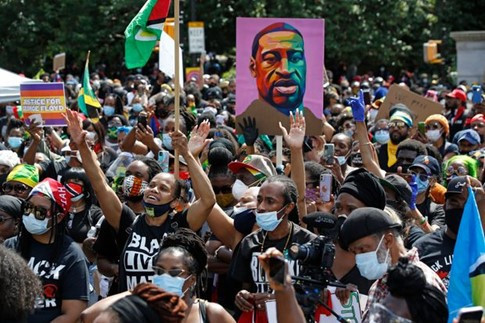
Given the global sway of American culture and the fact that the diasporic black communities look to the African American as paragons, it is appropriate to examine the philosophy of an organisation recognised as representative of black political thought. Already we have seen the impact of BLM on diasporic communities in Europe, building upon their growing influence on the citizenry of the United States. The Guardian writer Ellen Jones, salivating over the organisation, stated ‘It’s a movement that some analysts say is the biggest in US history. Between 15 and 26 million people participated in demonstrations following the death of George Floyd in May this year – and between then and August there were 7,750 demonstrations in all 50 states and Washington DC. Internationally, there have been protests in 60 countries and on every continent except Antarctica, with politicians from Boris Johnson to Justin Trudeau insisting that they, too, think “Black Lives Matter”.’[1]
Lofty achievements followed by high praise. Yet, outside of high numbers, famous names and a catchy phrase, is this a legitimate race-based organisation?
The organisation’s website states that BLM was ‘‘founded in 2013 in response to the acquittal of Trayvon Martin’s murderer.’[1] For seven years since the tragic incident, BLM has worked to ‘‘eradicate white supremacy and build local power to intervene in violence inflicted on Black communities by the state and vigilantes.’’ This certainly not a new agenda, particularly in the field of African American race politics; a sphere with a long history of resistance-based groups. Seemingly a traditional race-based organisation with a noble agenda and an optimistic program of upliftment for the descendants of Africa alone, historical staples of similar movements which rose and fell.
Yet, in the very next segment, those race-based pretensions are revealed as a grand fabrication. For BLM states, clearly and unequivocally, ‘We are a collective of liberators who believe in an inclusive and spacious movement. We also believe that in order to win and bring as many people with us along the way, we must move beyond the narrow nationalism that is all too prevalent in Black communities. We must ensure we are building a movement that brings all of us to the front.’ Not only in this a sharp diversion from the modus operandi of race-based organisations, the statement stands as a spectacular condemnation of black-centred movements. The most influential, race-based, organisation of the age is pursuing an agenda that endeavours to ‘move beyond’ what it describes as ‘narrow nationalism’ which is apparently ‘too prevalent in black communities’.
For those who have been awaiting the moment a serious organisation rises to resolve the plethora of issues that beset the black race globally, the endless déjà vu returns. Given that BLM speaks boldly of inclusivity and being an organisation that seeks to ‘bring as many people with us’, one can assume that the narrow nationalism they condemn is an ideology which seeks to assist black people alone. Horizons have clearly been broadened by this ‘collection of liberators’ that have yet to liberate a single person. As the protests, across North America, have shown a broad range of people have been involved in elevating the organisation. If the protests were about the callous manner in which black lives are taken, it has become clear that members of all races are united in their desire for a more just America. A noble endeavour, not one which should concern the best of Negrodom, however.
More Pan-liberal than Pan-African, more national reformers than global liberators; aside from the crime of false advertising, more serious charges emerge. There is a clear shift away from the traditional raison d’être of a race-based organisation: focusing on the issues of a particular race. The shift is toward what is described as a more ‘‘inclusive and spacious movement’’ which ‘‘centers those who have been marginalized within Black liberation movements.’’ Who, one reasonably asks, has been marginalised? ‘‘Black queer and trans folks, disabled folks, undocumented folks, folks with records, women, and all Black lives along the gender spectrum,’’ BLM confirms.[1]
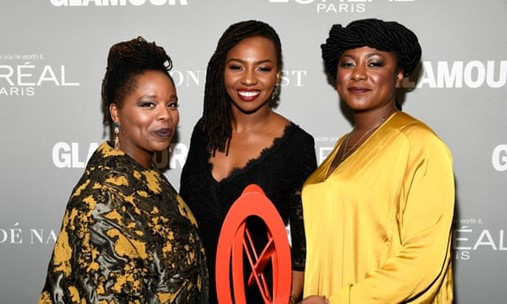
This brings us to the founders of BLM; Alicia Garza, Opal Tometi and Patrisse Cullors. Negrodom is informed that ‘‘BLM was formed in 2013 when Oakland-based organiser Alicia Garza felt moved to respond to the acquittal of George Zimmerman. Zimmerman had the year before shot dead an unarmed black teenager, Trayvon Martin, in Florida, and Garza posted an impassioned message on Facebook. Patrisse Cullors shared the post with the hashtag #BlackLivesMatter, and an inspired Tometi built the BlackLivesMatter.com website, choosing yellow and black as its signature colours. And with that a movement was born.’’[1] A message on Facebook, a hashtag posted, special colours chosen, and a website created; such is the horrifying ease with which it is possible to assume power over black masses.
Marcus Garvey once wrote, of African American leaders of race-based organisations, that ‘‘Some Negro leaders have advanced the belief that in another few years the white people will make up their minds to assimilate their black populations; thereby sinking all racial prejudice in the welcoming of the black race into the social companionship of whites’’. Much time has passed since those words were uttered, in the years between the First and Second World Wars. Much has improved, yet racial prejudice remains, as does the belief of ‘‘Negro Leaders’’. It seems all that has altered is the shift from ‘‘some Negro leaders’’, to all. We can but wonder when Negrodom last produced a leader who said anything other than ‘keep whining and pining, white people will see how unjust they are soon’. From the US to the UK, we hear the same unabashed beggary slip from the mouths of those who have gained inglorious prominence. It is never truly about the black race, but about the body politic of the adopted country they call home.
Our Black Lives Matter triumvirate is no different. Tometi states, “In the US, we’ve overvalued punishment and invested heavily in apparatuses that criminalise our communities … But you could always say: ‘No, we can actually invest in caring for our community.’ That care can look like more resources for education, more resources for mental health programmes and so on.” This writer shall say it plainly, for the distinction has been lost and the decades tumble in ignominy. If you wish to promote liberal policies to create a more equal society in the West, join a left-wing political party; if you wish to liberate Negrodom, build a race-based organisation dedicated to self-determination. The two are mutually exclusive, as our prominent people are either too weak, misguided or corrupt to distinguish between the two.
They must be, for history has shown that we are incapable of dovetailing the two without becoming seduced by the allure of the dominant culture. Those who begin a journey of liberating the black man oft find that after a few steps they prefer the road which leads to reforming the white man. What begins in earnest ends in ignominy. We have now had a long enough history in both the Democratic and Labour parties to allow the veil to slip completely. There is no true interest in self-determination but in collective improvement. They talk boldly of reform, but what exactly is to be reformed Negrodom or the West?
BLM ‘activist’ Chi Ossé, confirmed his ‘‘bid to serve as a Gen Z member of the New York city council, and call on a young, multiracial coalition of progressives across the country to step forward as well.’’[1] More suited to the Trump ‘Make America Great Again’ hats, than the kente cloth now so popular, the faux revolutionaries all want the same direful aim, to improve the West while issuing bold statements about a Negrodom they refuse to serve. Reaching the delusional zenith attained throughout Negrodom, Ossé claims ‘‘We have invested far too much in this country, both willingly and unwillingly, to not finish the job. We built this ship. It is our right to sail it, and our duty to point it in the right direction.’’[2] Never, in the history of mankind, has there been a case of victims so enthralled with their abuser and so perverted by the abuse that they received that they consider it their duty to improve their abuser.
The desire to forge our own path has long ceased to exist, those who now rise to prominence are a testament to that fact. The trusted lines are read from the old script, deploring the fate of black people and urging change. Fame arrives, the script is no more, and we discover that this change is to national institutions. The faux revolutionaries become members of the same institutions they once condemned, for ‘change from within’ will inevitably occur. While little alters, the fame acquired by the individual grants them a lifestyle that they could not have acquired without the revolutionary act.
Black Lives Matter UK gained legal status and renamed itself Black Liberation Movement UK, knowing well they shall not liberate a single person.[1] A list of those to receive a share of the £1.2 million, in donations, being handed out to ‘Black interest groups’ by BLM has been named. It is a who’s who of inconsequential charities, support groups and labour unions. An examination of the saddening list brings the reader to the conclusion set forth in this article, there is not a single serious organisation dedicated to the uplift of the race alone.[2] United Family and Friends Campaign, the organisation to receive the largest donation (£45,000) state the following on their website: ‘Established in 1997 initially as a network of black families, over recent years the group has expanded and now includes the families and friends of people from varied ethnic and cultural backgrounds.’[3] How familiar this sounds, what begins with aiding only Negrodom ends with ‘varied ethnic and cultural backgrounds’. AZ Mag, recipients of £7,500, is a ‘arts and culture initiative for LGBTQ+ people of colour. Independent Workers of Great Britain, receiving £15,00, is a trade union that does not even bother to mention black people on its ‘who we are page’. The Ebony Muse encourages each person to examine the list, for there are recipients (Sistah Space) that carry out good national work, none however carry out revolutionary work.
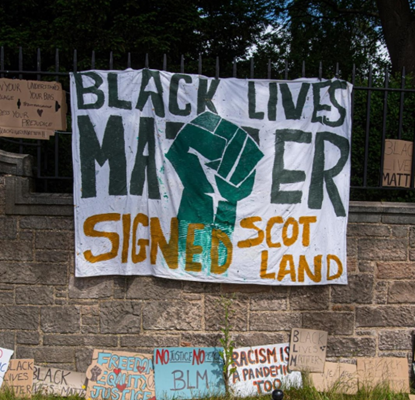
In the United Kingdom, The Joint Committee on Human Rights published another report into the investigation of the state of black grievances in England on 11th November 2020. A long mournful list of some of the reports commissioned which ‘‘have investigated and found, structural racial inequalities’’ is presented to the readers. The Macpherson Report (1999), The Angiolini Review (2017), The McGregor-Smith Review (2017), The Lammy Review (2017), Race Disparity Audit (2017), and the Windrush Lessons Learned Review (2020). Over two decades worth of the assimilational merry-go-round, with no end in sight. The BLM answer to this conundrum is the grand strategy of protests, marches, and risible funding of grassroots organisations with little power and no revolutionary aims.
‘‘The professional Negro leader and the class who are agitating for social equality feel that it is too much work for them to settle down and build up a civilization of their own. They feel it is easier to seize on to the civilization of the white man and under the guise of constitutional rights fight for those things that the white man has created. Natural reason suggests that the white man will not yield them, hence such leaders are but fools for their pains.’’ Wrote Marcus Garvey, a revolutionary who died eighty-one years ago. His remarks are as pertinent now as they were in the interwar years. There is much discussion surrounding the funders of BLM and the questions this raises about the sincerity of the leadership. There is no need to follow the trail of money to unveil BLM as a farce. What we have is an organisation that seeks to make war on internal institutions rather than create their own, encouraging an outpouring of anecdotes of how white people have made us feel. In search of white sympathy and the social benefits which may be proffered by the guilt-ridden, an unending list of dishonourable faux revolutionaries have stepped forth.
Otegha Uwagba, another revolutionary with products to sell declares, ‘‘I’ve spent my entire life treading around white people’s feelings’’.[1] “I just wanted to communicate the burden of whiteness, the mental and emotional trauma,” Uwagba says pitifully. Perhaps the profits from her book ‘Whites: On Race and Other Falsehoods’ will heal her trauma; as Frederick the Great said of Empress Maria Theresa, ‘‘she wept, but she took.’’ The comedian John Boyega, after a magnum opus at the London protests, has declared that he is petrified white people will no longer hire him.[2] Tineka Smith, another selling a book, has revealed that ‘‘Black Lives Matter changed my life, and my interracial marriage, for the better.’’[3] Mrs Hirsch, darling of the faux revolutionary class, also with a book on sale, wrote teary-eyed that ‘‘the graves of the enslaved are still being desecrated.’’[4] Mrs Hirsch, as a preposterous agony aunt, publishes regular malefic answers in The Guardian addressing the sorrows of the newspapers black readers. None ever write to her, she soldiers on manfully nonetheless, creating her own set of sorrows to address.[5] Lewis Hamilton, selling little but his soul, has revealed that ‘‘Watching George Floyd brought up so much suppressed emotion.’’. What Hamilton failed to confirm was that it was in-fact his blackness that, suppressed for thirty-five years, had suddenly made an appearance. Just in time, for Hamilton was named the United Kingdoms ‘most influential black person’ of 2020.

The disgracefully named ‘Powerlist’, topped comically by a sportsman and including the befuddled Mrs Hirsh, is released each year with abominable fanfare. Not a single person on the list is the head, or even a member, of an organisation with the sole aim of enhancing the global standing of black people. We are to celebrate sportsmen, musicians, journalists, editors, and television historians as our most powerful people, all the while knowing they have no standing in the corridors of power. The ‘Powerlist’ is little more than an annual reminder of the sorrowful state of the black race. Alongside this cabal of entertainers is a group more lamentable than any other, completing the top ten. Dame Donna Kinnair, Prof Kevin Fenton, Jacqueline McKenzie, Richard Iferenta are all laden with fabulous titles. Two directors, a partner, and a chief executive; each a paragon of the assimilation project, all in organisations that do nothing to aid Negrodom.
The black Dames and OBE’s, in accepting base honours, indulge in the old quid pro quo of servility in exchange for acceptance (four of the seven on the ‘Powerlist’ Judging Panel have received either OBE’s or MBE’s).[1] However, the intelligentsia is an essential element of any revolution which occurs. They are often in the vanguard, leading the way forward for those less educated. Turkey’s President, Recep Tayyip Erdoğan, ensured hundreds of teachers, scholars and civil servants within the Turkish intelligentsia were jailed in the aftermath of the 2016 coup attempt. In 2020 many of those arrested were jailed for life.[2] Such is the threat a serious intellectual class can pose. What we have instead, across all Negrodom, is a class of faux revolutionaries imbued with inertia.
‘There lives not three good men unhanged in England’, Falstaff lamented in Henry IV, ‘A bad world, I say.’ David Olusoga, a questionable historian and member of the repugnant power ten, spoke of the ‘‘exhilarating and humbling’’ moment when he was offered an OBE.[4] After naming other black sycophants who have accepted an OBE, Olusogoa in a long article in which he pretends to have contemplated declining the Oder of The British Empire declared, ‘I dislike the link to empire, but it felt wrong to turn down an OBE.’ There live unhanged a plethora of faux revolutionaries, the hangman has long taken leave of his duty, perhaps in search of a single good man or woman throughout all Negrodom.
__ATA.cmd.push(function() { __ATA.initDynamicSlot({ id: 'atatags-26942-6034c886864e7', location: 120, formFactor: '001', label: { text: 'Advertisements', }, creative: { reportAd: { text: 'Report this ad', }, privacySettings: { text: 'Privacy', } } }); });


