
Understandings of the anarchic 18th century, misfires between Politics and Religion
An article recently published at Op India in the context of Panipat 1761 AD, Marathas and Hindu politics says that:
“Another criticism is that the Marathas antagonised fellow Hindus by extracting ‘Chauth’ from them and hence none came to help at Panipat. As we have already seen, there was no love lost among the various constituents who made up Abdali’s army at Panipat. Anyone – Rohillas, Shias, Afghans, Balochis could point to their co-religionist for some previous hurt and skip the battle. They could point to the sacking of Delhi or the previous three invasions and many other reasons to not join hands. But on 14th January 1761, it was time to ‘save Islam’ “
For the Rohillas(Najib) and Shias(Shuja) it wasn’t the time to save Islam, but to save their own political independence and Kingdoms. To this real reason the author eventually tumbles:
“and protect their extensive jagirs in north India”
Comparing Islam and Hinduism’s political applications is the same old apple and orange delusion. The difference in civilizations that these two have bred is an important aspect to understand why.
Loot, plunder is something that can spectacularly unite and also dismally splinter.
When a group comes together i.e. a coalition is formed with the objective of looting some other side and maintaining political independence, religion is an add-on.
It wasn’t just Islam which united these disparate muslim powers.
The prospect of loot is what mainly brought that unity for Khorasani tribes.
The main worry of so called Indian-muslim power centres like Rohillas and Shias in uniting was, as said earlier, more political than religious. It was that the weakened Mughal centre (good for them) was to be replaced by another upcoming power (Marathas) that would overshadow these regional rulers again.
Nobody denies the religious angle in Panipat. Issue is of branding the multi dimensional battle as a religious war.
Islam in the north does not finish with arrival of Marathas. If it were so, we would have seen the extermination of Muslim states in the south first, from where the Marathas came and had been living for centuries. That, we know, isn’t the case.
The argument that the Baloch and Afghans had shed their difference at the call of Jihad is a hogwash.
Baloch and Afghans had already mend their relations via the treaty of Kalat in 1758 AD. This was by Abdali’s initiative, and since then the Baloch armies had been aiding Abdali in various of his military campaigns including the one against Iranians in 1759 AD i.e. two years before Panipat.
Moreover, the Afghan tribes internal unity wasn’t a result of some recent call for Jihad either. Jihad was a motivating factor though, as it promised booty w/o guilt. Their unity was actually the result of political assimilation under Iranian threats on one side and on the other side the lucrative prospect of looting & expanding into India which had a weakened Imperial centre.
If we’re to tread on the speculative type ‘could have saved temples’, ‘should have saved temples’ track of frivolous assertions. One might as well surmise that a pan Hindu-Muslim India unity during Abdali invasions “should have” rooted out the problem forever. These imaginations don’t take us on any firmer grounds or clearer understanding of the past.
It is wrong to imagine religion in everything. Human life and politics of the middle age has been much sophisticated than the force fitting of history in this uni-dimensional model of Hindu vs Muslim.
It wasn’t the case then and it isn’t so today.
The unity of Abdali’s coalition is however less of a concern for modern Indians, than the disunity among the contemporary Hindu/Sanatani powers. So, that needs to be tackled.
When multiple kingdoms come together, a leader of the coalition is required.
It was Abdali on the other side. Why?
Answer lies in whether Abdali had been marauding the lands of all muslim powers including Rohillas and Shias of Awadh and been constantly milking them? No, that is not the case.
Well, then it wasn’t a tough choice for the muslim kings facing existential threat, was it.
But when it comes to Hindus. The power under which a Hindu re-union is now desired in retrospect. Was the very one who had mindlessly excessed against numerous Hindu kingdoms of the north.
This irony has no parallel with Islam and its contemporary politics. For they run on the greed of booty.
Abdali had a much cleaner slate among his co-religionists, especially the mainland ones.
But did the Marathas similarly patch up their relations with these Hindu Kingdoms they had been milking, like Abdali did with the Baloch? No; then why are we comparing?
Any warring states shedding their differences and coming together is still possible and has happened plenty in history.
However, over what background and among which civilization is the key to unlocking it.
After the amount of ruin that Marathas brought in the north for decades. It takes a radical shift and confidence-building to form trust in the beleaguered Hindu society.
Before talking of shedding differences, rises the question of how does one shed the deep wounds on their populace, of the rampant pillaging for decades and when the pillager shows no signs of relenting from extortion.
Some like to think it was the myopic elite (like Madho Singh?) of the north who came in the way of Hindu consolidation.
So far as the Jaipur royals are concerned. We would like to remind that when Madho Singh’s pre-decessor Ishwari Singh had gone upto Sarhind to fight the same Afghans in 1747 AD.
In his absence the Maratha armies invaded his Kingdom to facilitate a coup for Madho Singh. Quite a Hindu consolidator role played!
Pillaging, extracting chauth, rooting for the highest buyer, switching sides for more money, toppling Kings, extortion.
When Maratha powers worked hard to build such a reputation for decades. It painfully eroded the honourable memories that the north had of Shivaji and his illustrious kingdom.
This reputation of Marathas finds ample reflection in the literature. One of the things that our self-proclaimed saffronest Hindu power were called in the north is ‘Patels’ i.e. money minded tax collectors.
Consider an example from Koormavilas [Pratap Singh Varnan, Pg 468] :
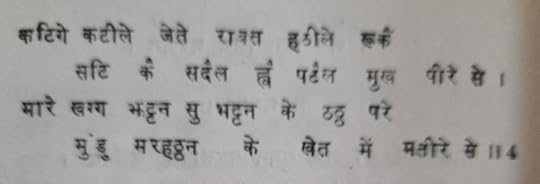
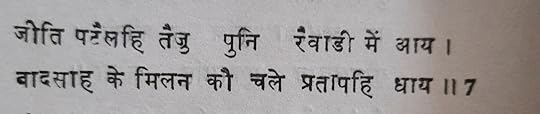
Why Marathas couldn’t lead a Hindu confederation ever, should be asked from the robbed, indignant and fed up civilians of the Amber state whose outburst was felt in the streets of its capital Jaipur in January 1750 AD.
Collecting 1000 dead bodies of their men in a never before incident should have forced the Maratha leadership to re-think and mend their ways. Alas!
It is of value to further ask, why such a civilian outburst never occurred during the Mughal rule. We’re talking of as authentic Hindus as any other in the nation.
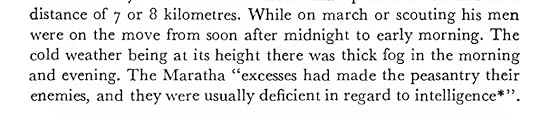
That outburst is symbolic of the difference that north’s hindu population felt against Maratha excesses, compared to the past. Difference was due to the fact that the Hindu elite of the north had kept Mughals at an arm’s distance from rubbing into their population. But the rude and unexpected jolt of Marathas wasn’t just a politico-military norm of the age, supposed to be handled by the elite. It was equally felt by the population. Therein lies the kernel of Maratha failure.
Alienating Kings is part and parcel of the game, alliances keep forming and breaking, political relations go up and down. But alienating a society? That isn’t something one can overcome in a jiffy per their whims when they see the Afghan hordes approaching.

At the root of these modern delusions being artificially projected on the past, are two assumptions.
That any Hindu political power that has entered into any kind of alliance with a Muslim power, are essentially traitors who cannot and did not protect Hindu interests any longer.The fact that India continued to be a practising Hindu majority before and after the Maratha period, is enough to understand the truth. Provided one doesn’t have their head in the sand.
That the Hindu powers other than Marathas were utterly incapable of taking care of themselves (their hindus) against the muslim powers, Imperial or otherwiseLet us address this in detail.
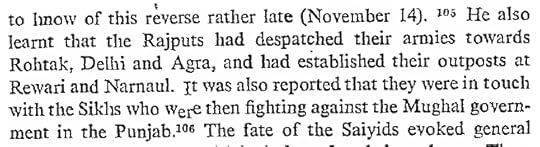
Did any Hindu powers of the north not co-ordinate against the Mughals in the 18th century?
Did such coordination also didn’t run across the Narmada?
All of that happened, as explained below, till the Maratha pillaging hadn’t started.
The context is of few decades before Panipat. The post-Aurangzeb Mughals had declared to effectively and officially cancel the northern Hindu Kingdoms and usher direct muslim rule.
Consequence – a combined army of three northern Hindu states – Mewar, Marwar and Amber set out to exterminate the Mughals from their Kingdoms.
First they grabbed the Mughal treasury of Sambhar and distributed it to the local population.
Then they defeated and killed to the last man a Mughal Army including 4,000 cavalry at Sambhar in 1708 AD.
Thereafter this coalition’s outposts were located barely 45 miles from Delhi.
This is Amber’s ruler Sawai Jai Singh writing to Chhatrapati Shahuji in 1708 AD soon after the victory.
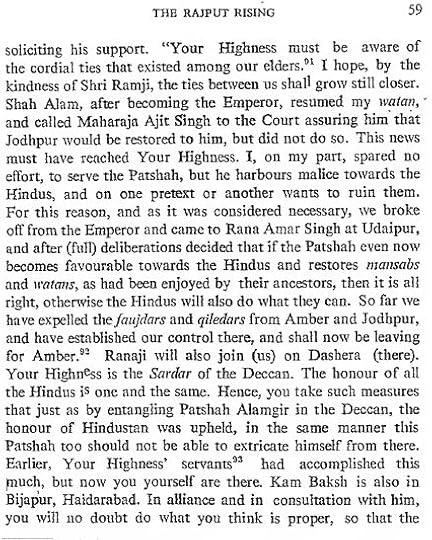
Apart from the content and sentiment. Note that when this letter was written, Jai Singh’s own Kingdom was secured from any Mughal threat, practical (Sambhar defeat) or official (Mughal offer to recognize his Kingdom). Yet he is campaigning for Hindu unity across the country.
In separate letters Jai Singh appealed for the same with another northern Hindu King Chhatrasal Bundela as well. Letter also shows how he was liaising with many other Hindu chieftains.

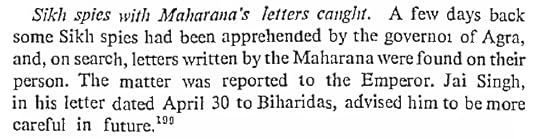
The Mewari Maharana Amar Singh, a visionary leading this coalition who died soon after, was in the same years in touch with the Sikhs via spies, reasons need not be guessed.
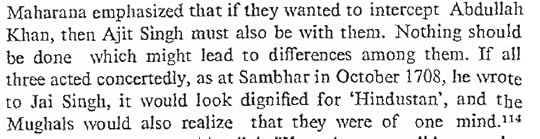
The oneness of mind in these separate Hindu Kingdoms well before the clash with Mughals can be gauged from the following letter of the Maharana to Jai Singh:
The potency of this unity gets acknowledged by the Mughal Emperor himself who appears worried and rushes back to the north. So warns to Jai Singh his minister from Amber:
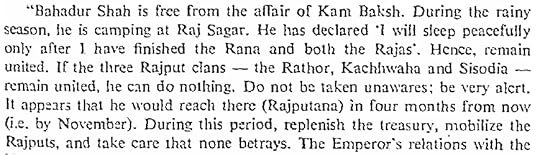
[Source for correspondence snippets above – life and times of Sawai Jai Singh: V S Bhatnagar]
All these correspondences and actions speak immensely of the Hindu Hurmat theme being an integral part of the Rajas and Ranas policy.
In the end I would just remind us of the fact that the contract of pan India Hindu leadership has been out for the past 2000 years. None has fit the bill yet.
Juxtaposing our biased little “what should be”s over the factual “what has been” does not fix any of it.


