
November Post: Harvest FestivalThis is the time of year w...
November Post: Harvest Festival

This is the time of year when many of us are preparing to celebrate Thanksgiving or a similar holiday feast of thanks. Harvest festivals have been celebrated in Britain since pagan times, giving thanks for a successful harvest and a blessing for the season to come.
With fond memories I think about my childhood growing up in England. I remember the excitement that ran though the school that I attended, at the anticipation of attending the harvest festival service in the village church. All the classes in school would gather in the hall before walking crocodile fashion, two by two along the lanes to the old stone church with its square crenelated tower, centuries old from the time of the Normans. As we made our way, the tower bells would begin to toll, ringing out over the English countryside. I could imagine the bell ringers hauling on the ropes, to swing the great bells into a peel of thanksgiving and welcome. Inside the church the flagstones echoed with the footsteps of so many children, the stone walls holding the scent of antiquity. We sat quiet and expectant, huddled close together along the wooden pews, looking at the beautiful needlework of the hassocks tucked into the back of the pews in front of us. All around, the somber church had taken on an air of festivity. Candles and lights twinkled, casting their glow on all the harvest offerings decorating the alter and the steps below. There were baskets spilling over with fruits and vegetables, flowers, autumn leaves and sheaves of wheat. We sang special hymns like All things bright and Beautiful and All good gifts.
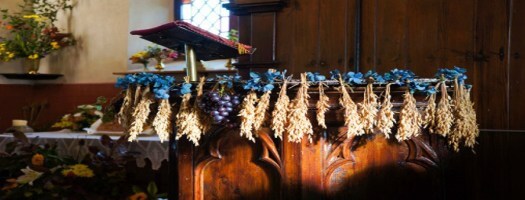
The festival of the harvest has been celebrated by country folk for centuries. Today we have forgotten perhaps the importance of growing and reaping our own food. Medieval life revolved around the agricultural year. Timing was paramount, before rains and cold could destroy a crop, the difference between survival or starvation for the whole community. Festivals were conducted between August and November depending on where you lived. The Anglo-Saxon word for harvest was “Haerfest” Traditionally the first day of harvest would be celebrated on August 1st which was called Lammas meaning “loaf Mass” this was when the first wheat to be harvested was baked into loaves of bread and given to the church for use in the mass.
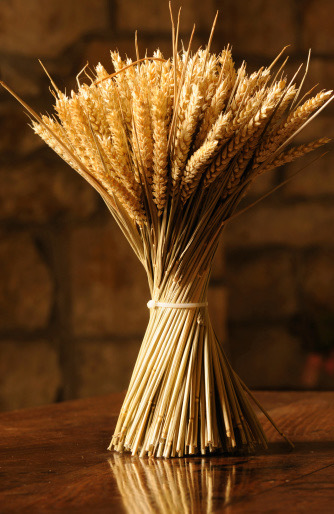
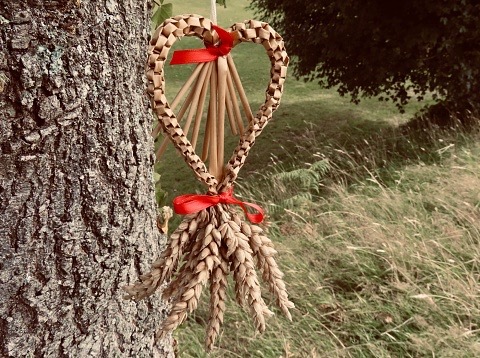
After the mass, all the men, women and children went into the fields to start gathering in the crops. The Lord of the manor could command all tenants and peasants who dwelt on his land to reap his grain (The English called wheat corn) This was back breaking work. Cutting tools were basic scythes and sickles. Work started at dawn and went on until dusk with a short break for food and drink in the middle of the day. The whole community worked together to bring in the harvest. On the last day of reaping, the people would often race to see who could finish the last ridge of corn first. The last stand of corn might be cut by a pretty village girl. The “Cailleac” or last sheaf of corn was thought to represent the spirit of the field. From that last sheaf, a “Corn Dollie” would be made and decorated. The Dollie would be taken to the barn with much merrymaking and music, drenched in water as a rain charm and kept for re-planting the following year. In the evening at the end of the harvest, called “Harvest Home” there would be a big celebration given by the lord.
Have a happy Thanksgiving.
Information from Encyclopedia Britannica
If you would like to receive future monthly posts, updates and giveaways, please leave me an email marilyn@storyteller.space or visit my website for more about writing and the history behind the scenes. HTTP://STORYTELLER.SPACE
Marilyn
The post first appeared on Storyteller.


