Indian Art and Life Affirmation
Since I met my roommate Srihari, he pressed that I scribble on his sketchbook whose future classical status I am positive about. While preparing for my last examination, on a Saturday I finally made an elaborate sketch. Days later I managed to write a commentary on each component of that sketch and this is it.
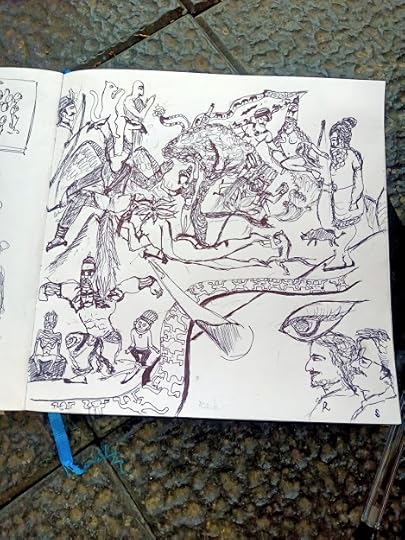
Indian Art, I have always maintained is life-affirming. It does not chase, much to the distaste of the British critic and connoisseur with his annoyingly stiff upper lip, symmetric perfection, a sombre austerity, or any such soft humanist-‘rationalist’ ideal. Was it not Nietzsche after all who remarked that for the “sake of health”, science and rationality must be barred from depriving the human soul of the consolations of metaphysics, art, religion, and pleasure? We find hence in Indian Art, in the galleries of Mathura or the panels of the Bharhut Stupa in the Indian Museum, or the reliefs on the walls of the terracotta shrines of Bishnupur, that very kind of health. This is not to say that there is realism or honesty in Indian art. One only has to see the breasts of Vijayanagara Salabhanjikas or virtually any part of the Devanganas at Patan, Khajuraho, or Halebid to learn that this was absolutely not the case. Still, however here is an ethical responsibility that these artists held towards desire, its role in the making of society, institutions, modelling of mores, and obviously, the species. This ‘sketch’ is an ode to the greatest motifs of Indian Art.
The foundational component is an image of Lajja Gauri lying on her belly. While Gauri is usually depicted seated in the birthing position and meant to symbolise sexuality, motherhood, and fertility, here she is an alternate posture but retains both the bloomed lotus as well as her motherhood – and she gives birth to the creator who would otherwise emerge from the navel of a reclining and slumbering Vishnu, Seshasyi. Is it after all not the power to create that creates? Lajja Gauri is adorned, while appearing naked (as Vidya Dehejia has pointed out, nude images in Indian art are never truly nude; they are adorned with ornaments, hair, and of course, space) with a lotus, yet another lotus and the progenitor, and also a monkey and parrot. These two are obviously inspired from the Shukabhashini and Markatapeeditha (in the Khidrapur School) sculptures that fill the walls of countless temples across the subcontinent. The monkey harasses the woman and the parrot is its best friend. Shooing the monkey and inviting the Shuka are among the prototypical woman’s favourite past times.
But why the parrot? I weave a story there too. She needs the parrot to communicate to yet another Surasundari – much akin to Damayanti’s use of Hamsa to hear about Nala – a Salabhanjika, one of the earliest motifs of Indian art with an unbroken heritage. The woman dons a top bun, Indian art’s favourite hairstyle and lets a foot rest on the tree’s bark. The roots of the tree hinge on to the round buttocks of Lajja Gauri. The tree once more is inspired from Indian Art too; it is a Kalpavriksha, a wish-fulfilling tree. Based off of the ideas that populate the Vedikas or railings of Bharhut and Sanchi Stupas, the tree ejects liquor, ornaments, and garments. All merriment is gifted by the tree. And the complex of the tree-clasping woman and the tree symbolise all things that are worth celebrating.
Meanwhile, Brahma is not alone. He as usual carries the Veda, a Danda, a Rudraksha Mala, and also a Kamandala with a pot of water from which lash out waves that wash the feet of a Vidyadhara couple. Vidyadhara couples are yet another image that can be found across India’s temples and serve a typical decorative purpose but their popularity is epitomised in the Doab of North Karnataka in the caves of Badami and temples of Aihole where one nearly comes to befriend the pretty pair. The washing of feet too is inspired from another recurring pattern – that of the iconography of Trivikrama. The Bhagavata Purana claims that the Ganga descended down to earth when Brahma sought to wash the feet of Vishnu who by the form of Trivikrama in turn by the medium of Vamana, pierced a whole into the sky as he sprang to occupy the entire cosmos. Whether or not Brahma in this tale is painted in Indian sculptures, Trivikrama is a persistent icon and with Brahma’s spilling his pot, I remember that motif too, and in washing the couple’s feet creation pays its due to love.
Now back to the Kalpavriksha. As is the custom on the columns of Sanchi, the Kalpavriksha is worshipped by men but here it’s a Buddhist monk – as appears in real life around us. Just as the crooked cat mimics the penance of the Yogis at the frieze of Mahabalipuram, here too a cat feigns fake Bhakti that is demonstrated by the monk facing the branches of the Kalpavriksha.
From the Shuka on the hand of the Lajja Gauri – a Gandaberunda, a very ancient Indian image explodes into being. The Gandaberunda has enjoyed various careers in its long history so much so that the Vaishnavas appropriated as a form of Vishnu that would slay, Sharabha, which was in turn a mythical creature appropriated by the Shaivas to trump the deity of Narasimha. Today it stands as an emblem of the State of Karnataka – due to the long presence of the motif in the thousands of temples of this state. In my piece it is the messenger that Lajja Gauri dispatches to carry news to her friend the Salabhanjika.
From the crevices under the arch formed by the rising Gandaberunda’s legs rises a mountain – the Kailasa Hill. However it is not resided upon by Shiva. Yet, it is carried by Ravana – and hence we the sculpture of Ravana-anugraha that is a primary icon within the Pashupatha pantheon, the best specimens of which can be found in Elephanta and Ellora. As much as Ravana is humbled by an invisible Shiva he welcomes other beings and shelters them under his empathetic arms. To one side you have Chamundi as found in the museum at Bhubaneshwar – an instance of the Indian Dionysian spirit – with a burning, erratic, fiery skeletal figure and those saggy breasts. On the other is the clown with the twisted arms and legs, a favourite entertainment and sculptural type in the temples of the South patronised in Vijayanagara times.
In the midst of all of this, a boar is running astray. A kirata of the forest, and bearded ascetic Arjuna have set their eyes upon it. I think of the agile Kiratarjuneeya panel of Kanchi and the fallen boar of the walls of Virabhadra Temple in Lepakshi when I sketch this episode across the page.
All of this is of course is carried on the snout of a Varaha who is used to supporting the entire world.
Meanwhile the Prakriti, the productive principle that births this world is the Bhavana, resident in me and my roommate Srihari. And with our eyes, we mere witness. By Darshana, we become Purushas.