Review: ‘The Return of the King’
Yes, it’s finally time to review the third and final installment of Peter Jackson’s The Lord of the Rings film trilogy! I keep saying it in each of the previous parts of this review series, but there’s really almost nothing bad about these movies. I’ll take it one step further: there is almost nothing about these movies that is not excellent. Not just that it’s not bad, it’s superb. Sublime.
This is the film that was nominated for and won eleven Academy Awards! That’s tied for the most of all time with such timeless epics as Ben-Hur and Titanic and the highest clean sweep. It also won four Golden Globes and was the first fantasy film ever to win an Academy Award for Best Picture.
The Return of the King will go down in history as one of the greatest films ever made in any genre, period. In my opinion, it is a must-see, which of course makes the rest of the trilogy required viewing. There simply is no reason to deprive yourself of this visual masterpiece.
In this film, the scope now lands on Gondor and Mordor itself, as Gandalf and what remains of the Fellowship has saved Rohan from corruption and invasion, and Frodo, Sam, and Smeagol trek ever closer to the ashen lands of the Dark Lord. We get to witness Sam battle an ancient, giant spider; we see a massive siege that is broken, then reinforced, only to be broken yet again; we watch as Aragorn the King leads a hopeless battle against the armies of Mordor in a desperate bid to help Frodo and Sam deliver the Ring to Mount Doom and destroy it.
And finally, we get to see peace. Aragorn reclaims his kingdom and redeems his bloodline. The hobbits return to the Shire. All is well in the world, but this world is no longer for Frodo. Having been a Ringbearer, he feels it his duty to leave Middle-Earth behind so that others may shape its fate, and so he sails into the West with Gandalf and the Elves.
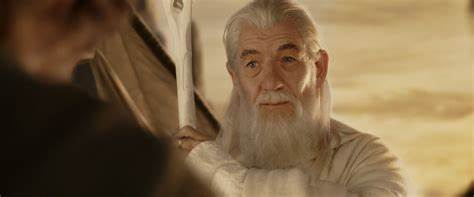 “I will not say do not weep; for not all tears an evil.”
I mean, come on. Have you ever heard a more emotional, powerful farewell? This is yet another example of a theme of Tolkien’s writing that I’ve hit on in every post, and that is a sense of hopeful sorrow. The recognition that tragedy, calamity, and sorrow necessarily exist in the world, which makes the good and peaceful times feel all the sweeter. It’s okay to cry sometimes, because sometimes tears must fall.
And by the way, now would be a good time to listen to the Academy Award winning song “Into the West” by Annie Lennox, played during the closing credits of The Return of the King.
Now in my last post, I did not have much to say regarding the charge of the Rohirrim at Helm’s Deep, and a reader pointed that out. I purposefully did not say much about that because I’m about to say quite a bit about the Rohirrim now!
As the armies of Mordor assault Minas Tirith, the Rohirrim of Rohan arrive to break the siege. Theoden King rides at the head of his army, and when he sees the vast host before him, he feels fear grip him. And if he’s feeling fear, then he knows his men must feel the same. So he turns and delivers a bone-chilling, spine-tingling speech:
“Arise! Arise riders of Theoden! Spears shall be shaken; shields shall be splintered! A sword day, a red day, ere the sun rises! Ride now! Ride now! Ride! Ride to ruin, and the world’s ending! Death! Death! Death! Forth Eorlingas!”
Goosebumps every time. But that speech isn’t even my favorite part of this scene. No, my favorite part and favorite character in this scene is actually the nameless soldier below.
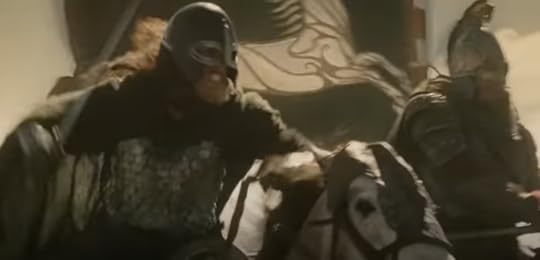
Watch this scene here and skip to the 4:45 mark. Here you see this nameless soldier, baring his teeth and growling like a savage beast as he urges his horse forward, overtaking the riders in front of him, sword in hand. He’s only on the screen for about two seconds, but a picture is worth a thousand words and this one here could fill a book.
What I see when I watch this is a broken man. I see a soldier whose young wife and children were slaughtered in their home by invading orcs and Uruk-hai while he was patrolling the plains of Rohan. He returned to a burned out husk of a house and corpses that no man should ever see, leaving him hollow. Adrift, empty, without a reason to live. But that emptiness soon gave way to hatred and vengeance, filling him with renewed purpose.
When Theoden King called for soldiers to ride to Gondor, this man did not obey out of any sense of loyalty or duty. He’s never cared about Gondor, and he cares even less now. At this point, he doesn’t even give a damn if Sauron wins the war and envelops the world in darkness because darkness is already all that is left to him.
No, this soldier is not here to fight for what’s right. He’s here for vengeance. He’s here to die. He doesn’t want to be part of the victory feasts; he wants to be part of the songs sung for fallen comrades. He came to die in battle, but not before taking at least twenty damnable, wretched orcs to the grave with him.
That’s why he’s growling and urging his horse to the front without any regard for his own safety. He wants to be the first rider to hit the orcs so that no one else can kill the creatures that are his to kill.
Later in the battle, after crashing through the orc lines and killing every orc he sets his eyes on, he does indeed die, slain by a Haradrim archer from atop an oliphaunt. Finally he has found peace, and can reunite with his family in distant lands beyond the vision of even the Valar. At least, that’s the ending I give to this nameless soldier’s story.
Finally, the movie is famous for “multiple endings”, there being three places where, if you haven’t read the books, it seems that the movie has ended. But I like this storytelling device. All throughout the movie there’s been multiple storylines, and so each storyline needs to conclude separately.
Aragorn’s story concludes as he reclaims the throne of Gondor and marries the woman he loves: Arwen, an elf and the daughter of Elrond. Frodo and Gandalf’s story concludes as they sail into the West, leaving Middle-Earth forever. And at last Sam returns to his wife and children in Hobbiton, and he declares, “Well, I’m back.”
And life goes on, just like that. Sam was a part of one of the greatest quests and adventures in history, and now his closest friend and mentor have both departed this world. But Frodo left Sam his book, the same book that Bilbo left to Frodo, so that Sam can continue their story. And so it is Sam who left us the story of The Lord of the Rings.
Befitting the longest movie of the trilogy, this post ran quite long! There’s not much else to talk about regarding the movie. What else can I say that eleven Academy Awards hasn’t already said? I hope you enjoyed this series and reading some of my thoughts on this timeless epic (believe me, I could fill a book with my full thoughts).
I may continue to share my thoughts on movies that I like, we shall see! But for now, thank you for reading and for sticking around this long!