A Petition from Blanche of Lancaster, Lady Wake, 1320
Blanche of Lancaster was born sometime in the early 1300s as the eldest child of Edward I's nephew Henry of Lancaster (b. c. 1280/81), later earl of Lancaster and Leicester, and Maud Chaworth (b. 1282). She was born in the reign of her great-uncle Edward I and died between 3 and 11 July 1380 in the reign of Richard II, when she must have been in her mid to late seventies, having outlived her six younger siblings. She was the aunt, and perhaps godmother, of the more famous Blanche of Lancaster (1342-68) who married John of Gaunt and was the mother of Henry IV.
Blanche married Thomas Wake, future Lord Wake of Liddell (b. March 1298), before 9 October 1316, probably not too long before. Edward II fined his ward Thomas £1000 when he found out, as the marriage had taken place without his licence; he had offered Thomas the marriage of Piers Gaveston's daughter and heir Joan, only to find that Thomas preferred to wed Blanche. Edward pardoned Thomas on 9 December 1318, and allowed him seisin of his late father John Wake's lands a couple of years early at the request of his cousin, Thomas's father-in-law Henry of Lancaster. [1] As to why Thomas preferred to marry Blanche of Lancaster, who had a younger brother and five younger sisters (though not all of them had been born by 1316) and was not an heiress, over Joan Gaveston, who was an only child until her half-sister Margaret Audley was born c. the early 1320s and was a sizeable heiress, we can only speculate. Blanche and Thomas Wake were married for over thirty years until Thomas died in 1349, though they had no children (Thomas's heir was his nephew John, earl of Kent, d. 1352).
On 24 April 1320, Edward II gave Thomas Wake permission to go overseas on pilgrimage with two attendants, William Wasteneys and Richard Normanby. Thomas was, however, still at his Lincolnshire manor of Bourne on 6 June 1320, when he made a grant to Sir Roger Belers that was witnessed by, among others, his younger brother John Wake and Wasteneys and Normanby, the men who would accompany him on pilgrimage. [2] Thomas did eventually leave England that year, and as chance would have it, his Lancastrian father-in-law Henry also spent much of the period from 1318 to 1322 overseas. Henry's obscure younger brother John of Lancaster, whose heir he was, died in France before 13 June 1317, and Henry went there in May 1318. On 28 September 1318, he was 'staying in France to claim his inheritance', and on 21 August 1320 was 'staying beyond the seas' until the following June, though he returned to England for a while in November 1320. [3] His wife Maud Chaworth accompanied him (see below for source).
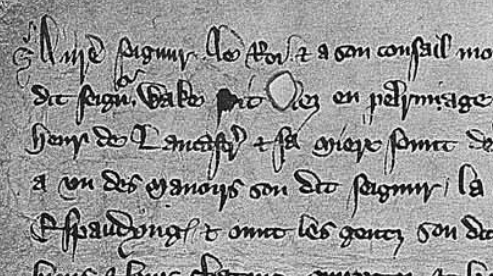
Sometime in 1320, after 6 June and before 24 November, Blanche of Lancaster presented a petition in Anglo-Norman to Edward II and his council, calling herself 'Blaunche Wake, cousin of our lord the king and consort of Lord Wake' and stating that her husband had gone on pilgrimage to Santiago de Compostela (seint Jake) with royal permission. [4] She added rather plaintively that 'her father Sir Henry of Lancaster and her mother are overseas, and therefore she remains alone'. Blanche went on to say that one of her husband's manors had been attacked by 'numerous robbers and murderers' from the town of Spalding in Lincolnshire, who had killed some of Thomas Wake's servants and her own, and badly wounded others to the point of death. She did not specify which manor, but Thomas held several in Lincolnshire, including Bourne and Market Deeping, which are both about twelve miles from Spalding. The people from Spalding had also stolen goods and chattels from the manor, and had taken away the dead bodies (les corps de eux q' sont mortz aloignez), an unusual detail which I don't recall seeing in a fourteenth-century petition before. Blanche finished by stating that she and her 'ladies', i.e. her attendants, were so frightened and distressed that they did not dare to stay at the manor, and she begged Edward II and the royal council to help her as soon as possible. Unfortunately, they did not, but only responded that she had no right to an action resulting from the petition. I haven't been able to find any other reference to this attack on a nearby manor by the people of Spalding.
Below, part of Blanche's petition.
In 1320, Blanche was only a teenager, who might have been eighteen but perhaps was as young as fifteen, and obviously felt isolated and afraid with her husband and her parents overseas. Her closest relatives in England were, apart from her younger siblings (assuming they weren't abroad with their parents), her father's cousin the king and her paternal uncle Thomas of Lancaster, earl of Lancaster and Leicester. Thomas of Lancaster isn't mentioned in the petition, and I have no idea if he tried to help her or not. Another close relative was Hugh Despenser the Younger, half-brother of Maud Chaworth, and thus also Blanche's uncle. Hugh was then Edward II's chamberlain and had already become a pretty powerful royal favourite, though I have no idea either if he did anything to help her. I find the petition poignant. Many years later, as a widow in the 1350s, Blanche, Lady Wake had an awful feud with Thomas Lisle, bishop of Ely, and gave as good as she got, but in 1320 she was young and vulnerable.
Thomas, Lord Wake was back in England by 24 November 1320 when he settled two of his own manors in Cumberland and Yorkshire on himself and Blanche jointly, and Henry of Lancaster had also returned by 16 November 1320. [5] I wonder if this isn't a coincidence, especially as Henry had originally intended to remain overseas until June 1321, and perhaps Blanche sent messengers to her husband and her father and they both hurried home. It kind of amazes me that Blanche lived for another sixty years after the events she described in her petition.
Sources
1) CPR 1313-17, p. 553; CPR 1317-21, pp. 43, 251-2; CCR 1313-18, p. 413; CIPM 1291-1300, no. 597 (John Wake's IPM; CIPM 1352-60, no. 219 (Thomas Wake's); CIPM 1377-84, nos. 438-45 (Blanche's).
2) CPR 1317-21, pp. 440, 494-5.
3) Foedera 1307-27, p. 334; CPR 1317-21, pp. 145-6, 153, 217, 503, 524, 548; CPR 1321-24, p. 69.
4) The National Archives SC 8/87/4346.
5) CPR 1317-21, pp. 524, 531.