Review: The Last Language
**5/5 Stars**
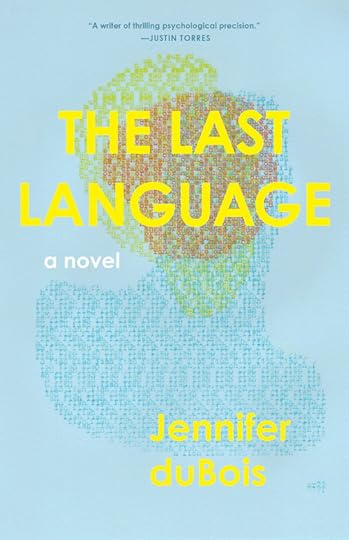
I’m trying to get through some books over the holidays. I decided to read Jennifer duBois’ The Last Language after discovering it on a “top books” list somewhere out there on an obscure blog. It was published this year, and I was disappointed to see it hasn’t had a ton of traction on the blogosphere. I highly recommend this book and read it in less than 24 hours. I get tired of seeing the same books recommended on mass media websites, which is one of the reasons I became a book blogger.
Currently, this book only has 34 reviews on Goodreads, but they are very strong, with a stellar rating of 4/5. The book clearly draws from the real-life case of Dr. Anna Stubblefield, a professor of philosophy and chair of her department at Rutgers. Anna was sentenced to prison for taking advantage of a non-verbal adult male who is disabled. According to court records, Anna got to know the male by attempting to communicate with him using “facilitated communication.” Facilitated communication is no longer considered a reputable method of communicating. Anna developed a sexual relationship with this male, claiming he consented using facilitated communication with her. However, when other people tried to replicate conversations with the man, he was unable to communicate. Anna was sentenced to 12 years in prison, but was recently released after only 2 years.
As someone who is a professor, I was curious to see how duBois would interpret this case. She could have exploited it, or sensationalized it, but I felt as though she was fair in her depiction of how a highly educated person might begin to believe in facilitated communication. Angela, the main character of the book who is presumably modeled after Anna, is an unreliable narrator at best. She is a former doctoral student of linguistics, kicked out of her program for reasons that are at first unclear. She is also a mother and recent widow, though she does not spend much time mourning.
She is hired to work with Sam, a young man who is non-verbal and lives with his mother. Angela begins to spend her night and day with Sam, consumed with what we are told is productive facilitated communication between the two of them. When Sam’s mother tries out the technique, however, Sam cannot communicate with her. It is only through Angela that Sam becomes alive with words, which is suspect to say the least. As you can guess, their relationship progresses, resulting in tragic consequences all around.
I have taken linguistics courses and am an anthropologist, so I really enjoyed Angela’s musings on the nature of cognition and language. duBois did a magnificent job communicating the questions that arise in linguistics. For instance, can a person conceive of a concept without language? How does culture dictate our ability to communicate and give words to concepts and ideas?
“Russian has one word for “light blue” and another for “dark blue”; Russian speakers do not register these as variations of the same color. While the Herero of Namibia have the same word for blue and green; to them, this is a single hue.”
“Saudade (Portuguese): a feeling of melancholic longing for an irretrievable person or place. Has analogues in Welsh (hiraeth) and German (Sehnsucht) and perhaps in some combination of our “nostalgia” and “utopia,” derived from Greek, especially if we consider that utopos originally just meant “nowhere.”
Communication with Sam becomes a way for Angela to push back against her former linguistic colleagues who believe in linguistic determinism: that cognition and thought first required language, and that “there was nothing to discover within people who didn’t have it (language) already.” Or, in other words, “a person cannot conceive of what he cannot name.” If you are looking for answers to why Angela believed facilitated communication worked, or if Sam truly could communicate, you won’t get them. There is a haunting ambiguity to this book just like the real-world case of Anna, who appeared to be two things at the same time: a person who cared deeply and advocated fiercely for disabled people and someone who took things much too far with a vulnerable person who could not verbally consent to a relationship or speak for himself.
A couple things really stood out during my reading of this book. First, duBois is a phenomenal writer. She subtly conveys so much emotion and feeling with analogies and linguistic theories about the relationship between language and cognition. Here’s an example of such writing:
“Language is when someone paints the hoof, and means the deer. But what if the deer just steps in paint, and walks directly onto the wall?”
“One thing all truths have in common: they are only visible from certain distances.”
Secondly, duBois shows that there are subtexts and complexities to human connection. Human relationships are not just words; they are a tilt of one’s head toward another, a finger brushing against a loved one’s face, a nudge of the foot under the table. Non-verbal communication is inherently human and loaded with emotion. Perhaps her intentions were for us to believe the unstable Angela, to buy into her conviction that Sam wanted to be with her and that he could understand her. Whatever the case, this book left me with more questions than answers, which is precisely why I enjoyed it so much.