If you grew up in the Fifties, you probably ate Spam
The 1950s were an interesting time for America—and forAmerican women. The men were home from the war, and Rosie the Riveter and hersisters who had filled in for the absent men were now expected to go home, havebabies, and care for their families. Ladies’ magazines were full of images ofhappy housewives wearing cheery little aprons and serving deliciousmeals—including lots of jellied salads, even jellied meats. Families moved tothe suburbs, the economy boomed, there were pesky wars in places like Korea butthe big one was over, and optimism was in the air. Or was it? And was thathousewife really happy?
I grew up in one of those stereotypicallyhappy homes. Not the suburbs, but inner-city Chicago. We were a family of four—mybrother being some seven-plus years older than me. Dad went to work everymorning as president of the Chicago College of Osteopathy, and Mom stayed home,saw us children off to school, grocery shopped, kept the house, fixed dinner.And always, before she fixed dinner, she showered and changed into a freshdress or a peasant blouse and long skirt, to look nice for Dad when he camehome. She handed him his Scotch and water, visited for a minute, and thenproduced a dinner of meat and potatoes to suit his Anglophile tastes.
But I know in her heart Mom yearned tobe part of the wider world beyond our home. She did not act on that, because itwould have embarrassed Dad if people thought that he couldn’t support hisfamily. Still, she had a degree from the University of Chicago and had beensecretary to the university’s chancellor, Robert Maynard Hutchins, founder ofthe Great Books Program. She exercised her abilities through volunteer work atthe hospital associated with the osteopathic college. Among herresponsibilities, she managed the hospital gift shop. Except that she wasalmost always a happy person, she might have been the perfect model for BettyFreidan’s unhappy housewife.
Mom also managed to steer a coursebetween good, old-fashioned cooking and the wave of convenience and preparedfoods that swept America in the 1950s. Social change in a society is oftenmirrored by change in its culinary world, and so it was with post-war America.The food industry that had been supplying military needs suddenly needed a new audience—theyturned to the housewife. The Fifties saw the rapid rise of conveniencefood—canned goods, cake mixes, TV dinners, frozen foods, instant foods, evenjunk food, anything that could cut down on the housewife’s time in the kitchenand give her more control over her own life. Frozen foods were a particularlysignificant advance for the food industry, even though few American homes hadfreezers. The futuristic dream was a kitchen stocked with frozen and preparedgoods that the housewife could bring to table in something under fifteenminutes.
The food industry, whose goal was moreto make a profit than it was to feed America, was quick to spot trends—andexploit them. Companies’ advertising departments were almost as large as theirproduction centers and accounted for all those pictures of happy housewives incheery aprons. One popular trend promoted in magazines involved gelatin. Jell-Omolded salads containing everything from hot dogs to olives to fruit suddenlyappeared on dining tables. We had our share of Jell-O salads. One inparticular, if I remember correctly, used dark cherry Jell-O, drained darkcherries, and maybe a touch of port wine. I don’t remember that Mom made manyother such salads and certainly never the jellied pickle horrors that we nowsee pictures of.
The company that produced Hellman’s mayonnaisesaw the trend and introduced, “Party Potato Salad”—potato salad in a jelliedchicken broth base and molded into a loaf shape by a bread pan. Made a greatcenterpiece. [Kate Prince, “Trends that Have Impacted the Food Industrythroughout the Years, investor.com, Feb. 2022] Other even less appetizingexamples were a tuna/olive/onion/vinegar dish in a lime Jell-O ring mold or theubiquitous orange Jell-O with grated carrots. We had that one a lot about mychildhood home. Years later I hosted a retro potluck dinner party, and oneguest brought that salad—I was rather glad to taste it again. The makers ofJell-O advertised that anything could go in their new lime product by showing adrawing of a dead fish, a shrimp, a chicken leg, a cucumber, a bell pepper,cabbage, one lonely walnut, an olive (also ubiquitous in those salads), celery,and a tomato slice. Presumably the cook was to choose among the items, butthere were some weird combinations.
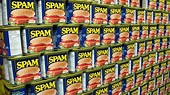
Spam and hot dogs, leftovers frommilitary meals, were frequently twisted into something approximating elegance:a crown roast of hot dogs, stuffed with mashed potatoes. Creamed chipped beef,once the despair of enlisted men and women, became a staple on dinner tables. Ifix it and enjoy it today, but there are still many people who scorn “shit on ashingle.” And, of course, there was Spam. Mom would slice and fry, or, tryingto make it a dinner dish, score it like a ham, stud with cloves, top with brownsugar, and bake. While I’m not fond of it today, I don’t have bad memories ofit.
This decade also saw the introductionof canned soup-based casseroles and TV dinners. The TV dinners usuallyconsisted of a meat, two vegetables, and a fruit or dessert, all in its littletin tray which the busy housewife could simply discard. There was no wastemanagement in the fifties. Typical dinners might offer turkey, gravy, mashedpotatoes, green peas, and a slice of pie. Or meatloaf, potatoes au gratin,green beans, and a brownie. To take advantage of TV dinners, households had toown two of the new innovations: a TV set and a freezer. We had a giant,chest-type freezer in our basement but never that I can recall had a TV dinner.
Canned soup casseroles also appearedin the Fifties. These relied primarily on Campbell’s cream of mushroom soup.The classic, developed by Campbell’s, was a tuna casserole with topped withFrench fried onions or crushed potato chips. Other casseroles might feature hamand Swiss cheese, sausage, any of countless ways of including chicken, aMexican beef casserole. Church and Junior League cookbooks offered endlessideas for using soup. Some purist cooks, decrying canned soups, devised ways tomake faux canned soup, avoiding they said the preservatives and fat of theoriginal. The trouble with these imitations was that they went counter to theidea of convenience and were much more trouble to make than opening a can. Momwas happy to use canned soup in casseroles, and it was one of the many thingsshe taught me. Despite many rather harsh critics, not all food of the Fiftieswas disgusting. Jell-O molds have pretty much phased out, but canned-soupcasseroles are still served in many households across the country, includingmine. Grocery stores still sell TV dinners and frozen pizza, so there is amarket somewhere.
I am embarking on a new project, acookbook probably titled Mom and Me in the Kitchen. I plan to explorethe food of the Fifties, as I learned it from my mom, and look at how itimpacted how many of us who cook today. I’d love to hear suggestions, comments, questions. Email me at judyltr@gmail.com.I will post excerpts from time to time on the blog.