We’re Mad at the Wrong People
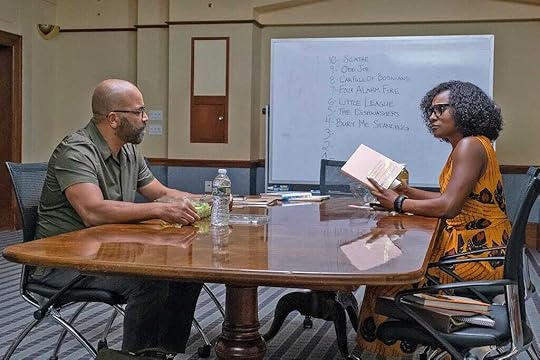 Claire Folger/ Courtesy of MGM
First, I want to express how ashamed I am of just getting around to posting about Cord Jefferson’s wonderful film, “American Fiction,” an adaptation of the novel “Erasure” by Percival Everett. I actually ventured out weeks ago during the cold “monsoon season” in Atlanta, eager to engage with this art not only because of its rave reviews but because I’ll watch anything with Jeffrey Wright cast in it, even when I don’t know what the hell is going on in the story (cue “Westworld” intro music).
I was also determined to see this film because, well, as a new Black Indie author myself, I couldn’t wait to get into its nuances from my fresh perspective. To plunge into a course of what I thought would be a two-hour fare of delicious, raucous satire, razing the entire American publishing industry and the narrow scope of what’s deemed “marketable” with regards to Black art. What I got was some of that but also a lot of what I hadn’t expected at all — a subtle, reflective, multilayered examination of not only the perception of Black lives in art but also a showcase of the reality of those experiences and the way we view ourselves on the artistic stage.
My late review is due in part to many circumstances similar to what Thelonious “Monk” Ellison, Wright’s character, struggles with — marketing and visibility. I was putting in my allotted hours of “dancing” for TikTok, navigating Instagram Reels, and, in general, attempting to please social media’s overseers — Mr. Algo and Master Rithm — in hopes that one person would see my posts and regard them as interesting enough to hit “Like,” “Follow,” or, best case, “Buy.” So, I understand Monk’s frustration. I laughed louder than anyone else in the theater when he met flirtatious Coraline (Erika Alexander), who articulated how she was a fan, and his response was, “So you’re the one.”
Not that I’m attempting to compare myself to Monk’s situation precisely. He’s at least been traditionally published and is respected academically as a literary genius, even if that is the exact kind of work that makes him “unmarketable.” However, the point remains that most of the struggles of Black authors, whether traditionally published or not, are often very much the same.
The book publishing business is not for the faint of heart. In the U.S. alone, there are nearly 11,000 books published each day. This number includes traditional and self-published works and accounts for nearly 4 million books released each year. Try to gain traction in that mire of self-expression, and you’ll understand why many individuals quit attempting authenticity and cozy up to the warmth of the ever-sage advice: “Write to the market,” essentially meaning, write what sells.
As I’ve learned in my own journey, what sells when it comes to fiction is YA, Romance (the spicier, the better), Fantasy, and Mystery/Thrillers — genre fiction over literary fiction, entertainment over “deep meaning.” That’s no shade to anyone who writes in those spaces. As the numbers show, the competition is already fierce; good luck getting into the game at all if you don’t write in those areas. It’s even more difficult if you write from the perspective of a marginalized group.
This is where Monk finds himself. He’s a man who writes with depth and layered messaging, works that require an astute focus on what’s presented on the page, and works that probably would never fit into a single category thematically. However, his books are always relegated to the “Black” section of the bookstore, simplified for cataloging when they aren’t inherently “Black” or exclusively “Black experiences.” He struggles to even keep his publishing deal in this environment. Monk is also dealing with family issues that bring his shaky finances into the equation as he witnesses the ascension of Sintara Golden (Issa Rae), the new “it girl” of the Black literary scene. She’s written what Monk deems as just another Black “poverty porn” novel pandering to white audiences for a paycheck (see “Write what sells”). Her book is a commercial success while, in his opinion, dragging out every trope of the alleged Black experience.
So much has already been written about “American Fiction” that by now, we know how this story unfolds. Monk writes a more marketable “Black” book called “My Pafology” (later retitled “Fuck”) under a pseudonym. It’s a parody meant to illustrate just what the publishing industry thinks of Black literature. However, his spoof is taken seriously and is a massive success. During this venture, Monk eventually has an encounter with Rae’s character Golden who, to his dismay, has the same criticisms of “Fuck” that he also found to be true of her novel, “We’s Lives in Da Ghetto” (this title will never not be funny by the way). She calls out the Black trauma themes and how it feels like pandering to her. When Monk asks, “But doesn’t your book do the same thing,” a very interesting discussion emerges that I was happy to see on screen.
Is Monk only critical of works by Black women that feature tales of the afflicted and oppressed? Is he as enraged by narratives from highly praised and esteemed white authors that depict the “downtrodden” within their communities?
Monk responds by saying no one believes those authors are representing the “definitive white experience,” but when Black people write those narratives about themselves, it reduces our entire community to one type of existence.
“Then it sounds like your issue is with white people, Monk, not me,” Sintara says.
Shots fired.
Monk admits there may be truth in that but is adamant about her type of representation in fiction being wasted “potential,” to which Sintara utters what could possibly be my favorite sentence in all of cinematic history pertaining to Black art.
“Potential is what people see when they think what’s in front of them isn’t good enough.”
Methinks she doth emptied the clip.
I often hear Monk’s viewpoint whenever a new Black film or series is released that features narratives from the more distressed corners of our community or from an even more challenging time historically regarding race.
One of the opinions expressed online on why the recent “The Color Purple” musical adaptation didn’t do better commercially was that our community was tired of seeing themselves in “Black trauma stories.” This was when I posed the question on Threads, “What exactly is Black trauma then?” Is it any story where Black characters experience hardship? Or, is it any story where Black characters experience hardship at the hands of white people? To be frank, as Sintara illustrated, most forms of dramatic storytelling feature some sort of trauma that its main characters are working to overcome. It’s the basic formula for a story arc — triumphing over tragedy or injustice and winning in the end. Even Disney animations geared toward children have left us with a slew of traumatizing acts. From “Bambi” to “Dumbo” to that agonizing parable of a father murdered in front of his son, his son then pursued by assassins only to have to spend his formative years lost in the wilderness while his mother and best friend nearly starve to death in his absence — straight trauma. “The Lion King” really did leave a ton of millennials wrecked.
Someone answered my question, stating that Black trauma stories were those where the hardship was at the hands of white people. However, that wouldn’t explain how that label was applied to “The Color Purple.” There’s no overbearing trauma placed on those characters at the hands of white people directly. There aren’t many white people featured at all. There’s the understanding that because the story takes place during a particular time in American history, Black people are enduring explicit racial injustices, but that reality is not heavily featured in the film. It’s simply an interpretation of the type of anguish that is unfortunately common among a spectrum of humans, specifically those born women.
Does this mean Black narratives from a particular time in history should be avoided because the reality of oppression will inevitably be a backdrop? Does this mean Black women can’t present art where a female protagonist suffers abuse from within her family dynamics because it too will be slapped with the dreaded “Black trauma” sticker? Where does this leave Black artistic expression? These people from these times and under these circumstances did actually exist, and they do have stories. Are we so preoccupied with how we are perceived under the white gaze that we’re ready to rid ourselves of all of these Black experiences of overcoming hardship because they’re too “embarrassing” to a particular Black outlook?
I remember a similar thought emerging around the movie “The Help.” Certainly, because that story was written by a white woman, featuring many white characters as oppressors with the stereotypical “white savior” trope, I understand the opposition considering those elements. What annoyed me with critiques from my community surrounding that story wasn’t due to any of those points but due to this notion that we’re “better” than maids and cooks and stories of painful vestiges from our past. The reason I took exception to that thinking is personal. My mother was a housekeeper… for white people in Alabama, during and directly following the Jim Crow era, doing so to pay for her way through college. She had ten other siblings and was extremely poor, and it was this sort of labor, along with other odd jobs, that allowed her to pay for her way through school and be one of only two siblings to achieve a college degree at that time.
Is that endeavor supposed to embarrass me somehow?
That reality has only ever filled me with pride and a push to achieve as much as possible because I never had to endure that to secure my education. It was a legacy that provided opportunities for me, and absent them, I’d likely not have had the solid path and trajectory I ended up on if my existence had been realized at all.
If someday I decide to honor my mother by telling her story, should I give second thoughts because her lived experience isn’t quite “good enough” to be portrayed by some people’s standards of how Black folks should look in front of white people?
I enjoy stories that feel deeply consequential about people who feel real and express the fullness of the human position — flaws and all — as they face difficult circumstances. They can be physically resisting forces in some dark dystopian “future” like Lauren Olamina in “Parable of the Sower,” where there are slavers, racial tension, and dire conditions. Or indeed, the reticent and modest way that Celie gradually rises above both inner and outer monsters in “The Color Purple.” We should be allowed as artists to offer that full expression of the mortal experience just like our white counterparts are allowed to do without the albatross of “how it looks to white people” constantly hung around our necks.
There must be room for all of our stories, for us to freely tell our jolly, Black romcoms, tragic romances, our sad orphan dramas, and our interpretations of deeper societal issues like every other Shakespeare, Dickens, or Poe that gets celebrated in the literary world and in other artistic mediums.
My novel has been summarized by the modest few who’ve actually read it as “raw,” “realistic,” and “portraying generational trauma.” However, I didn’t “write to market” either, as Monk believes Sintara does in some attempt at pandering or vesting in “poverty porn.” The only thing I “wrote to” was a principle of authenticity. And that should be the only thing that ever actually matters.
[image error]