Publishing: Signal to Noise/Noise to Signal

This week I want to talk about the amount of writers who are writing books and trying to get them published.
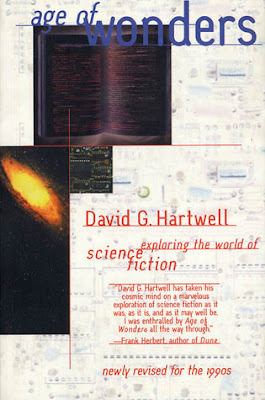 In the revised edition of Age of Wonders (1996) David G. Hartwell described the state of publishing of fantasy and Science Fiction at the time as being the most popular moment ever. He talked about previous decades, when attending conventions were about members discussed the works they had already and compared their impressions of them. This evolved into attending conventions to discover new works of science fiction and fantasy. Perhaps getting reading recommendations from friends who you rarely see apart from those conventions.
Fast forward three decades and it is rare that any individual would truly be capable of reading or even knowing about every novel published in a specific genre. It is impossible to truly collate a "Best Science Fiction of 2024" because no one has read all the science fiction published in 2024. Even if you were to be the editor of an anthology that focused on shorter works, it is highly unlikely you will be able to read every short story and determine a list. Granted, your list would also be subjective owing to your personal taste, but this does illustrate the lie of any title claiming to be the "best of".
Additionally, the annual awards of the genres cannot really claim to be the best in show. However, they are a recognised badge of status. For an author to win a Hugo, a Nebula, or a Locus award says something important about the story they have written. These awards, and also the World Fantasy Award, the British Fantasy Award, the British Science Fiction Association award, and the Mythopoeic Award all provide an endorsement from a community of peers. They give a guide to a wider reading public, and often publishers will place a little roundel on the cover of new printed editions of award winning titles.
 However, with the rise of the e-book and the deconstruction of publishing as solely a gateway industry, there are hundreds of writers telling their stories without any knowledge or interest in the conventions and events of Science Fiction and fantasy or the award lists and submission processes. Indeed, many of these writers have no need for them, as they have managed to establish audiences for themselves and are content to keep writing to service those audiences with new stories featuring favoured characters. There is absolutely nothing wrong with this. After all, what most writers want is to be able to tell their stories and to be able to afford to spend their time writing.
In some respects, I would argue the aspiration of being able to write for a living is a more real ambition, in that the tangible qualities of knowing your books will pay your mortgage and pay for your grocery shopping are more meaningful to your life than a trophy on the mantelpiece. This might be a goal that is more obtainable now than it ever was. A century ago there were less fully professional writers in the world and there are now, century before that even less, and so on. Perhaps the globalisation of publishing and audiences through the Internet has increased opportunities for all of us.
However, in other respects, this goal is all the more unobtainable for many writers owing to the aforementioned signal-to-noise and noise to signal ratio. A book launch on Amazon on any day of the year is likely to coincide with another book launch from someone else. In fact, many someone else's. In any given week, there will be multiple new titles appearing, being promoted, being advertised, and being talked about. As an author, you are quite lucky if those conversations are being had by people other than yourself! Perhaps your publisher has a marketing person or a marketing department, that can make life a little easier, but if you are self-published, then the majority of awareness may well come from your social media and your efforts to advertise.
It is here where the writer becomes vulnerable. Writing about very nature is not a sociable profession. Most writers will spend long periods of time alone in a room with a laptop for company trying to get today's words down or going through and edit or trying to think of a new story idea. Most writers are not natural marketers and promoters. Most writers did not decide they wanted to write for a living because they were good salespeople.
Just as there are a myriad of writers trying to find an audience for their stories, we now have a variety of additional support services that exist to deal with all the different processes that will take a writers story from their word processor to a printed book. Some of these services and people that provide them are excellent. I'm a big supporter of sensitivity reading, beta reading, professional editing offered as freelance service, and a variety of other efforts offered by experienced people with specialist knowledge. What I am not a fan of are book coaches, predatory marketing and promotion services, hybrid publishing packages and many of the other offerings that lurk around the independent book industry. Most of these seek to earn from the author, rather than assist the author in finding their readership. I would be surprised if many of the aforementioned marketing and promotion services offered a refund if the book being promoted did not sell a minimum number of copies.
For note here, I'm not talking about all independent book marketing and promotion. I know several excellent freelance book marketing and promotion companies who work with authors and with established publishers to arrange blog tours, book trailers, and a variety of other important and useful content to promote a writer's latest work. Some of the people in this industry do genuinely "give a shit". They do genuinely have the ability to cut through the noise and reach a readership. However, there are many bad eggs lurking around different social media groups to find writers who they can promise their services to. These will be upfront payments for an opaque package of promotional activities which will likely result in very little return. The problem, is that a writer will likely have little experience to compare with. After all, every Frodo, carrying a ring to Mordor needs a Gandalf to guide them. But whether you are truly hiring a marketing wizard or a marketing charlatan can only be determined by reading the sales figures.
I was reminded this week about the origin of a phrase: Yog's Law, nicely discussed here by John Scalzi. The key element of what should happen: "Money flows towards the writer". Not the other way around.
In some respects, writers don't help themselves. It can be easy to lean in to the solitary aspect of the craft. This can manifest in the way in which some writers socialise. The introspective nature of writing can lead to an introspective outlook. When we talk about our own work and neglect to engage with the work of others we reinforce this aspect of the writer stereotype. In some respects, joining a writing community and shouting about a book you have written and got published without engaging with any of the posts from other writers who have also published books is somewhat insular. To then expect people to engage with your post (when you have an engaged with theirs) is obvious hypocrisy. But I understand why it happens. Writing is a solitary craft. Writers do live with their stories. Those stories stay in their heads for quite some considerable time.
To my mind, this is where it is important to be a reader and it is important to be a reviewer. I have been very fortunate over the years to read many wonderful stories in a variety of genres not least Science Fiction and fantasy. I will continue to read, I will continue to review and every time I find something good I try to champion it, highlight it and talk about it. Granted, I may not get the same treatment in return, but the process is not an exchange or a trade. It is about recognising genuine quality. Recognising the signal amongst the noise.
 We stand in a moment where our ability to find the best stories may be threatened even further. With the rise of Chat GTP and other artificial intelligence tools, what once was considered a specialist craft may well become a product of Fordism. Stories may end up being assembled rather than created.
 Interestingly I reviewed a book several years ago that predicted this moment. An Android Awakes (2015) is an illustrated novel that tells the story of a robot trying to write a story that will pass as being written by a human. If it does not manage it, it will be destroyed. You can find my review here.
In this difficult time, perhaps I can offer some highly subjective advice? Your journey is your journey. Find good people who can help you on it and do your best to retain them. What works for you may not work for someone else, but share your experience anyway. Be generous and maybe people will recognise you for your generosity and be generous in return.
Being a Healthy WriterI've had some illness this week. A stomach bug has lingered for a few days, disturbing my sleep, but I have managed to establish 'date night' with my partner on Thursdays. That's something we've wanted to do for a while and was something we did prior to the Covid lockdowns. It was nice to go back to going out to spend a little time having a meal and chatting, even if I felt unwell that night.
Some nice spring weather has also helped with me restarting the DIY and gardening tasks. I'm taking it steady, but the regular activity is a good thing.
I'm working on finishing my fantasy novel draft. I've set low word count goals for myself (500 words a day), which means I am regularly exceeding this, rather than trying to write 1000-2000 words every time, which adds pressure to the process.
 I also did a little interview with Run Along The Shelves about the Fractal Series. You can find it here.