Decorative Skeletons

Until the last few years, the only time I saw plastic skeletons in people’s yards was around Halloween. They were meant to be scary. Some were positioned so they seemed to be crawling out of the earth, usually near fake tombstones. The dead coming back to life and threatening the living. They went with giant spider webs and spooky music.
They reminded me of the figures in the “Night on Bald Mountain” section of Disney’s Fantasia (1940). Skeletal humans on skeletal horses, all under the command of the bat-winged, golden-eyed demon at the top of the mountain. Mussorgsky’s piece was inspired by Russian folk tales about periodic gatherings of witches and dark spirits, including the restless dead, the ones who did not “rest in peace.”
The turning of the Celtic year
Ancient Celts had similar beliefs about the celestial turning points in the year. They felt that Samhain (October 31 – November 1) was the meeting of the light half of the year (summer) and the dark half of the year (winter). At that point, the division between this world and the world of spirits was at its thinnest, so many could cross over. While some spirits were welcomed, like honored ancestors, others were considered very dangerous. Ghosts, fairies, and other creatures on that night were under the control of the Lord of the Dead.
To the Celts, fairies weren’t cute, winged beings like Tinkerbell. They could be any size or shape, and they were angry that they’d been forced off their lands when the people arrived. So they got their revenge by causing trouble. My Irish grandmother blamed almost every misfortune on the Little People – The Others. If she couldn’t find her keys, they’d moved them. If someone got in an accident, it was probably the Others distracting the drivers. They were particularly dangerous to children and livestock.
On the night before Samhain, when the two worlds were tangled together and dark spirits drew the restless dead into their ranks, the living donned masks to scare off these evil forces and lit bonfires (bone fires from slaughtered animals) to beat back the darkness.
When the Irish came to America, particularly during the Famine of the 1840s, they brought their beliefs with them. By that time, the old Celtic traditions had been subsumed into those of the Catholic Church, so that Samhain, October 31, was All Hallows Eve, the night before All Hallows (All Saints) Day, November 1.
The Day of the Dead
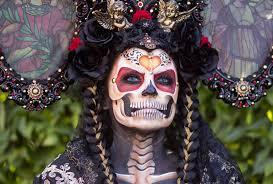
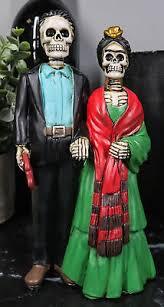
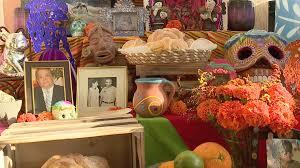
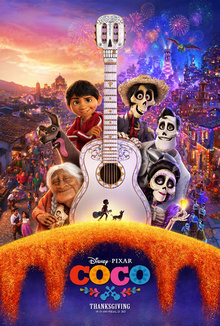
In Mexico, El Dia de los Muertos (The Day of the Dead) is celebrated on November 1 and 2. It’s the remnant of an ancient Aztec festival that lasted for a whole month honoring the dead. But not as creepy, scary monsters. Photos of ancestors who are remembered fondly are placed on ofrendas, or altars, along with flowers (usually marigolds), bread, sugar skulls, and the dead person’s favorite food and drink. It’s a party to which the dead are invited. The living join in by painting their bodies like skeletons, decorating the graves of loved ones, and dining with the dead.
The movie Coco, from Disney/Pixar, is a wonderful introduction to the version of the Day of the Dead popular around the city of Oaxaca, Mexico. https://www.youtube.com/watch?v=Rvr68u6k5sI
The Giants
Traditional Halloween skeletons and the Day of the Dead skeletons have at least vestiges of spiritual meaning, but the newest versions – giant plastic skeletons – seem to be simply yard toys.

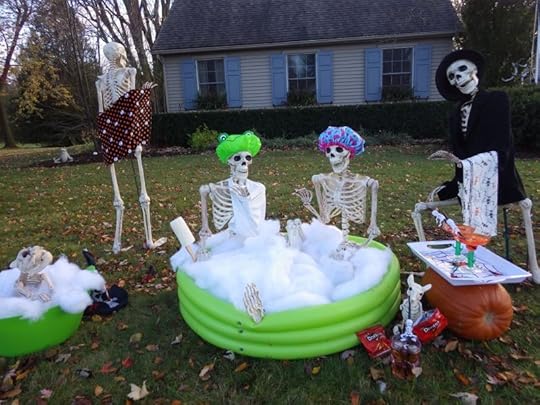
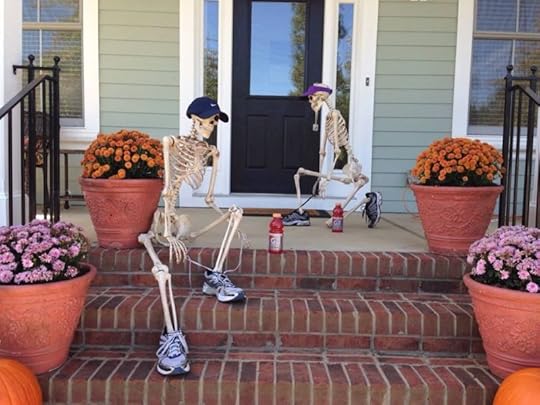
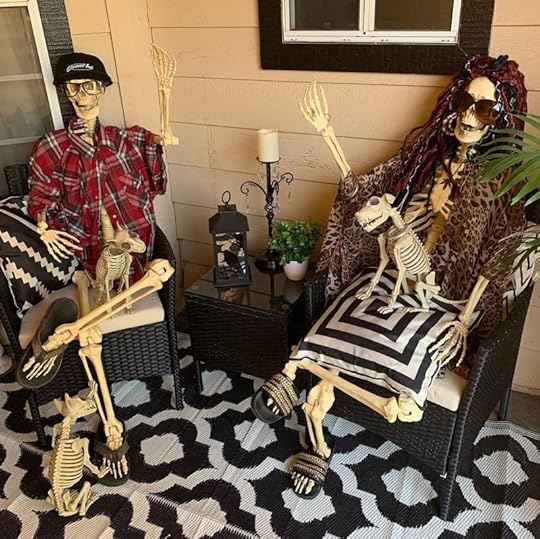
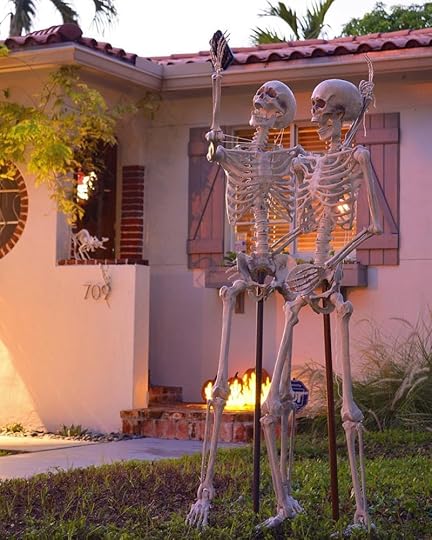
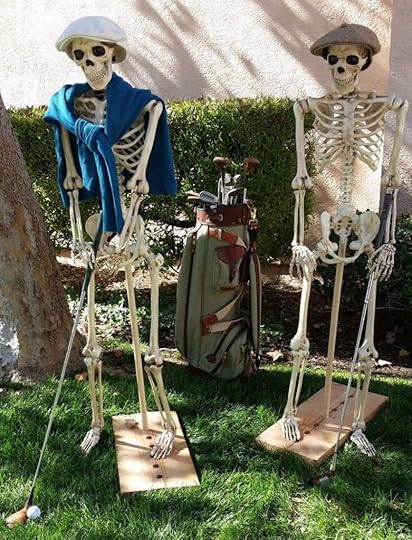
The most popular ones are 12’ tall, though you can also find them at 6’ or 8’. The 12’ versions sell for about $300 at Home Depot. They proved to be so popular, they sold out last year.
And they’re not limited to Halloween. I’ve seen them stringing up Christmas lights and hanging Easter eggs. Sometimes they’re playing golf or relaxing in the pool. The group in the top left photo seems to be getting ready for Saint Patrick’s Day (though the background seems to indicate the photo was taken in the fall).
These skeletons are quirky, not terrifying, and because they have movable joints, they’re endlessly adaptable to whatever the property owner wishes them to represent. When one homeowner was notified that the giant skeleton in his yard violated the HOA policies which required holiday decorations to be taken down after a month, he took to redecorating it for different holidays.

But there’s something a little weird about a giant skeleton with a Santa hat. Is that dead Santa? Or is the skeleton acting as a kind of fleshless Everyman? Perhaps a third party commenting on our strange holidays? What about the skeletal Easter Bunny? If Easter is a season of rebirth, the skeleton seems to send something of a mixed message.
I agree – The creations people make with the giant skeletons are often clever and well-executed. And some installations are used to raise money for charaties like St. Jude’s Children’s Hospital. Still, even a plastic skeleton is a representation of a dead human body, and there’s some inherent danger in chuckling at the dead. Perhaps that’s part of the appeal for some folks. It’s all a little edgy. But the giants stop short of being fun for me. I guess I can still hear my grandmother’s whispers about the dangers of mocking the dead.
Sources and interesting reading:
“Celtic Otherworld,” Wikipedia, https://en.wikipedia.org/wiki/Celtic_Otherworld
Pinterest has a whole page of ideas for decorating with the giant skeletons, with lots of photos: https://www.pinterest.com/search/pins/?rs=ac&len=2&q=skeleton%20decorations%20outdoor%20funny&eq=skeleton%20decoration&etslf=9113
“The giant Home Depot skkeleton is helping raise money for St. Jude Children’s,” Boston.com, 29 October 2021, https://www.boston.com/new/local-news/2021/10/29/home-depot-skeleton-st-jude-childrens-fundraiser/
Thomas, Heather, “The Origins of Halloween Traditions,” Headlines and Heroes: Newspapers, Comics and More Fine Print,” 26 October 2021, Library of Congress Blogs, ISSN 2692-2177