The First Draft is Done!
But what does that actually mean, you ask? You just want to know when you can read the story. Well, there’s still a lot of work to be done.
The First Draft [image error]
The First Draft is pretty much the author telling themselves the story. No matter how much you outline and prepare, once you start putting words onto paper, the story grows, blossoms, expands, and sometimes takes a sharp left turn you didn’t expect.
You might wonder why. There are many reasons, but I’ll just give you one biggie.
When you start writing a character, their personalities come out. You’ve given them (or they develop naturally) quirks and habits, so as they speak or take an action, they may say or do something you hadn’t anticipated. They become their own person and will say or do what is right for them. From your brain to your fingers, they can and will change, develop their sense of self, and become free thinkers. You can’t plan everything that will happen, nor should you try to, because some of the most amazing plots and characters have developed through natural growth and evolution.
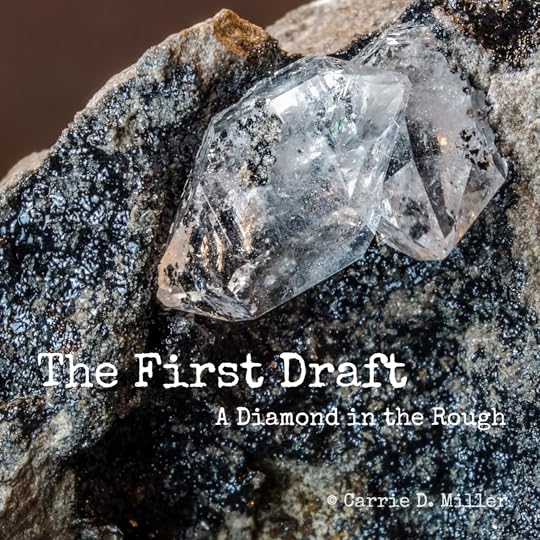
So, what all that means is that the First Draft is a diamond in the rough. I could also call it a dumpster fire, but I want to stay positive. You now have to chisel away all the grit and muck to find the beauty hidden underneath.
The Second DraftThe Second Draft is arguably harder than writing the First. Depending on how complete your First Draft is, the Second requires all the gaps to be filled and the placeholders replaced with details. These two things can be a huge endeavor. For me, if I’m not feeling particularly creative in that writing session or it’s taking me too long to come up with the right words, I’ll write [[describe the room]] or [[describe her reaction]], markers like that. Gaps could be when a character hasn’t been in a scene for a while. They need to be written in somewhere and given something to do that has a purpose. I have several gaps of transition: the dialogue or action needed to get from one paragraph to the next because there’s a change in mood or tempo.
This draft is also where continuity needs to be ensured, the logic verified, the inconsistencies made consistent, and all of the ‘to dos’ you indicated as you wrote completed, which can include additional research, movement of sequences, alterations in a scene’s location or time of day, etc.
Continuity is always an issue if you’re writing an installment of a series. So unless you remember every detail of what happened in the previous novel, you’ll have to go back and read all or parts of it to ensure you’ve not indicated something incorrectly. For me, it is things like: did the back door of Jo’s house have a screen door? Was the door to Aven’s shop glass panes or solid or both? I think the pathway to Aven’s shop was cobblestones, but I don’t remember. These might sound minor, but when they’re referenced in a scene, you need to get them right.
As a side note to writing a series: you have to create a detailed character profile so that as you write each installment, you can quickly refer to the profile to recall the character’s speech pattern, how they stand, how they react to certain situations, what they do when they’re nervous or angry, etc.
All this is a great deal of work! But it’s also a lot of fun and very exciting because the story is still growing, getting richer and fuller as you pry that lump of hazy precious stone free from the earth, and get it ready for cleaning and shaping.
The Third DraftI consider the Third Draft to be the clean-up phase. While many authors edit as they write, myself included, this is where you focus on the cleanliness of each sentence and paragraph.
Is the flow of the sentences into one another choppy or smooth? Does the paragraph or scene read like a step-by-step of what the character is doing? Is this paragraph just an info dump? Would this element be better treated if it was revealed in dialog rather than with narrative? Did the character need to say or do that, or did you just really love that bit because it sounds cool? Does this scene or side plot line help move the story along, or is it filler? This is where you’ll kill your darlings.
You’ve cleaned off all the dirt, buffed off the haze, and chipped away the excess bits to give your diamond its ideal shape. It’s now ready for polishing.
The Fourth Draft
[image error]
At this point, I’m going to print the whole thing out. Reading the words on paper gives your eyes an entirely new perspective. You’ll find lots of typos this way.
For me, after the Fourth Draft, I’m ready to send it to my editor. I may also let a few beta readers at it as well, depending on how confident I am.
To reveal the full luster of your diamond, polishing happens in several stages with different types of specialized cloths.
Time for the EditorAfter the editor turns your nice white paper the color of blood with her red pen, you have a good cry and walk away for a bit. When you come back and wade through the pool of blood again, you’ll see that much of what she indicated and suggested makes a great deal of sense.
As the author, you are so incredibly close to the story that you cannot see the problems. What’s that saying? “You can’t see the forest for the trees.” It’s true. Having a fresh pair of unbiased and experienced eyes go through your manuscript with a fine-toothed comb is absolutely critical.
If you have a good editor and trust her, you may still not accept 100% of what she’s suggested, and that’s okay. Of course, you’ll accept all the grammar corrections because that’s one of the primary services you’re paying for, but trust your gut on story and direction changes. You can also wait for feedback from the beta readers to see whether they mentioned the same things the editor indicated and then make your decision on what to do.
The Fifth DraftThe Fifth Draft is when you implement all the changes and alterations you feel comfortable making. Then, it’s time to enlist a few more betas and proofreaders.
The Final DraftNow we’re at the Sixth or Final Draft. You’ve corrected the problems your betas and proofers found, so you should be ready to publish. I say ‘should’ because this is the scariest part. You know something is lurking within those thousands of words that was missed by the dozen pairs of eyes. And there will be, but it won’t be the end of the world if it’s published with a ‘then’ that should have been a ‘than’. It happens to the best. You fix it and move on.
Your diamond now gleams and catches the light just beautifully. You’re ready to reveal all your hard work to the world.
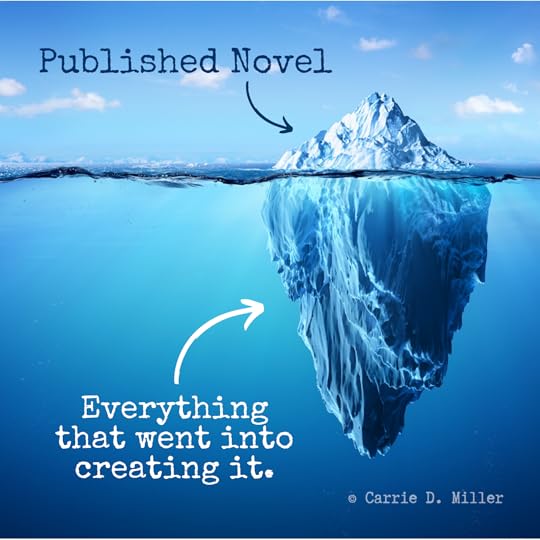
Final ThoughtsYou might be thinking that all these steps border on overkill. If you are, then you are wrong, my friend. The absolute last thing you as a reader want to read is a poorly-paced, choppy sentenced, plot-hole-filled dumpster fire, which is also the absolute last thing the author wants to publish. And being a self-published author, I’m already looked down upon by traditionally published writers, agents, publishing houses, and a vast number of readers. Our books have the reputation of being poorly edited and poorly produced, which, unfortunately, many of them are. It takes money for a good editor and a great cover designer. When you don’t have the money, you self-edit or get a friend who got good grades in English class to edit it, and you download a trial version of Photoshop and images from Pixabay and go to town. You may think I’m joking, but sadly, I’m not.
I hope you’ve enjoyed a little glimpse into my particular writing process, and have a new appreciation for what it takes to publish a novel. Every author has different means of achieving the same end, and the more experienced an author is, the fewer the steps in their process. I’m hoping for that eventually, but as it’s been many years since I’ve published, my lack of confidence is pretty high, so I’ll be taking every step to ensure I produce the best story I can for all of you who have waited so long.
The post The First Draft is Done! first appeared on Carrie D. Miller.