
Essence
Stories bring out the salient details of life to light. They remove all of the fluff of everyday that obscures the true through line of the main emotion and bring out the core ideas up to the surface for observation and examination. Fictional stories are stripped down and embellished accounts of real life — one can be both. They zoom in on the important stuff and focus the reader’s attention squarely there. Perhaps that’s why a good story is so engrossing — it captures something true and allows us see it more clearly.
There is a parallel in art — painted portraits bring out character better than a casual look or even a snap shot. When drawing a portrait, it is much easier to start with a photograph than by having a person sitting for the process. A photographs manages to capture some essence of personality and thus simplifies the process of portraiture. It is similar in the realm of words. By identifying the salient features, art renders real world more comprehensible and memorable. Caricatures do so even in more ruthless way.
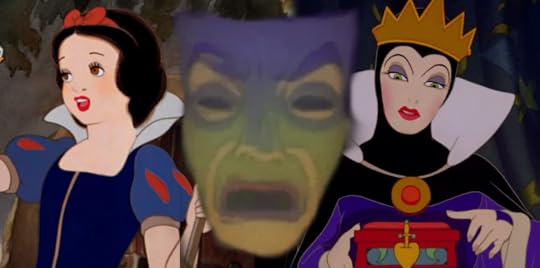
Building on my fairytale theme from last month’s post, consider Snow White. This fairy tale strips everything away, leaving just the bare bones of characterizations thus allowing room for story development. The stepmother is wicked and wain. The princess is clueless and pure — pure white! And so clueless that she marries the man who assaults her in her sleep. Even the seven dwarfs are named for their basic defining characteristics: Sleepy, Sneezy, Grumpy, Happy, Bashful, Dopey, and Doc for “smart”. This is the distillation of the first order. Children’s stories tend clear out a lot of nuances from their narrative — it’s easier to stick black and white dichotomies without those pesky shades of gray. This is actually very developmentally appropriate. Shades of guilt, for example, don’t truly develop until high school age. If you ask a kid in middle school if it was okay to steal food from a store to eat, the child is more likely than not say that it is against the law and thus wrong. But an older child will start to perceive nuance — it might be okay if the person was very hungry and had no other options, but still wrong. Cognitive complexity takes time to develop. It is one of the reasons we as a society prefer to draft young men into the military; it is much harder to make adults comfortable killing one another.
I mostly write young adult and general fiction in the genres of science fiction and science fantasy. But “Pigeon” was an exception. It is an urban fantasy written for middle grade kids. The characters and story are more black and white. It is still a good ride! I hope you check it out in this month’s giveaway along with all of the other cool books! Happy summer reading!
FREE sci-fi ebooks giveaway: https://sffbookbonanza.com/free-books-may-2024/
AND FREE fantasy ebooks: https://books.bookfunnel.com/kracken-good-free-fantasy/c3dtpdccl3


 newest »
 Thank you! I didn't know that. But the point remains -- Disney distilled characteristics into the dwarfs to something extremely basic, making the young viewers recognize those traits. Simplification helps highlight the differences. This is common and developmentally appropriate for the age level. Interestingly, though, similar distillation works for older readers as well. Life is complex and nuanced. If we include too much, the through line gets lost. Good writers are those who know what to include and exclude in their stories.
Thank you for reading and commenting!!!!
 Welcome! I enjoy your posts. I'd suggest that Doc or Prof indicated someone not specifically clever in this case, but learned. Doc was the oldest dwarf if I recall correctly, he had gained a lot of knowledge about his skill of mining.
Funny, now that you are adding details, I think I remember reading this story -- the non-Disney version -- in a book as a kid... Memory is a funny thing... Thank you for reading!
Originally a Middle European folk tale written up by the Brothers Grimm.
Yes. I've read some of them in Russian. In English, I was horrified when I tried to read them to my kids! ;-)
Welcome! I enjoy your posts. I'd suggest that Doc or Prof indicated someone not specifically clever in this case, but learned. Doc was the oldest dwarf if I recall correctly, he had gained a lot of knowledge about his skill of mining.
Funny, now that you are adding details, I think I remember reading this story -- the non-Disney version -- in a book as a kid... Memory is a funny thing... Thank you for reading!
Originally a Middle European folk tale written up by the Brothers Grimm.
Yes. I've read some of them in Russian. In English, I was horrified when I tried to read them to my kids! ;-)



Even the seven dwarfs are named for their basic defining characteristics: Sleepy, Sneezy, Grumpy, Happy, Bashful, Dopey, and Doc for “smart”.
The dwarfs had no names in the original story. Disney assigned them names. They didn't have many distinguishing characteristics in the original either. They were just shown as men who wanted a woman to do the housework.
When a school wanted to perform a play based on Snow White, a friend tells me, they were told that Disney had copyrighted the names, so they had to change them to Dozy, Prof, etc. They also could not use the songs from the film without paying Disney for the privilege.