An Interview with Author Ruta Sepetys
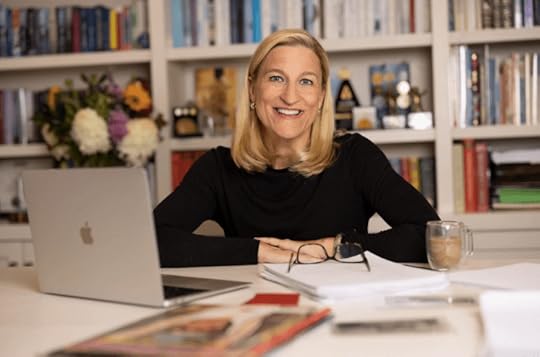
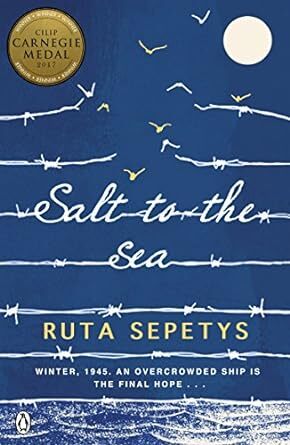
This month we had the special privilege of interviewing author Ruta Sepetys about her book, Salt to the Sea as we have been Traveling Europe Through Books. With Lithuania as our focus for June, we chose Salt to the Sea to read in our online book club because it features a strong Lithuanian character and an event, the sinking of the Wilhelm Gustloff, which has an important connection to Lithuanian history. As an accomplished Lithuanian-American author, Sepetys is uniquely qualified for the task of bringing us this little-known story in English. She calls herself a “Seeker of Lost Stories.”
Christine from FBN: Thank you, Ruta, for talking with us! Salt to the Sea has such an interesting structure, moving quickly from character to character in first-person narrative. Many of the scenes are told from multiple viewpoints. What made you choose this form for your book?
Ruta Sepetys: I traveled to six different countries researching Salt to the Sea and met with many people who experienced the refugee evacuation of 1945. During the interviews, it was clear that each person viewed the experience differently—through their own cultural lens. So I created four separate characters to give voice to a particular regional experience and allow the reader to look through their “lens.”
FBN: I was really impressed with how you were able to capture certain cultural aspects of the various countries from which the refugees come, in small details. This aids in a truly life-like portrayal of the characters (ex: Emilia’s rescuer reminding her of the knights from the caverns in Poland, and her references to St. John’s Day and St. Florian, the gentility of the East Prussians, and Florian’s father’s involvement with the attempted assassination of Hitler.) Did you specifically research these types of elements or did you just draw them from things you already knew about those cultures?
RS: Thank you! I specifically researched those elements. Cultural elements, even food, can bring emotion and authenticity to a story. So when interviewing true witnesses, I made note of cultural references.
FBN: You are of Lithuanian decent, but were born in America. How much was Lithuanian culture part of your upbringing? Was this a motivation for you to tell this particular story? Did you have to research much about Lithuania for this book?
RS: My Lithuanian heritage has been a large part of my identity. Growing up in the U.S. with a name like ‘Ruta Sepetys’ always sparked questions. I was constantly responding with, “I’m Lithuanian.” Even though that was my response, I wasn’t familiar with all of Lithuanian history —certainly not the deportations. In 1940, Stalin pushed into the Baltics and my grandparents and father fled from Lithuania. When I was visiting family members in Lithuania in 2005, they told me that some of my grandfather’s family had been deported to Siberia. I was shocked and ashamed that I knew nothing of this part of history that had affected my own family. Stories of Stalin and the Soviet occupation aren’t often discussed. I wanted to share the story of the people of the Baltics who had endured Stalin’s terror.
FBN: How did you first learn of the sinking of the Wilhelm Gustloff? What made you decide to write about it?
RS: My father’s cousin told me that during World War II there was a ship that sank with a death toll far greater than the Titanic and Lusitania combined, yet the story had somehow remained hidden for over seventy years. The ship was the Wilhelm Gustloff and she had been granted passage on it during the evacuation. I researched it and discovered that the sinking of the Wilhelm Gustloff on January 30, 1945 was single largest maritime disaster in history but most have never heard of it. It made me wonder, what determines how history is preserved and recalled? Why do some parts of history become part of our collective consciousness while others remain hidden? That question inspired me to investigate and write Salt to the Sea.

FBN: The sinking of the Wilhelm Gustloff is both fascinating and terrifying. What specific research did you do to recreate this momentous event? How much of what you wrote would you say is based on research and how much is artistic license?
RS: I traveled to the former region of East Prussia and walked the path of the refugees that I describe
in the book. I visited the port where the Wilhelm Gustloff boarded and departed. I interviewed survivors, witnesses, and family members of victims. I also interviewed three divers who had separately explored the sunken ship. Nearly all of the book is based on research with the exception of the dialogue and Florian’s experience with the amber swan.
FBN: A major theme in the book is secret-keeping. Everyone in the book seems to have a secret, to the point that it reads like a mystery novel. What is the significance of secret-keeping to you, and what made you choose it as a theme for this novel?
RS: I find that secrets and silence breed speculation and uncertainty. If we don’t know the full details of a story, the tendency is to fill in the blanks ourselves. But in doing so, we sometimes create false narratives and that can lead to unnecessary suspicion and confusion. So I wanted to focus on that aspect for the book.
FBN: The Amber Room has a fascinating history. What inspired you to use it in the book?
RS: The Amber Room was a glittering chamber of amber, jewels, and gold. The Nazis stole it from the Russians during the war, but it disappeared during the evacuation. The Amber Room was last seen in 1944 and to this day remains one of the enduring mysteries of the art world. During my research, I read a few accounts that claimed the Amber Room treasure had been loaded onto the Wilhelm Gustloff. So I wove that storyline into the novel and one of the characters.
FBN: Alfred is an interesting character that gives a perspective in sharp contrast with the others. Is his character based on anyone in particular? Did you do anything in particular to “get inside the head” of a Nazi soldier/sailor?
RS: The character of the young Nazi, Alfred, was an opportunity for me to study visibility. What happens to a young man who is basically invisible but one day is given a uniform and suddenly becomes visible…even in his own mind? To get inside the head of the character of Alfred I studied and researched Adolf Hitler as a teenager.
FBN: Your books are as poetic as they are informative. The chapters at the beginning and end of Salt to the Sea that start with “Guilt is a hunter…Shame is a hunter…[and] Fear is a hunter” are especially poignant and evocative, and this use of repetition lends a type of rhythm to the prose. Do you have any background in poetry as a genre, or do you simply enjoy combining it with your prose?
RS: Thank you! Actually, my background is in music. Prior to becoming a novelist, I spent more than twenty years in the music industry working with songwriters, musicians, bands, and film composers. And working in music taught me the power of rhythm and melody. Most people won’t remember anything I say in this interview, but if they hear a song they haven’t heard in several years, they can still sing the words to the song. And that’s because rhythm and melody make something memorable. So I try to weave rhythms into my prose.
FBN: Who did you write the book for and why? Do you feel that this novel has reached its audience?
RS: During my research interviews with the victims’ families, I could hear—and truly feel—their hope that readers might learn about the tragedy. Their emotions were palpable and I wanted to give voice to their loved ones who never had a chance to tell their story. I wrote the book for young readers and I’m so grateful that the book is being used in schools worldwide as it will be the young people who carry our fading history into the future.
 About the Author
Ruta Sepetys (Rūta Šepetys) is an internationally acclaimed, #1 New York Times bestselling author of historical fiction published in over sixty countries and forty languages. Sepetys is considered a “crossover” novelist as her books are read by both students and adults worldwide. Winner of the Carnegie Medal, Ruta is renowned for giving voice to underrepresented history and those who experienced it. Her books have won or been shortlisted for over forty book prizes, are included on over thirty state reading lists, and are currently in development for film and television.
Ruta is the daughter of a Lithuanian refugee. Born in Michigan, she was raised in a family of artists, readers, and music lovers. Ruta is passionate about the power of history and story to foster global dialogue and connectivity. She has been invited to present at NATO, European Parliament, the U.S. Capitol, the Library of Congress, and Embassies worldwide. She was awarded The Rockefeller Foundation’s prestigious Bellagio Fellowship for her studies on human resilience. The New York Times Book Review declared, “Ruta Sepetys acts as champion of the interstitial people so often ignored—whole populations lost in the cracks of history.”
Ruta was bestowed the Cross of the Knight of the Order by the President of Lithuania for her contributions to education and memory preservation and was recently honored with a postage stamp containing her image. She is extremely proud to be of Baltic heritage, even if that means she has a name no one can pronounce.
Ruta lives with her family in the hills of Tennessee.