
An Out-Take from The Hellion’s Heart
I don’t generally share out-takes from my booths – the scenes have come out of the book for a reason, and the details never align perfectly after they’re cut – but I thought I’d share this one today because I still like it.
Joshua’s past in The Hellion’s Heart has shaped his present, particularly his year as a rakehell in London, as well as the death of his betrothed. One of the things Helena does is help him to find a better balance with that experience and that means they can have a future together.
I originally wrote that story so that Mrs. Oliver told Helena about Joshua’s past, but later, it made more sense for Joshua to share his own story. The story did change slightly in the actual book, as did the order of events in his courtship of Helena, but I can’t resist a visit from Esmeralda Ballantyne, disguised as Mrs. Oliver. Here it is. 
An excerpt from The Hellion’s Heart by Claire Delacroix
Copyright 2024 Deborah A. Cooke
Helena was intrigued by the hideous and crooked old woman introduced as Mrs. Oliver. Why was she the duke’s guest? Surely she could not be the same Mrs. Oliver who had written those pages of amorous advice that had been in Eliza’s possession?
To Helena’s horror, her curiosity was noted, for Mrs. Oliver came to sit with her when the picnic was served. A footman brought a chair for her and placed as she instructed, then she fell into it like a sack of potatoes. Helena was both appalled and fascinated. The older woman fixed her with a surprisingly intent look and smiled. “You know who I am,” she said, her voice so deep that she croaked like a toad. “Where did you learn of my work?”
Helena found herself as crimson as a strawberry herself, but she could not lie. “My brother’s wife had some pages of your advice.” She took a fortifying breath and glanced about to ensure that no one was watching. “Upon the merit of a forthright touch,” she whispered, quoting the pages in question as her cheeks heated yet more.
Mrs. Oliver cackled. “How unsuitable a choice of reading for a maiden.” She seemed to be more inclined to be amused than scandalized.
“I found it fascinating,” Helena confessed. “Is there more?”
“Of course, there is more. It is a book. That does not mean you should be reading it, not before there is a ring on your finger.” Mrs. Oliver’s gaze sharpened. “Why is there not a ring upon your finger? You are of an age to wed and quite pretty. Have you not met a man you found suitable? There are many choices here today.”
Helena was keenly aware that the gentlemen in question all hovered around the duke’s ward, Mlle. Lafleur. “I have found the perfect man,” she confessed.
“But you have not convinced him to propose? I find that difficult to believe, Miss Emerson. You seem to be possessed of both charm and determination.”
“He proposed but I declined.”
Mrs. Oliver laughed aloud. “That is an intriguing strategy to win a man’s regard.”
“I did not realize at the time that he was the right man for me,” Helena said, feeling both flustered and frustrated. “It was only later that I recognized my error, and I have no notion of how to repair it.”
“Ah. And does the gentleman remain unattached?”
Helena looked toward the viscount, who was offering Mlle. Lafleur a cup of tea. “Thus far,” she said grimly. She knew that Mrs. Oliver followed her gaze.
That lady took a bite of her sandwich, peering at the contents as if she expected to find more than a slice of cucumber. “It is true that once a man decides he has need of a bride, he does not generally linger over the process. If one lady declines his attentions, he is more likely to seek another more willing candidate than to persist where he has found failure.”
“I could not bear it if he weds her,” Helena confessed under her breath.
“Then you must contrive that he does not,” Mrs. Oliver said, as if the matter were as readily resolved as that. The older lady surveyed the viscount with an appreciation that was utterly unsuitable, given her many years of seniority. “The Hargood brothers of Addersley,” she said under her breath.
“You sound as if you know of his family,” Helena contented herself with saying.
Mrs. Oliver chuckled. “Once upon a time, there were two Hargood brothers, each as handsome as the other. They came to London one season and took the town by storm with their daring and audacity. I always thought the younger was the instigator, but they each possessed as wicked a repute as the other. It was simplicity itself to find them for they were always together, always impeccably attired and always in attendance at the very best parties. They won in the gaming hells. They danced in every ballroom. They stole the hearts of debutantes on an hourly basis, yet neither of them cared. They were devoid of emotional attachments, save to each other. They seconded each other at duels. It was said they shared women as readily as cravats.” She nodded. “And the ton could not resist them. Every hostess invited them. Every young lady dreamed of them. Every young buck saw them as competition. Those were lively days and nights, to be sure.”
“You knew them then?”
“Of course. I knew everyone then,” Mrs. Oliver assured her, though Helena was inclined to doubt the claim. She could not imagine all of society knowing this wrinkled crone, let alone admitting to it. Mrs. Oliver had to be one of those people outside of society, one who yearned to join it but could only look on. “Of course, it had to end. The wheel turns for all of us, and it turned within a year for the Hargood brothers.”
“What happened?”
“It was a woman, of course. Some said it was inevitable that they would love the same lady. Other wiser souls realized that one brother could not bear for the other brother to hold anything without sharing it.”
“Gerald,” Helena whispered.
Mrs. Oliver met her gaze steadily. How remarkable that the crone had such lovely green eyes? Helena could barely discern them through the multitude layers of veils, but their hue was remarkable. “And so, the one brother fell in love. It was said he meant to wed the girl, but the other brother stole her away.”
“What was her name?”
“Miss Charlotte Havilland. Oh, she was beauty, to be sure, her company coveted by all in society. She was said to be effortlessly charming and a delight in conversation. Her laugh was compared to the tingle of silver bells.” Mrs. Oliver shook her head. “She had no fortune but an excellent family name and connections beyond most. There were rumors that her godfather intended to settle a fortune upon her, but only if he approved of any match she made.”
“Did he approve of the brothers?”
“He approved of the elder, to be sure. Perhaps that was the fly in the ointment of the younger. In the end, the brothers feuded with each other as they had battled with so many others, and the younger challenged the older to a duel. They met at midnight, neither with a second for they had each always stood with each other. Two brothers, once as close as two halves of a whole, each intent upon injuring the other. Only one, it was said, would walk away.”
Helena leaned closer, rapt upon the tale, which seemed very distant from this sunny afternoon.
“But that was not what happened,” Mrs. Oliver said, her gaze following Mlle. LaFleur and the viscount. “For the young lady could not bear the fact that she had come between them. She came to the field, revealing herself only after the shots were fired. She threw herself at her beloved, her weight taking him to the ground and out of harm’s way, for she knew the brother to be the better shot. The shot was meant to go wide, as the tale was told, but she put herself in its path.”
Helena gasped. “She was not injured?”
“She died,” Mrs. Oliver said finality. “And the brothers parted forever, though not in death. The older brother left London that day, returning to his father’s home, and became the diligent and dutiful son he had previously been. He forswore all the pleasures he was certain had led him astray, taking no brandy, racing no horses, fighting no duels and never gambling again. The younger brother in contrast cast himself into such pursuits with greater abandon, as if he strove to forget the tragedy that had parted the brothers. I heard him declare to any who would listen that his heart was broken with the loss of his beloved, but I did not believe him.”
“Why not?”
The older lady fixed Helena with a shrewd glance. “Because he was one who loved himself best of all. I believe he only wanted the lady because his brother had won her, and the lady proved herself a fool to choose the wastrel brother over the one of merit.” She turned to look at the viscount. “It seems he is doomed to be unappreciated by women, though I cannot fathom why that might be. Perhaps Mlle. LaFleur perceives his true merit.”
Helena looked toward the tea table, her heart sinking that Mlle. LaFleur and the viscount were still there together.
“On the other hand, few men can resist the allure of a lady prepared to fight for her desire,” Mrs. Oliver said softly and Helena recalled what she had read.
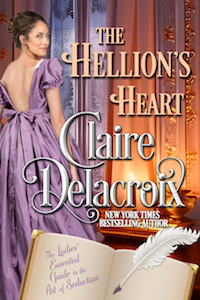
Helena Emerson yearns for romance and adventure, and dreams of wedding a duke for love. She knows she would never be able to endure a marriage with the serious Viscount of Addersley, no matter how handsome he might be. Consumed with logic and good sense, the man might as well be a statue. He does not even dance! She declines his offer, much to the outrage of her family, determined to wed happily or not at all.
But Joshua Hargood, Seventh Viscount of Addersley, is not the man Helena assumes him to be. He put aside his rakehell ways a decade before, blaming himself for the accident that claimed his intended. He has, however, never been able to resist a dare if the reward was worthy, and the challenge of undermining Helena’s assumptions is tempting beyond all. He takes a disguise, planning to be a rogue only for the lady he desires to wed, convinced that this is the merit of his scandalous past. Helena is captivated by her mysterious suitor and soon pierces his disguise, only to learn that the viscount lost his betrothed years before—is his heart even available to claim?
No sooner is Joshua convinced of success in his suit than his notorious brother, believed dead at Waterloo, returns to demand his due. Joshua knows that his embittered brother will only be satisfied when Addersley itself is destroyed, along with Joshua’s own happiness and prospects. Is he doomed to watch past tragedy repeat itself, or can Joshua save both his legacy and his beloved Helena?
Available July 22 in eBook and Paperback!
Pre-order the ebook:
Amazon.comAmazon.caAppleGooglePlayKOBONookBooks2ReadGoodReadsBookBub


