The Microcosm of London or London in Miniature: The Coal Exchange
published by Rudolph Ackermann in 3 volumes, 1808–1811.
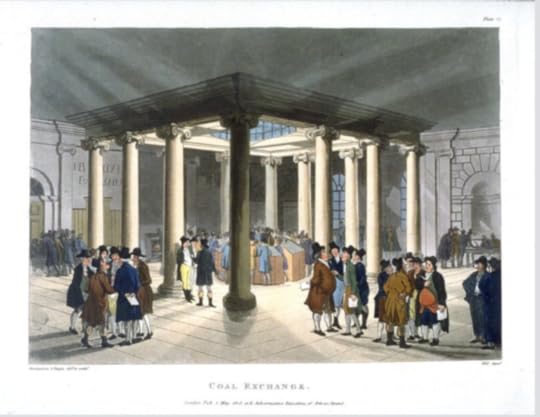
COAL EXCHANGE.
The print of the Coal Exchange is intended to represent that busy period of the day when buyers and sellers meet for the purpose of completing their old bargains, and making new ones. The groups are disposed with so much felicity, that they form a pleasing foreground, and break in the architectural perspective without diminishing its effect. A collection of individuals, meeting with a view to their separate interests, necessarily describe the same passions, varied only by the difference of character upon which they operate; but the artist has given an expression to the group on the left hand very different from either of the groups on the right: the simplicity which distinguishes one of the figures is highly characteristic. The tall figure with a paper in his hands behind him, appears intended to represent a trader of the old school, and forms an admirable contrast to the buckish nonchalance of the more modern merchant leaning against a pillar. The aldermanic figure which appears to be resisting the eloquence of an inferior tradesman, is happily contrasted with the spare and meagre figures which compose that group. There’s an arch simplicity in the countenance of the orator with a pen in his hand, that seems to bespeak confidence as well as attention. There is a chaste correctness in the whole picture, highly creditable to the taste of the artists, and it produces altogether an effect which the subject scarcely promised.
This building was purchased, in the year 1805, by the corporation of the city of London, from the merchants and factors whose private property it had been, for the sum of 25,400/. in pursuance of an act of the 43d George III. intituled. An Act for establishing a free Market in the City of London for theSale of Coals, and for preventing Frauds and Impositions in the Vend and Deliveryof all Coals brought into the Port of London, within certain Places therein mentioned.The powers granted by this act have been altered and enlarged by subsequent acts of the 44th, 46th, and 47th George III. The property of the land and building is vested in the lord mayor, who is empowered to receive a duty of one penny per chaldron (or ton, if sold by weight,) on all coals, CINDERS, or CULM, brought to the port of London: the object of this duty is to repay the purchase money, and to support the expences of the establisment; when a sufficient sum for this* purpose has been raised, the duty is to cease. The business of the Coal Exchange is conducted by fifteen gentlemen, called the Board of Sea-Coal Meters. In their office is taken the metage duty above-mentioned; and also the orphan duty, which is collected by the principal clerk (as deputy for Mr. Alderman Newnham). There are two clerks in this office, and about one hundred ship-meters, assisted by labouring meters. The duty on metage is one shilling, to be paid for every live chaldrons or one vat, which is paid into the Chamber of London by the meters upon oath. Their business is, to deliver all coal-ships that come into the port of London. Every ship, within twenty-four hours after her arrival at or to the westward of Gravesend, is obliged to send an affidavit of the quantity and quality of her cargo; which, unless freighted for government, must be sold in the open market. Any merchant or owner may bring their own coals into this market, without the intervention of a factor or middle man, in quantities not less than twenty-one chaldrons. Every sale must be in the regular appointed hours, from twelve to two; and the price of the coals, with the name at full length, of both buyer and seller, entered in a book, a copy of which must be given to the clerk of the market, who is to keep a register of each sale: the penalty for not delivering such copy to the clerk, is not exceeding 100/. nor less than 20/.: any fraudulent bargain, such as the making an entry of one price in the market, and agreeing upon some deduction or abatement to be allowed afterwards, subjects the offender to a like penalty.
The Land-Coal Meters is another department: there are three principal meters for the city of London at present, but the establishment will be reduced to two at the death of any one of the present holders of that office. Their business is, to inspect by themselves, or by their deputies and labouring meters cause to be inspected, the admeasurement of coals sold by wharf measure. Others are appointed for Surry and for the city of Westminster. In London, the principal meters are appointed by the lord mayor and court of aldermen, and are liable to be fined or discharged for neglect of duty or malversation in their office: their jurisdiction extends over the city of London and its liberties, and from the Tower to Limehouse-Hole. The principal meters for Surry are elected by the churchwardens of the different parishes, and are, for neglect or other offences, under the controul of the quarter sessions for the county: their jurisdiction extends over all the parishes on the southern banks of the Thames, from Egnam to Rotherhithe. The principal meter for Westminster is appointed by the king, and under the controul of the magistrates. There are three clerks of the market, and also a beadle, who resides in the house.
It is impossible in our limits to enter into the minutiae, but a general idea of the extent of this important trade may be formed from an average estimate taken from the books, by favour of Mr. W. Drummer, principal clerk in the Sea-Coal-Ship Meters’ Office, and deputy receiver of the orphan duty. The number of the ships employed are from three hundred and fifty to five hundred, which make about four thousand seven hundred voyages, and bring to the port of London the amazing quantity of 960,000 chaldrons of coals, yearly.
A duty of one shilling per chaldron on all coals brought from Newcastle-upon-Tyne to the port of London, was granted by King Charles II. to Charles Lenox, Duke of Richmond, his natural son by Lady Louisa Renne de Pennecourt, a lady who was brought over by his sister, the Duchess of Orleans, in the year 1760, for the express purpose of making a conquest of that amorous monarch, with a view to confirm him in the French interest: in this project she completely succeeded, and retained her ascendency over him till she died. Charles created her Duchess of Portsmouth, Countess of Farnham, and Baroness Petersfield: Louis XIV. also, at his request, conferred on her the title of Duchess of Aubigny.
In the year 1799, government thought proper to purchase of the late duke his right to the duty on coals above-mentioned. It appears, from the books in the Sea-Coal-Meters’ Office, that it brought in to the duke from 22,000/. to 24,000/. per annum: he, however, agreed to accept from government an annuity of 20,000/. for his own life and that of the present duke.
St. Paul’s Cathedral was principally built by several duties on coals. By the 22d Charles II. from 1670 to 1677, two shillings per chaldron was laid on coals, from thence to 1680, three shillings per chaldron, one fourth to be applied to the building St. Paul’s; 1st James II. from 1687 to 1700, one shilling and sixpence per chaldron, two thirds towards the building; 8th William III. from 1700 to 1708, twelve shillings per chaldron, two thirds for the use of St. Paul’s; 1st Anne, for eight years from 1708, two shillings per chaldron, the whole for this great purpose.
Back to Table of Contents