French and Creole in Louisiana, 2010-2022: A Very Brief Analysis
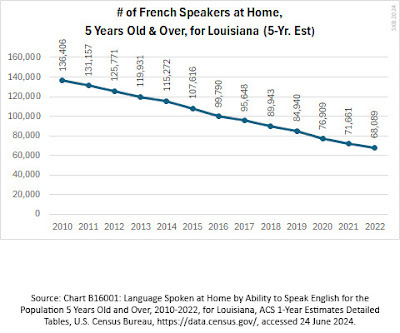
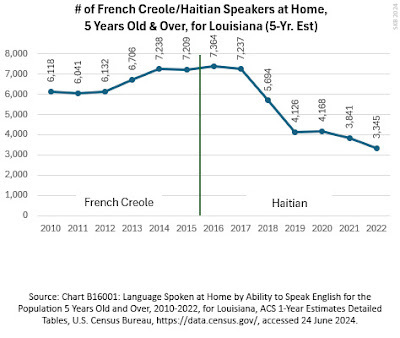
As a follow up to my recent essay “Disappearing Cajuns and Creoles? Ethnic Identity and the Limits of Census Data,” I have produced line charts representing data for two Louisiana languages, French and Creole, as spoken at home by persons aged five and older. The statistics used to construct these charts derive from the U.S. Census Bureau's American Community Survey (ACS), compiled annually from 2010 to 2022. (Stats for 2023 and 2024 are not yet available.)
On viewing these charts one feature becomes immediately clear : a general decline in the number of Louisiana’s French and Creole speakers.
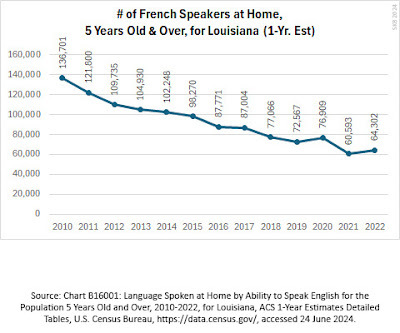
Discussing this with others who share my interest in all things Cajun and Creole, the consensus, though speculative, is that the decline stems largely if not solely from the demise of older French- or Creole-speaking persons, combined with an insufficient number of younger French- or Creole-speakers to replace them.
This downward trend — perceptible today even through impressionistic data (such as the dearth of French or Creole heard on the street, in commerce, or in other workday contexts) — explains the fervent “call to arms” among Louisiana’s sizeable corps of language and cultural activists.
Clearly there is no time to lose, yet, as esteemed folklorist and linguist Barry Jean Ancelet has often pointed out, “Chaque fois que l’on s’apprête à fermer le cercueil sur le cadavre de la culture cadienne et créole, il se lève et commande une bière!” Or, in translation, “Every time we prepare to close the coffin on Cajun and Creole culture, the corpse gets up and orders a beer!”(1)
It should be kept in mind that the stats in question are estimates derived from sampling and not the result of direct inquiry of all possible census respondents statewide. Moreover, while it is fact that the U.S. Census Bureau reports the results shown on the following charts (assuming, of course, I report the data accurately, and I think I do), readers with a healthy measure of skepticism might rightly ask, “Does this census data actually reflect the reality of language use in Louisiana?” That, however, is a topic for another day.
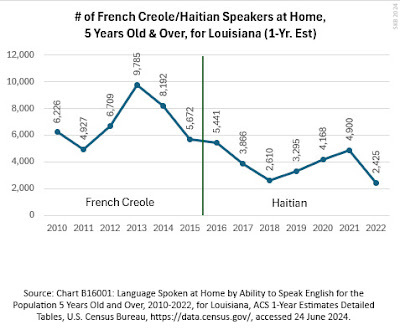
A note about the terms "French Creole" and "Haitian" as used by the U.S. Census Bureau: from 2010 to 2015 the Bureau collected language data on “French Creole.” From 2016 onward, however, it apparently ceased to collect data on that language or dialect, and instead began to collect data on what it referred to as “Haitian.” (A vertical red line on the "French Creole/Haitian" charts indicates where in time this change occurred.)
It is unclear if, in Louisiana’s case, the Census Bureau regarded “Haitian” as merely “French Creole” by another name. There does, however, appear to be some continuity in the numbers reported before and after the change in terms. It is therefore possible that census respondents considered “Haitian” a reasonable substitute for “French Creole,” especially given historic links between Louisiana and the people and culture of Haiti. I refer to large numbers of Haitians, both free and enslaved, who came to Louisiana in the late 1700s and early 1800s.
I leave it to others to determine why the Census Bureau made this switch and if, in the context of these ACS results, it is valid to interpret “Haitian” as synonymous with (or at least a close approximation of) “French Creole.” Regardless, “French Creole” is now viewed as a misnomer because it implies a dialect of continental French: rather, the tongue is now viewed as its own distinct standalone language called Creole, Kreyòl, or Kouri-Vini.
Finally, each language, French and Creole, is represented by two charts: one chart is based a one-year estimate and the other is based on a five-year estimate. As the Census Bureau explains:
Notes
(1)Ancelet is quoted in Jean-Benoît Nadeau, “Mardi gras en Louisiane,” Le Devoir (Montreal), 24 February 2020, https://www.ledevoir.com/opinion/chro..., accessed 30 July 2024.
(2)“Understanding and Using ACS Single-Year And Multiyear Estimates,” U.S. Census Bureau, 2018 [PDF document (excerpt)], https://www.census.gov/content/dam/Ce..., accessed 30 July 2024.
On viewing these charts one feature becomes immediately clear : a general decline in the number of Louisiana’s French and Creole speakers.

Discussing this with others who share my interest in all things Cajun and Creole, the consensus, though speculative, is that the decline stems largely if not solely from the demise of older French- or Creole-speaking persons, combined with an insufficient number of younger French- or Creole-speakers to replace them.
This downward trend — perceptible today even through impressionistic data (such as the dearth of French or Creole heard on the street, in commerce, or in other workday contexts) — explains the fervent “call to arms” among Louisiana’s sizeable corps of language and cultural activists.

Clearly there is no time to lose, yet, as esteemed folklorist and linguist Barry Jean Ancelet has often pointed out, “Chaque fois que l’on s’apprête à fermer le cercueil sur le cadavre de la culture cadienne et créole, il se lève et commande une bière!” Or, in translation, “Every time we prepare to close the coffin on Cajun and Creole culture, the corpse gets up and orders a beer!”(1)
It should be kept in mind that the stats in question are estimates derived from sampling and not the result of direct inquiry of all possible census respondents statewide. Moreover, while it is fact that the U.S. Census Bureau reports the results shown on the following charts (assuming, of course, I report the data accurately, and I think I do), readers with a healthy measure of skepticism might rightly ask, “Does this census data actually reflect the reality of language use in Louisiana?” That, however, is a topic for another day.

A note about the terms "French Creole" and "Haitian" as used by the U.S. Census Bureau: from 2010 to 2015 the Bureau collected language data on “French Creole.” From 2016 onward, however, it apparently ceased to collect data on that language or dialect, and instead began to collect data on what it referred to as “Haitian.” (A vertical red line on the "French Creole/Haitian" charts indicates where in time this change occurred.)
It is unclear if, in Louisiana’s case, the Census Bureau regarded “Haitian” as merely “French Creole” by another name. There does, however, appear to be some continuity in the numbers reported before and after the change in terms. It is therefore possible that census respondents considered “Haitian” a reasonable substitute for “French Creole,” especially given historic links between Louisiana and the people and culture of Haiti. I refer to large numbers of Haitians, both free and enslaved, who came to Louisiana in the late 1700s and early 1800s.

I leave it to others to determine why the Census Bureau made this switch and if, in the context of these ACS results, it is valid to interpret “Haitian” as synonymous with (or at least a close approximation of) “French Creole.” Regardless, “French Creole” is now viewed as a misnomer because it implies a dialect of continental French: rather, the tongue is now viewed as its own distinct standalone language called Creole, Kreyòl, or Kouri-Vini.
Finally, each language, French and Creole, is represented by two charts: one chart is based a one-year estimate and the other is based on a five-year estimate. As the Census Bureau explains:
Each year, the U.S. Census Bureau publishes American Community Survey (ACS) 1-year estimates for geographic areas with populations of 65,000 or more. . . . For geographic areas with smaller populations, the ACS samples too few housing units to provide reliable single-year estimates. For these areas, several years of data are pooled together to create more precise multiyear estimates. Since 2010, the ACS has published 5-year data (beginning with 2005–2009 estimates) for all geographic areas down to the census tract and block group levels. . . . This means that there are two sets of numbers — both 1-year estimates and 5-year estimates — available for geographic areas with at least 65,000 people. . . [while] Less populous areas . . . receive only 5-year estimates. . . . There are no hard-and-fast rules for choosing between 1-year and 5-year data.(2)
Notes
(1)Ancelet is quoted in Jean-Benoît Nadeau, “Mardi gras en Louisiane,” Le Devoir (Montreal), 24 February 2020, https://www.ledevoir.com/opinion/chro..., accessed 30 July 2024.
(2)“Understanding and Using ACS Single-Year And Multiyear Estimates,” U.S. Census Bureau, 2018 [PDF document (excerpt)], https://www.census.gov/content/dam/Ce..., accessed 30 July 2024.


No comments have been added yet.