The Way Station- 2024
It was clear from the stench and miasma that the animal had been dead for at least a week. Its fur was matted, its abdomen distended, and all four paws pointed towards the heavens. Flies engaged in a riotous feeding frenzy, playing tickle and tease.
Death can be a contagion, so I chose to steer clear of the carcass beside the road. The sun continued to beat down unmercifully, baking the highway and countryside around me. If I didn’t find shelter soon, it would do the same to me. The heat had persisted for as long as I could remember, and today was no different. The air was still, with only whispers, and a cloudless expanse above.
Looking over my left shoulder, twin strips of asphalt bled off into the distance. Before me, it was much the same—blistering, motionless, and barren—which is why I chose the off-ramp in the first place. I needed to find someplace else to be, somewhere different from before.
With the world upon my shoulders and what remained of my belongings on my back, I continued my determined shuffle west, one dusty footstep followed by another. Everything exposed was already blistered and red, my lips peeling, eyes nearly blinded from the glare. And yet, I continued as I always did—determined, driven, haunted.
“No one ever said it was going to be easy. Then again, no one ever said it would be this hot,” I thought, my words as baked and hardened as the asphalt beneath me. “I could always break into a rain dance…” But one look at the heavens above said no—deadpan steel-blue skies with not a cloud in sight. It would take a hell of a lot more than a rain dance to break the current drought; it would take God drowning the world.
Upon reaching the top of the off-ramp, I had a decision to make. I could cross the road before me and return to the highway below, essentially continuing my previous journey into the sun, the direction my shadow seemed to be leaning. Or I could hang a hard right and head towards more of the same low rolling hills I had just traversed. Or I could veer left towards the town of Summersville, population six hundred.
Water running low, judging from the slosh at my left hip, the idea of running into people, if any still lived, haunted me. The last time I was around people, there had been gunfire. Lots of gunfire. “And that’s the last thing I need,” I muttered. “Looks like I’ll be hanging a right after all.”
An hour later, the highway was all but swallowed up by the hills I had just passed through, my shadow escaping as the sun continued its sky-high climb. During my trek, I had stopped once, long enough to take a sip of water, brush the hair from my eyes, and shift the pack on my back. My tee shirt, both weathered and worn, lay thin on the shoulders and continued its pattern of sticking and un-sticking.
Whether blistering hot or chilly as all get out, this part of the country couldn’t quite seem to make up its mind. And the further west I went, the worse this condition became.
I had been born long ago to a good family. My father, though strict, had taught me everything I would need to know about how to survive and become a man. My mother had taught me all the finer things in life, such as what herbs to pick to flavor a soup just right, or how to care for my wounds. She also taught me how to enjoy the simpler things in life—the way shadows seemed to grow long in the fall, or how a particular beam of sunlight could break free from the clouds and highlight a particular patch of ground in the distance. There were other things as well, like how clouds seemed to roll and roil just before a mid-Summer storm.
The silence in the fields momentarily drew my attention elsewhere, away from my memories, until I realized that these fields were the same as all the other fields I had passed through—nondescript and knee-high in grasses and weeds, all rolling green. A single speck trolling a sullen sky caused me to absentmindedly reach for my journal. I had a habit of chronicling my journey, had since the beginning. I often found comfort in the art of sketching what I saw. Nothing grand or all that inspiring, but like my mom, I found joy in the simplest of things. Once I discovered a wildflower, white petal crowning green leaves, struggling against the elements, eking out an existence between the cracks of an asphalt highway. Another time it was a weathered and oddly tilted fence post. The fence itself had long ago vanished, having returned to rust and dust, but in mute testimony, the post remained—another bent and aged squatter wandering the greater plains, much like myself.
According to my latest figures, I had covered almost thirty miles since the morning. Not bad considering that my feet, back, and shoulders ached. It would be a whole lot easier if I were to list what didn’t ache, rather than what did.
The sun was a good three fingers from the horizon when I came across the mile marker, a reflective green and white rectangle approximately twelve inches long and half as wide. The sign itself was attached to a galvanized metal pole and held approximately five feet off the ground by two galvanized bolts. The sign read: Mile 244.
Allowing the pack to slide from my back, I gently lowered it to the ground before opening it. Reaching in, I quickly and carefully retrieved three objects. The first was the most important: my father’s sextant, which I kept in a worn and threadbare black bag. The second object was equally as important but for an entirely different reason—my journal, a chronicler of events. The third and last object was a well-worn and much-thumbed copy of The Farmer’s Almanac dated 1982.
Three-quarters of the way through the journal lay a thin red ribbon. Opening the journal to this point, today’s entry, I hesitantly lifted the ribbon, closed my eyes, and inhaled deeply. The faint scent of lilacs remained and continued to amaze me even after all these years. Lowering the ribbon, I set the opened journal across my knees and removed the sextant from its protective bag. With nary a shadow behind me, I raised the sextant to my eye, sighted in on the Moon—a silvery smudge barely a finger’s width above the horizon—and measured the angle between it and the sun. Locking and rocking the instrument, I made note of the indicated angle in degrees and seconds in the left-hand margin of my journal. I then opened the Farmer’s Almanac and cross-checked the angle I had just measured to the correct table to find the time in Greenwich Mean, before comparing this figure to the intricate watch I wore on my left wrist.
“Still off by more than a minute.” Considering that my watch was constantly being updated by the atomic clocks located deep beneath the U.S. Naval Observatory in Washington, D.C., this seemed an impossibility—one I chose to ignore. My next two measurements, which I also jotted down, indicated my longitude and latitude—my current position in the world: 38°25’2.08″N by 96°33’25.35″W. Finishing, I carefully repacked each item, tightened my straps, and then re-shouldered my backpack before continuing my journey north. There was a place I needed to be, a sanctuary some would call it, others Nirvana. I called it home. And according to my measurements, I still had a long way to go to reach it.
Nightfall would catch me stretched out in a local grotto, eyes heavy, heels kicked up to a velvety black sky full of unknown stars spinning high overhead. And in that darkness, I dreamt.
Of a time when I was yet a child. My father would take me out into the great night and point my face towards the heavens. “Do you see that?” he would ask. I would shake my head no. “See what, Daddy?” With his father’s lips only inches from his ear, “Those seven stars right there.” Following his father’s lead, “That’s the Big Dipper, a very important group of stars, son. So important that they could save your life one day.” “How, Daddy?” How could pinpoints of light possibly save his life? “Do you see how those first three seem to form a handle, while the last four form the dipper portion?” He shook his head. “Let your eyes follow those last two stars, son.” He did. “Now imagine a straight line being drawn across the sky with its beginning, its point of origin, being those two stars.” Sudden realization, like a shade being withdrawn, “I see them, Daddy.” “Good. Following our imaginary line, notice that after only a few degrees, we run into what appears to be a much smaller dipper, one in which the handle seems inverted as if flipped inside out.” “Yes.” “That bright star, the one the Big Dipper points to, that’s Polaris, son, what we call the Northern Star.” His father faces him. “If you are ever lost, my son, if you ever lose your way, just seek out the Northern Star—it will always lead you home.”
This would become a lesson he would never forget.
Morning
Morning broke, bringing with it an alien landscape. In many places, like old bones or relics from a time long past, shale, granite, and limestone thrust themselves up from the earth. The same desolate sky hung high overhead, a vast expanse of emptiness. The sun, already a punishing force, promised another day of blistering heat.
For three more days, I endured this relentless terrain, the heat an ever-present companion. Each day felt like a trial by fire, the landscape offering no respite. It was on the fourth day that I encountered the first real signs of ‘them’ since my run-in at the gas station, all those many miles back.
The Gas Station
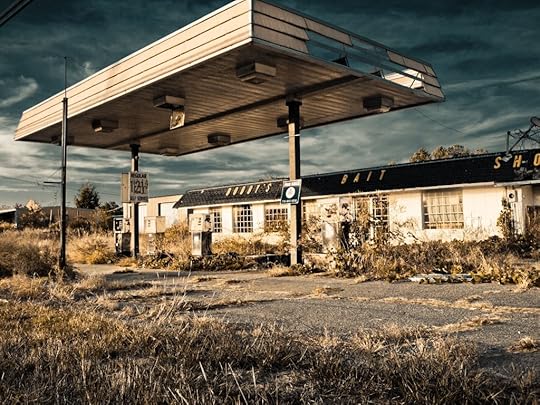
Like a mausoleum, it seemed to rise from the rocky soil with sandblasted walls, dusty brown paint, and streaked glass. An abandoned—long-abandoned—filling station, its four walls streaked in shadow and ochre blush. One large garage door was all that remained of three, and it was closed. The remaining bays, minus doors, were nothing more than blotches of darkness glaring out across the highway. Like a dead man dreaming in the noonday sun, the entire structure seemed to be slumbering.
A large plate-glass window remained intact in front, its surface streaked in ripples of gold and blue, rainbows of refracted and reflected light. The front door, currently situated at an odd angle, hung open, its darkness beckoning while at the same time repulsing—a yawning threshold to a much darker interior.
The station’s pumps were long since gone, only the twisted remains of rusted pipe remained, poking up from an oval-shaped concrete island. Overhead, what used to be a canopied awning was now skeletal and torn, its four large posts pointing at odd angles toward the sky. The parking lot around the filling station lay broken and shattered, with tufts of yellowed prairie grass waving in between. The place was a pop-up picture opened to the American countryside in a book about dirt.
Flashback: The Gas Station Forty Years Prior
Entering the station proper, my senses had been immediately overwhelmed by a variety of smells: the deep damp stench of oil, gasoline, and compressed air, and the sharp tickle of fresh rubber mixed with Wrigley’s Doublemint Gum. There was something else as well, something I couldn’t place. Across a grease-smeared and scratched glass counter stood a register, unattended, much like the station itself. Beside the register, a three-tiered rack of Wrigley’s gum, rows of green, blue, and yellow. On the other side of the register lay a stack of ratty-edged maps, a cup of broken and chewed pens and pencils, and one of those four-by-four boards with a nail driven through it. Impaled on the nail was a mishmash of old receipts stacked an inch thick.
The wall across from the counter held a dusty rack of Ever-Ready car batteries, beside it, a dented can overflowing with greasy shop rags. A tattered calendar turned to December 2019 seemed to round things out, hanging limply above the battery rack. Other than an overturned chair behind the counter, and a coat rack holding an umbrella beside the door, there was not much else to catch my eye or hold my attention.
Present Day: Re-Entering the Gas Station
With one hand on the door frame, I cautiously entered the gas station. Instead of oil, gas, and compressed air, my senses were assaulted by the stench of dry rot, disuse, and dirt. Yellowed wallpaper, peeling in strips, lay on the worn linoleum floor, along with mounds of dried grass and weeds. An abandoned bird’s nest of daub and mud adorned three of the corners. A stack of worn and fingered phone books lay haphazardly stacked against the far wall. The glass countertop of yesteryear had been replaced with plywood. There was also no register. Gone were the days of Wrigley’s gum, paper widgets holding business receipts, and a year-old calendar opened to December.
I paused a moment to gather my thoughts.
Sudden thunder as the wall next to me hammered twice; sheetrock lifting outward before exploding in a cloud of white dust. Instantly my hearing was gone, what was initially sharp had become muffled silence. I immediately dropped to the floor, fragments of wall raining down around me. From the darkness beyond the office, three brilliant strobes of light reached towards me in ever-expanding rolls. My world had become one of cordite and gunpowder, smoke, dust, and debris.
Right hand reaching, I felt the steel before I pulled it—Lex Talionis, the Law of Retaliation. In one smooth motion, I brought its comforting weight and steel to bear. The last time I was in this situation had been back in Omaha—three souls lost their lives that day, all by my hand, and all because of ‘them.’ Always, they seemed to be ahead of me, while I remained what felt like three steps behind. At least at the diner, there had been some warning, some notice given. I simply hadn’t wandered in oblivious… not like here and now.
Back then, my entrance into the diner had been preceded by a star, its shape seemingly painted by a child’s hand, chalk white, on the top step below the front entrance. Next to a crescent moon, I’d learned to keep my eyes open. Not this time, though. There had been no star painted outside, no crescent moon above the door, no upside-down ‘For Sale’ signs propped up or hanging in the front window, only ambush and gunfire. They were getting smarter.
Strained silence with after-images of light floating and darting. Outside, a golden-red coyote paused in mid-stride, seemingly caught halfway between this side of the highway and the next. Its head turned towards the station, ears cocked, tail tucked. Between one breath and the next, she was gone, vanishing into the afternoon’s silence and glare. The coyote had been in Omaha as well, only afterward, not before, like some harbinger of doom. That, or death.
Rolling to my right, I moved beyond the counter and into the space between it and the wall, directly in front of the backroom door. I felt it might be my only chance at surprise, and probably what the other party felt to be my only recourse as well. A moment before I acted, my eyes were drawn to my right hand, to the word ‘Justice’ tattooed in blue across the knuckles, and crosshairs blazoned across the first joint of my trigger finger.
I rolled out and brought ‘Retribution’ to bear, while at the same time squeezing off two thunderous rounds, afterimages of light and smoke. I continued to move, bringing myself to the other side of the door frame, out of breath but heartbeat steady. My backpack remained where I dropped it, just outside the front door. Silence reigned. A glance assured me that the coyote was gone. Only then did I notice the sign, a star, finger smeared in white and ochre on the linoleum floor just inside the threshold where baking sunlight met the floor. Beads of sweat broke from my brow and ran down my nose. A fly buzzed around, making itself a nuisance. Errant strands of hair stuck to my face. It was the little things that were irritating in times like these.
In the stillness, there was movement. I leaned to the left in time to catch her under the chin with my pistol as she stepped from the room. A single shot, and a thunderous roar, lifted the top of her skull, showering the ceiling and doorway with brain and splinters of bone. I quickly rolled to the right, sparing myself most of the mess. A single tear of red slowly made its way down my cheek. I waited for what seemed an eternity. Most of the time, they hunted in pairs, lay in groups. Not this time, though.
Afterward, and sometime later, I regained my backpack, holstered Lex Talionis, and stood above her, hands on my hips. For all she had become, she remained a child—they all did, dirt-smeared face, vacant eyes, and dark stringy hair. She was dressed in little more than rags. She’d also lost a shoe in the struggle afterward—the struggle to hold onto life as it slipped through her fingers and bled from her skull. Still clasped in her extended left hand was an ancient iron, an old-time six-shooter, the kind you find in Westerns. Her right hand was clawed and crowned with dirty, broken fingernails, smeared with white and ochre paint, the word ‘Croatoan‘ carved in the center of her palm. Her wrists were chaffed and torn, evidence of her countless bids for freedom. Today she had gained that freedom—just not the freedom she desired.
It was close this time. One day, maybe soon, it will be my time to lose a shoe. But not today.
That Night
With the stars burning bright and a small fire flickering between me and midnight, I wept. Not for today, not even for the girl, though I have wept for such before. No, today I wept for the promise of tomorrow and all the tomorrows to follow. Sometimes I feel like I’m the only thing standing between my old world and the world they wish it to become.
‘Ayin tahat ayin.’ Justice, blind or impartial, retribution will find a way… and I will not rest until I hunt them all down, all the ‘theys,‘ and put an end to this nightmare once and for all.
Until that time, I ride.