Mars Opals
I was looking into what natural materials have been found on Mars, with an eye towards what future colonists would have available to use, and was delighted to discover that Curiosity, that clever little robot, has found opals on Mars.
Curiosity, it turns out, is sitting on top of a motherload of opals located at the bottom of Gale Crater. Unlike the strong carbon structure of diamonds, opals are made of a softer solution of silicon dioxide and water, forming from the sediment of evaporating bodies of water. For example, the opal mines in Australia are the result of the death of a former sea in the middle of the-now barren deserts of Australia, and the same appears true for the area of Mars that Curiosity is exploring.
This discovery means Curiosity is sitting in the middle of the fossilized remains of a lake or sea. More proof pointing to a past Mars that was warmer and wetter. Right now, this is important data to help form a more complete picture of Mars’s geologic history. In the future, however, this could suggest a local industry in opal mining. Imagine the demand for opals all the way from the Red Planet!
Technically, you can extract the water that makes up part of the opal’s structure by grinding it to powder and heating it up. The news of opals on Mars has caused a lot of scientists to get excited about the idea of opals as a water source for humans on Mars, but that seems like a lot of wasted energy, not to mention a waste of opals, for small amounts of water, especially when there is water ice at the Martain North Pole – and probably other places as well – that would be a much easier source of water. If opals were mined on Mars, I imagine it would be for the same reason they are mined on Earth – to make very pretty and pricey jewelry.
Opals have been prized as precious gems for as far back as humans have found them. In the Middle Ages, opals were considered extra good luck because, since they contained all colors in their multi-faceted sparkles, it was thought they had all the virtues of all gemstones. Also, there was a superstition that an opal wrapped in a bay leaf would grant invisibility – despite how easy this theory would be to disprove, given access to some opal jewelry and a kitchen herb garden.
In the 19th century opals briefly went out of fashion when the best-selling author of the day, Sir Walter Scott, wrote a novel in which an opal possesses evil powers and leads to the main character’s death. The idea of an opal carrying bad luck lingered in Eastern European superstition well into the 20th century, with not even prosaic communism able to fully stamp it out.
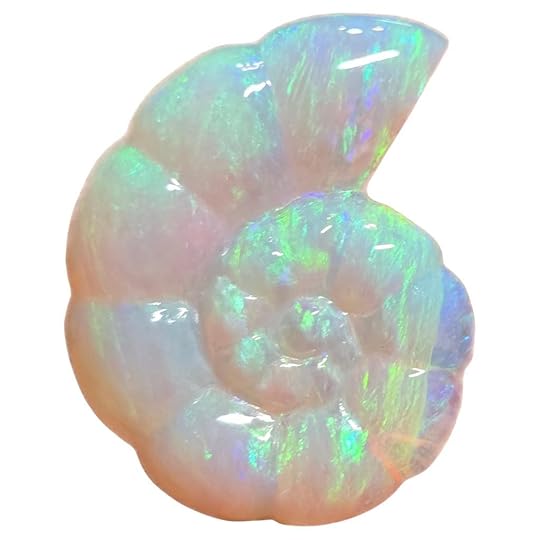
Meanwhile, there are also the even more rare opal fossils. Opals are formed when a solution of silica in water collects in cavities within rocks. Any cavity will do – if the silica solution finds a space left by rotting shells or bones, like a mold, the opal silicia solution will produce an opal cast of the original object. Entire dinosaur skeletons have been dug up that have been turned into pearly, sparkling opals.
Old school sci-fi writers imagining gems on Mars usually just went with the obvious of bright red rubies or blood red diamonds, usually adorning the crown of some alien empress of Mars who falls for the charms of some brash Earth man, but Curiosity’s discovery shows that the fact is much more dazzling than the fiction – the Red Planet contains the surprise of brilliant, icy white precious stones flashing a thousand iridescent colors hidden in between the red rocks of the Mars surface.
And what if opal bones were found on Mars…?