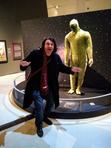
Is Tommy Wiseau Autistic?
First of all, I am not making a diagnosis here; I am not qualified to do so. Instead, what I am doing is turning on my own background knowledge, as an autistic person, and observing and reflecting on Wiseau’s life and cinema. Based on my own experiences, thoughts and feelings as an autistic person, I can recognize commonalities with Wiseau. It is those commonalities, suggesting Wiseau may also be autistic, that I want to discuss here.
Secondly, it is not my intention to disparage Wiseau in any way. I am a fan of what he has accomplished. However, that said, it is hard to predict how someone might take it if you insinuate they are autistic. On one hand, it could be something positive that helps manage a person’s life and explains their special gifts. On the other, due to social stigma, it may be considered an insult – or at least an invasion of their privacy. It is hard to judge how someone may react; it is totally up to the individual and their personal circumstance. All I can say is I mean no harm; the fact that I see some commonalities between myself and Wiseau demonstrates affection, and a quest for understanding, rather than criticism.
Lastly, my research is based upon viewings of The Room and The Disaster Artist, as well as reading the book The Disaster Artist: My Life Inside The Room, the Greatest Bad Movie Ever Made. Below are some of the criteria I used. Individually, they are not exclusively autistic traits, but from a holistic standpoint, taken as a whole, I believe they suggest Wiseau may be autistic, thus explaining his behaviour and unique cinematic style.


It’s embarrassing to admit, but in the past I have become overly protective of friends and, at the same time, jealous when they succeed. At the time, I did not understand why I felt that way, but now I see it as part of my autism. Jealousy is an emotion I despise, but perhaps it is driven by my innate (misguided?) sense of justice and at times an inflated sense of what I deserve in life, as I see others succeed with apparent ease. Once you let someone into your inner circle, you become too dependent on them and overbearing, to the point it bothers the other person. Unable to see social cues and establish appropriate boundaries, perhaps I was seen as too needy – too clingy? This trend is clearly evident in Wiseau’s relationship with Greg in the film The Disaster Artist.

I’ve often said that I don’t need to be an actor because masking 24/7 is a life-long role – an Oscar-worthy performance. Yet, throughout my life, I have dabbled in mimicry, short films and improvisation. I’m surprised more autistic people don’t go into acting (or do they?), since – to an extent – we all need to do it as part of everyday life; we can’t survive a day without it. While there are not many well-known autistic actors, I wonder how prevalent this trend is among the neurodiverse.

Accent
Wiseau’s accent has been described as “untraceable”. I also had an accent that at various times has been called “southern” and Irish. Someone once told me I pronounce words so clearly it is as if English was my second language. Combined with a speech impediment when I was young, I do vocalize differently than neurotypicals. Perhaps Wiseau’s accent and vocal mannerisms are also due – in some degree – to autism.
Obsessions
It is a well known fact that autistic people tend to have a special interest, which for me can quickly become obsession. For Wiseau, it is American Culture.

From what I have read about Wiseau, and as evidenced in the film The Room, he does not seem to have a grasp of how old he is or what a man his age should be doing. In the film The Disaster Artist, when Greg’s mother questions why a man his age is hanging around her son, he lies about his age. He also has trouble judging the age of others. This is similar to my own autism in that I look young for my age, still have adolescent interests, and have trouble guessing what age other people are – let alone figuring out what a man my age “should” be doing with his life. I don’t like being asked my age; I’m embarrassed when people are shocked, saying I look younger. Perhaps autism explains why Wiseau is also secretive about his age.
Limited Facial Expression
Wiseau usually looks serious and intense, if not poker-faced. The same has been observed of my facial expressions over the decades. Unease with smiling is also part of my autism. Many have told me to lighten up, loosen up and smile more; but it didn’t do any good. My autism is such that I have limited facial expressions and I do not easily, naturally smile. I think the same can be said of Wiseau. I’ve heard experts describe the face as an “emotional billboard”. They can read faces like a map, sometimes enabling them to determine psychological states. Wrinkles are caused by certain facial muscle being used when we smile or react to social stimuli. Being autistic, I don’t react to those stimuli the same way; my face can remain immobile and facial muscles remain unused, thus wrinkles do not form. This may explain why I look younger than I am.
Reluctant to Discuss Past
Based on what I have read about Wiseau, he is reluctant to discuss his past in detail. Instead, he seems to obfuscate with information that can be hard to verify. Similarly, as an autistic person, I find it hard to discuss my past. Perhaps because of past trauma, or maybe just a lack of patience with having to carry on conversation, lack of trust, and/or a failure to understand why the person is really asking about my past. Either way, many thoughts and worries become hurdles when I’m asked to recount my past.
Telephone Manner
I’ve read that Wiseau has an odd telephone manner. I don’t like talking on the phone at all. I’d prefer email, or maybe a Zoom call. When on the phone, my voice can be flat and I can lose patience easily. I think my aversion to the telephone is due to my autism and theorize that Wiseau’s odd phone manner may also be due to autism.
Clothing
I think part of my autism is adopting a certain characteristic style of dress – often dark colours with a lot of layers. It is a survival mechanism – an attempt to be comfortable among the myriad of stressful social interactions of everyday life. Wiseau seems to have adopted a similar style of dress which may also help him cope in social situations. For example, are the ubiquitous sunglasses due to light sensitivity and/or avoiding eye contact? He seems to prefer loose fitting layers, rather like myself, with somewhat of a goth touch, rather like myself. Several belts, buckles and keys. Maybe he too feels comfortable and safe in layers. Maybe like me, he wears layers to hide the profuse sweat owing to the stress and pressure of social interactions. Lastly, I have a sense that I need to be “wearing my life”, so people can read me without saying a word, often to the point of over dressing, similar to Wiseau’s need to have so many belts and key chains. As I have written in a prior blog, I use style of dress as a “badge” to attract similarly minded people, since I cannot rely on my social skills alone to build bridges in social situations.

It seems Wiseau does not know the limits to what is acceptable, so he often becomes over-the-top – too intense for those around him to deal with. This is similar to my own situation. Sometimes I over share, sometimes I under share; it’s hard to keep the balance right.

There are several examples of this in both The Room and The Disaster Artist, many of which generate laughter – due to their incongruous nature. Wiseau blurts out seemingly random statements, often brief with no context or further explanation, thus confusing people around him. Wiseau keeps mentioning that he is driven by “human behavior” but obviously knows very little about it. For example, the scene in The Room when he is told a gripping story of domestic abuse only to laugh as a response; in The Disaster Artist, the crew sees this as socially unacceptable. I’ve also been guilty of this in my past; things I’ve said have shocked people or openly made them wonder where I was coming from.

“What a story, Greg!”
No Relationship / Relationship Difficulties / NaivetéWhile Wiseau writes himself a partner in the form of Lisa, it appears that in real life he is not involved in a relationship. Perhaps he does not have the capacity and, based on prior experience, would rather divert his energies elsewhere. Problems with relationships are perhaps best exemplified by the awkward scene from The Disaster Artist when Wiseau has trouble even pretending to make love to a woman, leading some to question whether he has any experience at all in that regard. Lastly, his dialogue with Lisa is naïve, suggesting he is drawing on what he has observed in culture rather than what he has experienced in real life.

If you watch Wiseau closely, he does not appear to have a natural gait. He moves as if in a trance, his mind elsewhere. Specifically, there is not much swing to his arms. He appears tensed up. This is also a feature of my autism. I’ve been told I “walk with purpose and intent”. Sometimes when I’m waking, I get so distracted with a thought that I snap out of it and don’t recall the path I took to get there. I think the way I walk is influenced by different spatial awareness, fear of being judged in public spaces, and a heightened sensitivity to my environment – all characteristics of my autism, and possibly Wiseau’s autism.