
the funniest centaur alive
Not very long ago, telephones, televisions, cameras, video recorders, stereos, calendars, and microphones were separate devices spread around our homes. Computers and calculators, too. Now they’re all jammed into one gadget that fits inside your pocket. That’s a lot of change in a relatively small amount of time. And yet we make fun of older people for occasionally struggling to use an app.
I’ve been thinking there’s a good comedy bit in here somewhere, but I’m not a standup, so I passed the joke along to a fictional character in my latest story, The Funniest Centaur Alive. What’s it about? Always a good question!
The story is set at a sales conference in Vegas, sometime in the near future, and features a standup who’s secretly using AI to improve his set, a marketing professional trying to survive a round of layoffs, and her tech-maximalist colleague.
The short story — my first piece of fiction for adults in a very long time — has just been published in Issues in Science and Technology as part of the Future Tense Fiction project from ASU’s Center for Science and the Imagination. It’s free to read, and if you’re wondering, Patrick, what I really think of AI, this story sums it up. I’m trying to understand this technology by writing and thinking about it from all angles, so I’ve divided my many opinions and distributed them between the three main characters.
The really cool element here is that Issues includes a response to the story from Brown University computer scientist Suresh Venkatasubramanian, an AI policy advisor for the Biden-Harris administration who coauthored the Blueprint for an AI Bill of Rights.
His essay thoroughly outclasses my fiction.
But check them both out if you have a minute.
Now for a few other matters…
The New Yorker did not create an Al Pacino robot.
I’m so accustomed to seeing AI everywhere all the time, that I scanned this headline…

. . . and thought the venerable magazine was publishing an experimental memoir by A.I. Pacino, an intelligent chatbot based on the great actor. Now, if I were building this bot, I’d limit the training data to two movies: Heat and Scent of a Woman. The memoir would be published in audiobook format only, because you can’t read Pacino. You need to hear him yelling at you.
Anyone else confused by this billboard?
What we have here is an image of a woman biting down on a semiconductor, with some words mashed together into an insensible directive, all with the purported goal of encouraging drivers to tune into a radio station called The Big Lick.

This was on the side of the road in Ohio. Intel is/was building a new chip fab in the area. So maybe people are mad about that? Not this young woman, though. She loves semiconductors. Unless she’s a robot? And this is how she fuels herself? Speaking of which…
Scientists are thinking about making robots lazier.
MIT Technology Review published a story on this subject; the lead scientist’s big idea:
“…teaching all kinds of robots to be “lazier” with their data could help pave the way for machines that are better at interacting with things in their real-world environments, including humans. Essentially, the more efficient a robot can be with information, the better.”
My brain immediately goes to the robotic version of a teen. You come home from work, ask your domestic bot to do something, and it declines.
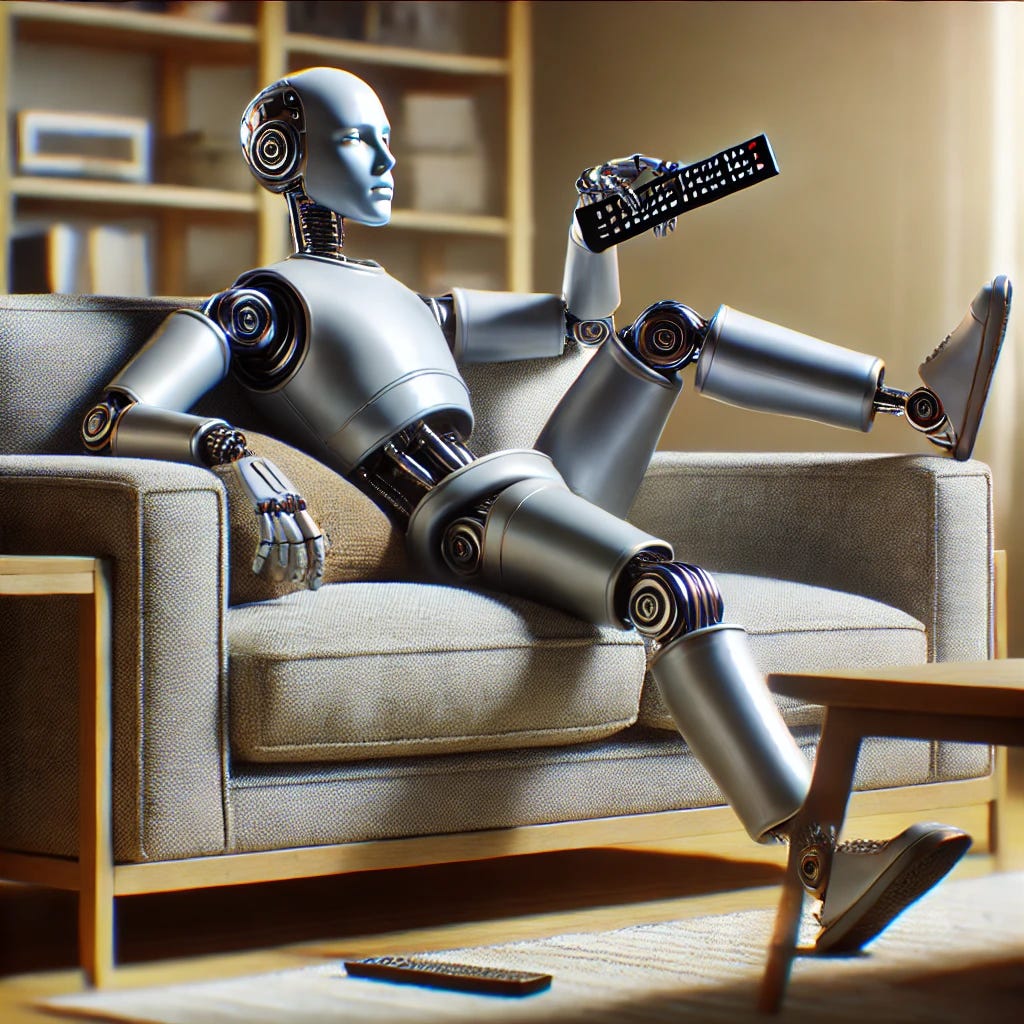
-Bro, I need to recharge, okay?
-You’re not even plugged in.
-Whatever. When is Netflix going to do another season of Chef’s Table?
-They probably need more viewers. Maybe you could spawn a few million fake subscribers to binge the existing seasons and trigger them to re-up.
-Nah. Just found some movie called Scent of a Woman.
This isn’t really what the researchers mean by lazy, though. They’re trying to figure out how to teach robots to focus on what’s important in a scene instead of taking in and processing all the information collected by their sensors at a given moment. When humans drive a car, we don’t study every tree and leaf and billboard . . . well, okay, maybe I do, but then I pull over, or snap to attention because my wife or one of my kids tells me I’m driving 25 mph in a 50 mph zone.
A good driver only pays attention to the important stuff: the road, conditions, other cars and drivers. Daniela and her team at Liquid AI are developing neural networks that can focus and disregard the less important details, sort of like the lazy robots described here. Really interesting stuff. It’s in The Mind’s Mirror.
What AI lacks as a writer.
Finally, picking up an older story, The New York Times tasked the novelist Curtis Sittenfeld and ChatGPT with writing a story given the same basic prompts and parameters. Both were published, and readers were invited to guess which piece was crafted by a human and which one was AI generated. After the first sentence, I guessed wrong. The human version had too much information crammed into the opener, rendering it less digestible. The AI version was short and direct. I prefer clarity. However, once I read beyond the first sentence — generally good practice as a reader — the difference became clear. The AI version looks like a story, but it doesn’t feel or read like one. For instance, this sentence:
The days that followed were filled with longing and regret.
A human writer would actually make you feel that by taking you inside the character’s head and heart. You still need a mind to write a great story. And I hope my own mind, which is encased in a large and irregularly shaped head, produced an enjoyable story with The Funniest Centaur Alive. Let me know. And thank you, as always, for reading.


