
Young, Beautiful, and on Her Way Out

For more background on The Manic Pixie Dream Girl, check out my previous post, The Myth of The Manic Pixie Dream Girl.
But, in short, the MPDG exists to bring excitement and inspiration into the male MC’s life. She is often the woman: young, beautiful, and on her way out.
Wait, what?That’s an actual quote from Autumn in New York. It’s what Will’s (Richard Gere) best friend says when he learns that Charlotte (Winona Ryder) is dying. And no, it’s not meant to be ironic. The best type of MPDG is one who comes along, transforms the male MC, and then gracefully exits before she grows old, ugly, and weighed down by life’s realities.
Here are some examples.[image error]
Love Story, a 1970 romantic drama starring Ali MacGraw and Ryan O’Neal: Jenny (MacGraw) is a quirky free spirit. She captures the heart of Oliver (O’Neal), who’s wealthy, reserved, and has big-time daddy issues. Jenny’s carefree attitude and love for life brings Oliver out of his shell and helps him discover his true passion for writing. But she has to die from cancer before Oliver and his dad’s relationship begins to thaw. This film’s most iconic quote is, “Love means never having to say you’re sorry.”
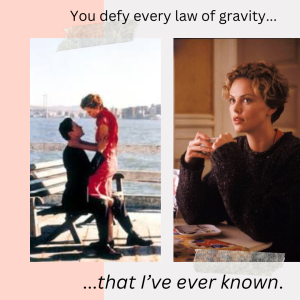
Sweet November, starring Charlize Theron and Keanu Reeves: Sara (Theron) is a quirky free spirit who teaches Nelson (Reeves) to live in the moment. She convinces him to spend a single month living with her and promises to change his life in the process. Nelson agrees, but falls in love and proposes. Naturally, Sara reveals she has terminal cancer, and wants to spare Nelson the pain of watching her die. So, even though he begs her not to, she takes off and dies without him by her side.
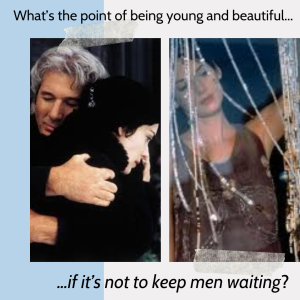
Autumn in New York, starring Richard Gere and Winona Ryder: Will (Gere) is a successful restaurateur who falls for Charlotte (Ryder), who’s-you guessed it–a quirky free spirit. Despite their age difference, Charlotte’s zest for life draws Will in. She’s always surrounded by fairy lights and glass beads, reciting Emily Dickinson, and stealing Will’s watch so he’ll learn not to value material possessions or worry about time. Turns out Charlotte has a terminal illness, and despite Will’s efforts to hire an expensive surgeon and save her, Charlotte dies. But not before she gives him his watch back for Christmas.
Okay. These films are at least 20 years old.Many people believe dying MPDGs don’t appear in movies anymore. That we’ve moved past the trope. Maybe. But I recently watched We Live in Time, starring Andrew Garfield and Florence Pugh. While it’s a good movie that doesn’t go all-in for the dying MPDG, it gets its toes wet.
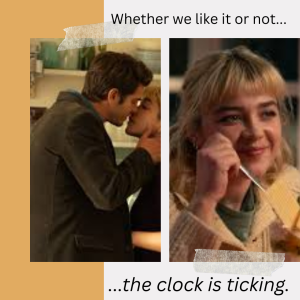
We Live in Time, is a nonlinear love story. Tobias (Garfield) is a modest Weetabix employee who’s getting divorced when Almut (Pugh), an ex-professional figure skater/Michelin star restaurant owner, hits him with her car. Talk about a meet-cute! Of course, they fall in love. And while Almut has a personality, goals, and dreams of her own, she is also a quirky free spirit who’s teaching a dull man how to live. This qualifies Almut as an MPDG. She keeps condoms ready for when he’s unprepared and considers skipping chemo to enjoy her remaining time, leaving Tobias in awe. His role is to admire her, while she fulfills his desires, even postponing cancer treatment to have his child and using her last days to plan his dream wedding.
Okay, but why is any of this a problem?Maybe it’s not. Confession: I enjoyed several of these movies, and I love a good tear-jerker. All I’m saying is that, in all these films, the MPDG’s death serves as a catalyst for the male character’s growth, leaving the audience with a bittersweet ending that romanticizes terminal illness. None of these women (except maybe Florence Pugh’s Almut) ever seem ravaged by how sick they are. They stay beautiful, no matter what. And then, they die before life drags them down. Or, before dragging down the men in their lives.
This brings me back to the use of “girl” versus “woman.” While there is an occasional MPDG romance with a happy ending, often they end either with her death, or with her leaving (like in 500 Days of Summer.) That way, the girl never has to mature. She can stay as a girl forever.
Young, beautiful, and on her way out.

You can start reading my FREE, Taylor Swift- inspired short story, Love and Poetry today!
Subscribe to Laurellit.com and I’ll send it to you right away. Let’s keep in touch!The post Young, Beautiful, and on Her Way Out first appeared on LaurelLit.com.
The post Young, Beautiful, and on Her Way Out appeared first on LaurelLit.com.


Laurellit.com

- Laurel Osterkamp's profile
- 525 followers

