Father and Son
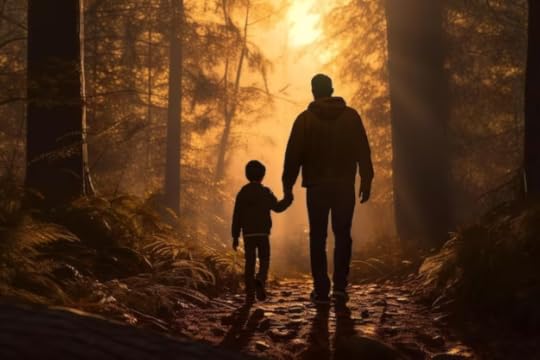
OnWednesday, November 17, 2010, the weather was chilly and cloudy, typical forlate fall in Miramichi. Historical websites reported that no notable eventsoccurred on this date. But at 4:20 p.m., my oldest brother, Norman and Iwere present as history unfolded for our family. We sat on either side of ourfather's bedside while Norman comforted him with quiet reassurances as I heldhis hand. His breathing became ragged, eventually, the only sound in the roomwas the clicking of the clock.
Ilooked at the body that once was our dad, John Dolan. His bear paw hands werestill rough as sandpaper. I thought of him tossing me effortlessly as a youngchild into the air. His face and arms held a tan from the previous summersitting on the veranda overlooking his beloved Miramichi River. We were in theliving room, which was renovated for a sleeping area. In its last role, itheld many warm memories. Dad's "modified" Christmas trees had stood,tied to the wall to prevent them from falling. As youngsters, we held no noticeof the crooked tree and the fading decorations. Our imaginations conjuredimages of extravagant gifts, including GI Joes and talking dolls. The realityof simple presents on Christmas morning did not lessen our joy. As kids, weknew nothing of Dad's sacrifices to buy even basic gifts. Seven children andhis mother had to be fed and clothed. Our house was over a century old andshowing its age. With few tools and less ability, Dad struggled to keep ittogether. We may have complained about some of our clothes but knew wewere loved. As a small boy, I would sneak past my brothers and sisters aftersupper to join Dad on the couch. I would snuggle into him as he read his paper,and if I were lucky, we would fall asleep, me safe and secure in his arms.
Manyof us view our parents through a narrow lens, seeing them mainly as caregiversand nurturers. We often overlook the individuals they were before we enteredtheir lives. They may have set aside their dreams and goals to ensure that we,their children, could pursue ours. I occasionally asked Dad about his fatherand life as a youngster, but his brief responses were not much help. My fathertreated words like chocolates. He savoured and consumed them sparingly.
Dad'sfather died of sepsis when my father was fourteen. His mother carved out aliving taking in boarders and raising a few farm animals. Despite the hardship,she insisted he stay in school beyond the usual Grade eight level. Dadwent on to complete High School. In 1940 he joined the masses of young men andwomen who took up arms against the Nazi repression. After the war, he returnedto Miramichi and met a young nurse. John struggled to overcome his shyness and eventuallywon Rita Ramsay's love. The two married and settled into the Dolan Homestead inNelson. Dad spent most of his adult life working at the village lumber andplywood mills as a wood scaler and then as a company bookkeeper. We didn't owna car. I recall many evenings as a child sitting on our fence post, waitingimpatiently for my dad to walk up the road from work. Sometimes, I would sneakaway from Mom and run to meet him. This was our time together as I told him ofthe day's event.
Dad'sown story to this point is not unique or exceptional. But it was meaningful tomany, including the citizens of Nelson. Residents heard the new gospel ofshared ownership and responsibility from Dad and other leaders. The resultswere astounding. They included the establishment of Beaubear Credit Union andCo-op as well as a Cooperative housing project. Dad's greatest gift to hiscommunity was leading the construction of a regional high school. He and theparish priest, Father Ryan, marshalled the required resources and support thatmade education possible for Nelson kids and the surrounding communities.
Dad lived a quiet and humble life.One summer evening, we sat on his veranda watching a spectacular sunsetperfectly mirrored on the great river. I asked him why he gave up so much ofhis free time, often at the expense of his family; his response was typicallydirect;
"It was expected of anybody fortunateenough to be educated that they would give back to the community who supportedthem."
I am immensely proud of and loved myfather. But our story was, at times, a lonely and frustrating one for me. Thelittle boy who fought for quiet times with his father struggled to find hisplace in a world he was not sure wanted him. Sexual identity does not suddenlyappear. It is sewn into our genetic makeup and manifests from our first smileor tear. I could not express the alienation I felt as a child, but I needed tobe comforted in my journey of self-discovery. I spent my youth and part ofadulthood in a circle of self-doubt and fear. My father could not support me inmy struggles. He wrestled with depression throughout his own life. Theeducation that was supposed to bring him freedom resulted in his self–bondageto a community that never acknowledged his contribution.
I took up my father's leadershipburden as a young man. One of the projects I worked on was in education. Theresult was a community college campus built in the Miramichi region. I wasstarting on Dad's well-worn path. Subconsciously, I was seeking his attentionand approval. I got neither. A truism I learned helps explain my response toDad's absence. "Those whose love we wanted but didn't get, we emulatethem. What we know of manhood is through our fathers."
Eventually,I got off the hamster wheel of seeking approval from others. Learning to acceptand love me has taken a lifetime. Dad's lesson for me was, "Life isneither bad nor good. What a person does with their life defines the richnessor poverty of our existence." He and I did our best with the tools we hadin our lives. I have experienced richness beyond what I anticipated, and I oweDad for much of that.