
The Eighteenth of April
If you want to know what generation someone is, just start reciting Paul Revere's Ride by Henry Wadsworth Longfellow. If they continue reciting it after you finish the second line, they are a Boomer. We are the ones who believed every myth and exaggeration our teachers told us. Did George really chop down a cherry tree? Did Abe really help his brother make footprints on the ceiling? Did ole Dan'l really kill a bear with his bare hands? Did Paul Revere really shout, "The British are coming! The British are coming!" as he spread the alarm?
I don't know about the first few questions, but since America250 is upon us and so is the eighteenth of April, I decided to investigate Paul and the claims made about him. Henry Wadsworth Longfellow immortalized this act of patriotism in his classic poem (the bane of schoolchildren of my era), Paul Revere's Ride. Check it out on this site, the real story. The facts weren't like I remembered. It was more like history vs literature. Longfellow took liberties with history in order to make a good story. "One if by land and two if by sea, and I on the opposite shore shall be." Not accurate. Close. Two lanterns only before Paul stopped off at his house and picked up his boots before he took the rowboat to ride to the other shore. In 1931, artist Grant Wood painted The Midnight Ride of Paul Revere. He said the poem inspired him. I wonder if he also had to memorize it.
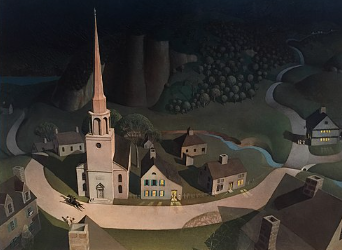
All this is leading up to the celebration of America's fight to be free two hundred fifty years ago. I've been surprised at the number of people who had to memorize it from top to bottom. I didn't go all out. I learned enough to count for credit and then stopped. Reading through it now, however, I wish I had continued. It graphically describes each stop along the way, the passion of the people, and the desperation in the countryside. A must read!! I'm posting the full poem at the bottom of this; no copyright since it was published well over a hundred years ago. Give it a read...and a memory test. You'll be glad you did.
Catch of the day,
Gretchen
Paul Revere's Ride
The Landlord's Tale
HenryWadsworth Longfellow
Listen,my children, and you shall hear
Ofthe midnight ride of Paul Revere,
Onthe eighteenth of April, in 'Seventy-five;
Hardlya man is now alive
Whoremembers that famous day and year.
Hesaid to his friend, "If the British march
Byland or sea from the town to-night,
Hanga lantern aloft in the belfry arch
Ofthe North Church tower as a signal light, --
One,if by land, and two, if by sea;
AndI on the opposite shore will be,
Readyto ride and spread the alarm
Throughevery Middlesex village and farm,
Forthe country folk to be up and to arm."
Thenhe said, "Good night!" and with muffled oar
Silentlyrowed to the Charlestown shore,
Justas the moon rose over the bay,
Whereswinging wide at her moorings lay
Thesomerset, British man-of-war;
Aphantom ship, with each mast and spar
Acrossthe moon like a prison bar,
Anda huge black hulk, that was magnified
Byits own reflection in the tide.
Meanwhile,his friend, through alley and street,
Wandersand watches with eager ears,
Tillin the silence around him he hears
Themuster of men at the barrack door,
Thesound of arms, and the tramp of feet,
Andthe measured tread of the grenadiers,
Marchingdown to their boats on the shore.
Thenhe climbed the tower of the Old North Church
Bythe wooden stairs, with stealthy tread,
Tothe belfry-chamber overhead,
Andstartled the pigeons from their perch
Onthe somber rafters, that round him made
Massesand moving shapes of shade, --
Bythe trembling ladder, steep and tall,
Tothe highest window in the wall,
Wherehe paused to listen and look down
Amoment on the roofs of the town,
Andthe moonlight flowing over all.
Beneath,in the churchyard, lay the dead,
Intheir night-encampment on the hill,
Wrappedin silence so deep and still
Thathe could hear, like a sentinel's tread,
Thewatchful night-wind, as it went
Creepingalong from tent to tent,
Andseeming to whisper, "All is well!"
Amoment only he feels the spell
Ofthe place and the hour, and the secret dread
Ofthe lonely belfry and the dead;
Forsuddenly all his thoughts are bent
On ashadowy something far away,
Wherethe river widens to meet the bay, --
Aline of black that bends and floats
Onthe rising tide, like a bridge of boats.
Meanwhile,impatient to mount and ride,
Bootedand spurred, with a heavy stride,
Onthe opposite shore walked Paul Revere.
Nowhe patted his horse's side,
Nowgazed at the landscape far and near,
Then,impetuous, stamped the earth,
Andturned and tightened his saddle-girth;
Butmostly he watched with eager search
Thebelfry-tower of the Old North Church,
Asit rose above the graves on the hill,
Lonelyand spectral and somber and still.
Andlo! As he looks, on the belfry's height
Aglimmer, and then a gleam of light!
Hesprings to the saddle, the bridle he turns,
Butlingers and gazes, till full on his sight
Asecond lamp in the belfry burns!
Ahurry of hoofs in a village street,
Ashape in the moonlight, a bulk in the dark,
Andbeneath, from the pebbles, in passing, a spark
Struckout by a steed flying fearless and fleet:
Thatwas all! And yet, through the gloom and the light,
Thefate of a nation was riding that night;
Andthe spark struck out by that steed, in his flight,
Kindledthe land into flame with its heat.
Hehas left the village and mounted the steep,
Andbeneath him, tranquil and broad and deep,
Isthe Mystic, meeting the ocean tides;
Andunder the alders, that skirt its edge,
Nowsoft on the sand, now loud on the ledge,
Isheard the tramp of his steed as he rides.
Itwas twelve by the village clock
Whenhe crossed the bridge into Medford town.
Heheard the crowing of the cock,
Andthe barking of the farmer's dog,
Andfelt the damp of the river fog,
Thatrises after the sun goes down.
Itwas one by the village clock
Whenhe galloped into Lexington.
Hesaw the gilded weathercock
Swimin the moonlight as he passed,
Andthe meeting-house windows, blank and bare,
Gazeat him with a spectral glare,
Asif they already stood aghast
Atthe bloody work they would look upon.
Itwas two by the village clock
Whenhe came to the bridge in Concord town.
Heheard the bleating of the flock,
Andthe twitter of birds among the trees,
Andfelt the breath of the morning breeze
Blowingover the meadows brown.
Andone was safe and asleep in his bed
Whoat the bridge would be first to fall,
Whothat day would be lying dead,
Piercedby a British musket-ball.
Youknow the rest. In the books you have read,
Howthe British Regulars fired and fled, --
Howthe farmers gave them ball for ball,
Frombehind each fence and farm-yard wall,
Chasingthe redcoats down the lane,
Thencrossing the fields to emerge again
Underthe trees at the turn of the road,
Andonly pausing to fire and load.
Sothrough the night rode Paul Revere;
Andso through the night went his cry of alarm
Toevery Middlesex village and farm, --
Acry of defiance and not of fear,
Avoice in the darkness, a knock at the door,
Anda word that shall echo forevermore!
Forborne on the night-wind of the Past,
Throughall our history, to the last,
Inthe hour of darkness and peril and need,
Thepeople will waken and listen to hear
Thehurrying hoof-beats of that steed
Andthe midnight message of Paul Revere.


