Middle Mayhem
Most novice writers give up when they get to the middle. They just don’t know what to do. It bores them with all the tedium of the journey. Nothing much happens.
Maybe. Or maybe not.
Like in the beginning, each chapter, each page, each paragraph has to lead the reader to the next.
Unlike the beginning, the middle isn’t in a straight path at all. It meanders and wanders into unpredicted places. Dangerous places. Wrong turns and character confusion abound.
The middle is where you lay out all the possibilities, and somewhere in a tiny note is the correct path to the truth.
There are beats within the middle too, that will help to prop it up. I’ve discussed these before here. Dead center of the middle is, you guessed it, the midpoint. This is a very important beat, It’s an Aha! moment. OR an Oh No! moment. Everything the character thought she knew turns on its head and she’s got to rethink and approach the problem from a different angle.
Halfway between the first turning point and the midpoint, however, is a pinch point. This is nothing more than a hint of what will happen in the midpoint. And I do mean only a hint. Something the reader might just gloss over and then when she hits the midpoint will say, “Wait. What? Didn’t I read that somewhere?” Better yet, the reader will think it was her idea.
There’s a second pinch point between the midpoint and the next turning point. It will give a hint of what’s coming up in that looming turning point.
Those are three major structural props to help you through the middle.
But wait! There’s more!
I’m talking about subplots. This is the place where they really come into play. The rule of thumb is you’ll have one subplot for every 20k words. So, an 80k word book will have 4 to 5 subplots. These can be anything. And they may or may not tie into the real plot.
We’re talking developing love interests, a mechanic who’s been harping at the character to fix the car which eventually breaks down, a nosy sister, fight lessons, etc… Like the main plot and the characters, these will also have rising and falling action and their own arcs (to be discussed in a future blog post).
So, the action of your novel middle might look like this:
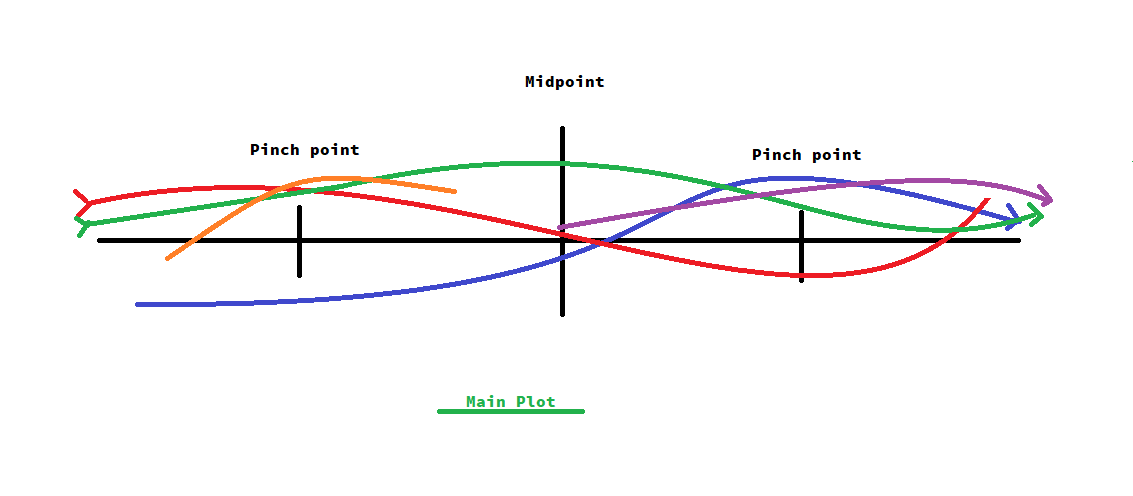
Here, the main plot is the green line. Note it peaks at the midpoint. The rising action is over the first pinch point where the main character apparently didn’t notice the hint we laid in there (just the way it’s supposed to be).
See how the subplots keep the action in your reader’s face?
In this example, of the four subplots, only one actually begins before the middle. It actually doesn’t matter where these begin and end. You can start them in chapter one, or end in the final chapter. Some are short, some are long. That doesn’t matter either, just mix them up so some are long and some are short. What matters most is the structural support they give your novel.
A final note about the middle. Be mean to your main character. Just as mean as you can. Make him hurt in every plot and subplot you have. Make him bleed. Make him want to quit. It’ll pay off in the end.