Source
(Published in the June 2025 edition of The Christian Century)
My phone vibrated in my pocket. I ignored it. I sat in Denver’s majestic Saint John’s Cathedral, savoring the worship, the sacred space. The caller could wait. For days, I had been at my wife’s side in the hospital. There it was again, the buzz in my pocket. Again, I ignored it. I realized it could be the hospital.
She was fine when I left her the night before. We were there for her chemotherapy treatment and TPN—Total Parenteral Nutrition—the milky white nutrients in a bag her body craved. She had become a thin, frail, near ghostly version of her usual vibrant self. But we had hope—it’s all we had during her six-year cancer journey.
I bolted from the Cathedral, found our car, and motored toward the hospital. My pocket vibrated yet again. This time, I took the call.
“I am sorry. This morning, your wife aspirated, sending harmful liquid into her lungs; she went into severe shock, her nurse initiated a rapid response, and she is now in intensive care, in critical condition. She is intubated. A ventilator is breathing for her, medicine is keeping her heart pumping.”
Her source of life was reduced to machines. I was stunned, suddenly facing the real possibility of losing my beloved wife of forty-four years.
“He is not far from any of us, for in him we live and move and have our being.” (Acts 17:27,28)
My wife loved and lived this verse, which speaks of who truly is our source of life. I cling to this verse now, like how my fingers dug into the steering wheel that morning drive back to her.
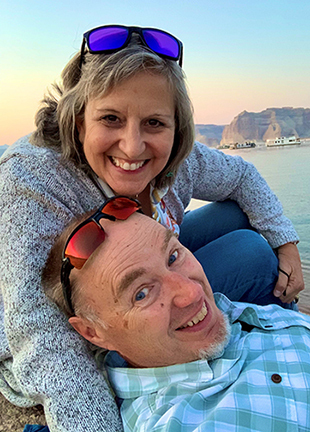
In a caring and compassionate marriage, something remarkable happens. Two individuals can become more like one, start to look alike, act alike, finish each other’s sentences. It’s beautiful. It’s creepy. More than the sum of their parts, they become sweeter, wiser, achieving things neither could on their own. We had that kind of union.
“We see you have a standing order for resuscitation,” said the voice on the phone. “Would you consider changing that to a DNR?”
“What?” I was jolted into a brutally different world, pulled into a dark, cold space where breathing was suddenly hard. I probed. “Why should I reconsider this? Tell me more.” My foot instinctively pressed into the accelerator pedal.
“At this point, her condition is precarious. Her body is so frail. Her outlook isn’t good. If her heart fails and we resuscitate her, she will most likely not be the person you know. We don’t advise it.”
At that, my heart felt like lead within my chest. I couldn’t believe my next words. “Okay. I’ll change her standing order to DNR (do not resuscitate).” That decision, made while navigating freeway traffic, my mind racing faster than the cars around me, was the hardest decision ever. In a few days, I would face an even harder one.
Arriving at her room, I initially hesitated at the doorway to ensure it was her on the receiving end of all the tubes. She’s been in ICU before, recovering from surgery, so I wasn’t completely unprepared. This felt different. This wasn’t planned. We weren’t supposed to be here, in this room. She was motionless, expressionless. Nurses and interns were busily adjusting machines. With eyes swelled with tears, I leaned into her and spoke.
“Honey, I’m here. I love you.”
Her head awkwardly lunged toward me a few inches; her face still expressionless. Her head landed back on her pillow. I was a bit startled but excited that she heard me, knew I was there, and responded. That would be her last obvious response. Her hands never answered my squeeze with one of her own. Her face showed no reaction as I lovingly spoke to her over the next four days. Her body fought valiantly, her vitals slowly creeping upward before worsening. On her fourth evening, her heart pumped for the last time; the flat line on the monitor mirrored my own sudden emptiness. Nurses entered the room within seconds, followed by the ventilator specialist. The specialist looked at me, awaiting my consent to turn off her breathing machine.
I waited a few seconds, maybe longer. It felt longer. I nodded in approval.
There it was—the most gut-wrenching decision I’ve ever made. It was the right decision, but that doesn’t take away the stench, the ache, the regret. The magnitude of that head nod was immense, adding to my pain. My precious wife was now unplugged from her life source. And so was I.
With our union severed, I’ve experienced something unexpected. I feel less than one. The math is weird. It’s like one plus one was more remarkable than two, yet this greater-than-two minus one has been reduced to less than one, less than me, a lost soul searching for life.
Every day is an opportunity to lean into my pain, my grief. Some days go well. On other days, I’m simply a big ball of weeping mess. That’s the nature of grief, I’m told. So, each day, I do what I must. I accept. I go slow. I listen for my life source, for words of love, ready to leap into a divine embrace.
—Samuel C Hughes