Disguised as Christ
Every art medium has its limitations, and that is part of what makes each one great in its own way. A film will not convey the same impact as a painting, or a photograph, or a sketch. In the same way, a narrative account will be different from a poem. And within each of these, there are further limitations: a rondeau is a poem, but it is not a haiku, or a limerick, or a villanelle, even though all these are poems as well. In art, everything is a choice, and that choice becomes part of the overall piece itself.
Such is the case with “Isaac and Jacob,” a 17th century painting by the Dutch Golden Age painter Abraham van Djick. Van Djick was one of the many talented painters who lived under the shadow of Rembrandt during a time when religious art was undergoing significant changes. The Protestant Reformation, especially in Calvinist regions, rejected the lavish, iconographic, and often didactic religious art typical of Catholic churches, viewing it as potentially idolatrous and distracting from Scripture and worship. This led to a shift toward simpler, more restrained church interiors and a move away from public religious imagery. Simultaneously, art found new life in secular and private spheres as the market moved from church commissions to private collectors.
Thanks for reading! Subscribe for free to receive new posts and support my work.
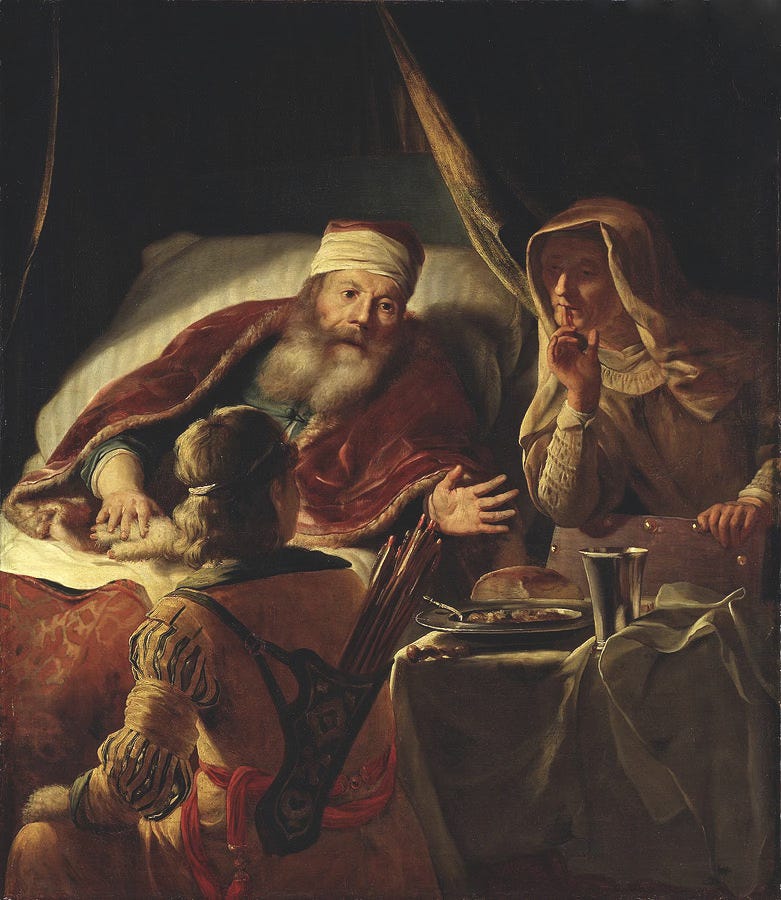
Van Djick’s painting displays this tonal shift well, both in how it emphasizes the humanity of the Biblical account and in its overall moral ambiguity. Van Djick was far from being the only painter of this era to depict this Biblical moment (in fact, Rembrandt himself produced a sketch of it), but van Djick’s painting stands out from the rest with one particular detail: Jacob’s face is hidden.
The Biblical account gives virtually no moral commentary or inner dialogue to unlock Jacob’s perspective in this moment. When we read the account, we only hear his lying responses to his blind but suspicious father’s questions. But when van Djick renders Jacob looking in the direction of his mother, we can understand why. The text indicates that Rebekah instigated the ruse, not Jacob. This doesn’t make Jacob guiltless, but it does reveal that he was listening to the words of his mother and looking to her for guidance. After all, she cooked the meal, she took Esau’s clothes and gave them to Jacob, she put the goatskin on his body, and most notably, she told Jacob when he questioned the idea, “Your curse be on me, my son. Just obey me and go get [the goats] for me (Gen. 27:13).”
All of this comes through in van Djick’s portrayal, which is a textbook display of artistic choice. A painting cannot move, neither in its application nor in its final display. Paintings are not meant to move, at least not in the way a film moves. So when we see Rebekah’s finger pressed over her lips to silence Jacob, hunching over the chair to make herself clear (even though she is literally in the shadows), we don’t have to guess at Jacob’s face or thoughts. It’s a masterful demonstration of visual subtext.
Biblically, we know from Genesis 25:22-23 that Rebekah received a word from the Lord that Esau would serve Jacob. Did she share this with anyone? Surely she shared it with Isaac, right? We can wonder. But we just don’t know. What we do know, however, is that her choice to deceive her husband stood in the family tradition of both deceit and human action in accomplishing divine promises. Both Abraham and Isaac lied about their wives being their sisters, and Sarah (Rebekah’s mother-in-law) told her husband to sleep with her servant girl in order to have the child God promised to give them. It’s a remarkably ugly picture for being the family chosen by God to bring a blessing to the entire world.
But one detail that always stands out to me in this moment—a detail that van Djick’s painting handles very subtly—is the detail of Rebekah putting Esau’s clothes and goatskin on Jacob. It’s clear when you look for it—the quiver of arrows on his back and the furry hand being touched by Isaac. It’s the clearest picture of the deceit—Jacob is literally wearing a disguise to hide the fact that he is a fraud.
The detail stands out to me because it makes me think of Galatians 3:27, which says that all who have been baptized into Christ have “put him on,” or to put it another way, they have been “clothed with Christ.” Every Christian has the freedom in Christ to approach the Father’s throne with boldness to receive the inheritance that belongs to Christ, and this is only possible because we have, like Jacob, put on someone else’s clothes. It is no wonder, then, that so many Christian people still feel like unworthy frauds. Satan’s attack is to say, “It’s a disguise. It’s goatskin. It’s stolen clothes.”
The difference, however, is that God had decreed for it to be this way. It is the very reason Christ came to earth—not just to forgive us and pay for our sins, but to become our righteousness (1 Cor. 1:30). Ephesians 1:6 speaks of the grace that has been lavished on us in the Beloved Son.
In his book Knowing God, J.I. Packer describes this Jacob/Christ comparison:
“We have been made ‘accepted in the Beloved.’ As Jacob was clothed in the garments of his elder brother, so we are clothed in the righteousness of Christ. As Isaac mistook Jacob for Esau, so God accepts us as sons, because He sees us in His Son.”
I like to imagine that van Djick’s choice to hide Jacob’s face has something to do with this interchange of identity. Jacob was not Esau, but God had already declared that Esau would serve Jacob. Isaac gave the blessing that belonged to Esau, but he gave it to Jacob. In the same way, when we look in the mirror, we likely do not see Christ. But God has declared that anyone who is in Christ is a new creation (2 Corinthians 5:17), and the blessing that belongs to Christ now reaches us. It’s not dress-up—it’s a transformation into his likeness, and his Spirit (whom Ephesians 1:14 calls the down-payment of our inheritance) is working to make it so.
It is like Gerard Manley Hopkins said: The just man “acts in God’s eye what in God's eye he is—Christ.”1
Thanks for reading! Subscribe for free to receive new posts and support my work.
1From “As Kingfishers Catch Fire”