A Lancashire Ghost Riot: The Up Holland Poltergeist
In the summer of 1904, the village of Up Holland in Lancashire was in the grip of a ghost fever. A destructive poltergeist hurled lumps of mortar, stones and weighty tomes around a haunted bed chamber, and adventurous local councillors, police and spiritualists tried to solve the mystery, as did thousands of drunken ghost hunters in the graveyard outside the house.
Mysterious flying masonry, ghost busting councillors, lascivious highwaymen, riotous revellers and Lancashire’s terrifying hell hound, the skriker… this is the story of the Unseen Agency in the haunted chamber: the Up Holland Ghost.
The House by the Cemetery
The haunted chamber in the haunted house overlooked the cemetery, which you might think rather gloomy. Beneath its window was the grave of highwayman George Lyon, executed in 1804. Just beyond the church yard can be seen the ruins of an ancient abbey.
On the other hand, the house had a pub on either side of it. The house by the cemetery was a place where spirits of the present world and spirits of the next were in close proximity. It was one of the oldest houses in the village of Up Holland, about 4 miles from Wigan in Lancashire.
Sometime in July 1904 the occupants of the house, widow Mrs Winstanley and her three sons and two daughters, began to be troubled by strange and violent phenomena. In the room overlooking the graveyard, stones and chunks of mortar from the wall would fly across the room. Sometimes strips of wallpaper would be torn from walls for no reason. A hatbox and a weighty volume on the history of England were all hurled around the room in the hours of darkness by what the newspapers enigmatically called the ‘unseen agency’.
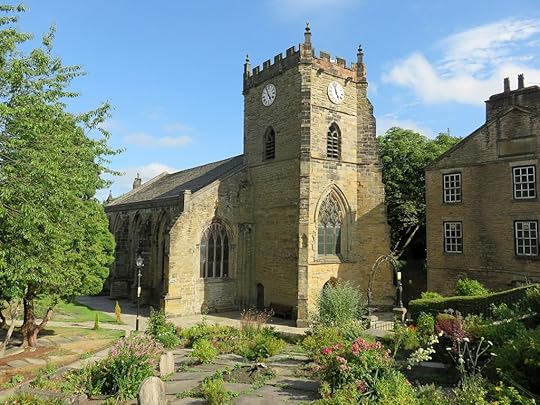 Church of St Thomas the Martyr Up Holland
In reporting on the Upholland Ghost, the press rarely passed up an opportunity to make fun of the Lancashire accents of the people they interviewed. One of the three Winstanley brothers (the eldest, who was 20 years old) was asked how he felt about the disturbances. ‘Aw wur freetened at fust,’ he told the journalist, ‘but aw’m geetin’ used to it.’[i]
The noise from the nocturnal crashing of mortar and stones could supposedly be heard from 60 yards away, and as word spread of the strange happenings, the villagers began to congregate every night in the graveyard hoping to witness some ghostly activity.[ii]
Ghostbusting Councillors
And if there’s something strange in your neighbourhood, who’re you going to call? Well, in this case, the council. Councillor Baxter, on hearing of the commotion, decided to put together a team of investigators made up of himself and two other local councillors, Mr Bibby and Mr Lonergan. The three of them spent several nights in the haunted chamber, where the Winstanley boys slept. It’s unclear from the accounts whether all three boys slept in the same room – or even in the same bed), but for several weeks they were joined after darkness by intrepid ghost-busting councillors, visiting spiritualists, journalists and the curious who were invited up to witness the unseen agency hurling masonry and other objects around the small room.
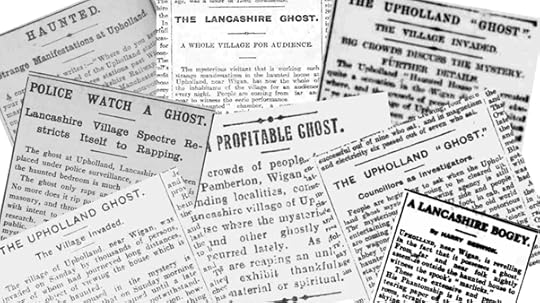 1904 headlines about the Up Holland Ghost
The mysterious missile hurling only occurred after dark, which may have aroused suspicion in some sceptics. The three brave councillors, however, knew better and were convinced the Winstanley lads could not possibly be perpetrating some kind of hoax.
This is how Baxter describes what happened as he and the other councillors clutched their flashlight in the silence and darkness of the haunted chamber:
“All at once there is a sound as of trickling water, and this is followed by the mysterious knocking, which seems to travel from one side of the room to the other round the walls. When the knocking has reached the window recess, the stones are pulled out and thrown on the floor…. There was something like a crack in the wall and then a piece of something was sent right across the room. This was followed by paper from the walls being thrown under the bed and bits of plaster being sprinkled up and down the room.” [iii]
On one occasion, one of the councillors was in another room in the house and was hit by a stone thrown from the haunted chamber. This was surprising as the stone would have needed to make a mid-air right angle turn before it bounced off his head. The councillor dashed into the room, clasped his hands in prayer and declared, ‘In the name of the Lord, speak!’[iv] The ghost remained dumb.
According to the Daily Mirror the ghostbusting councillors kept watch in the haunted chamber for eight nights and in that time didn’t see any evidence that the three lads who slept in the room were causing any of the mischief.[v] And these clever, important men could never have the wool pulled over their eyes by three lower class youths, could they?
Ghost Hunting Flashmobs
The ghostbusting councillors had to admit defeat. Having ruled out trickery, they were convinced something uncanny was occurring, but couldn’t get to the bottom of it. They did, though, keep some of the stones they had been pelted with as ghostly relics of their encounter with the unknown at the haunted house by the cemetery. One of the stones was even displayed at a local shop to satisfy the visitors who were descending on Up Holland as the story spread.
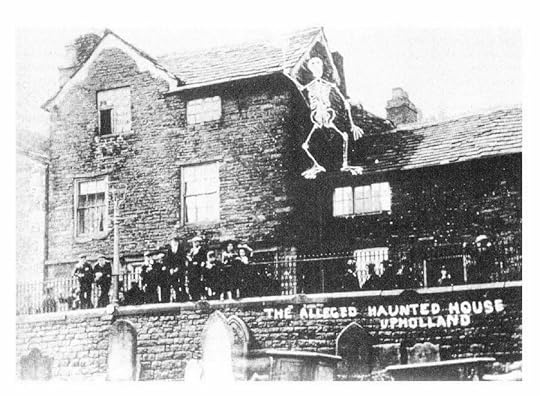 The Haunted House by the cemetery (Alan Miller)
Police Sergeant Ratcliffe also visited the Winstanleys and spent time in the haunted chamber and he concurred with the councillors: this ‘hubbub’ could not have been caused by human agency.[vi]
The house became a ‘Mecca’ for psychic investigators from far and wide, as the Manchester Evening News put it. Mediums and spiritualists visited the haunted chamber but could not lay the ghost.
But the most numerous of the ‘psychic investigators’ were those gathered below the window of the haunted chamber in the cemetery. They came in their hundreds from Wigan and other nearby towns, with entrepreneurial locals putting on waggonettes to carry the curious up to the village. The newspapers spoke of the village being ‘invaded’.
These unruly ‘ghost flashmobs’ as I call them were a strange feature of the late nineteenth and early twentieth century. Rumours of a haunting would attract huge crowds who would proceed to get drunk, make ghostly noises, prank and scare one another through the night in a riotous impromptu party-cum-ghost hunt. As happened in Up Holland, the police would often lose control as the crowds got larger night by night and more people turned up for spooky, inebriated and riotous fun in the dark. The fact that Up Holland’s haunted house had a pub on either side of it was most convenient, and the landlords were selling out of beer. One of these pubs, the White Lion, still operates in Up Holland.
By early August the crowds of drunken ghost hunters in the cemetery numbered over a thousand. Many, hoping to provoke some ghostly activity, threw their empty bottles at the house. In fact, the gathered throng were so rowdy that the spiritualists trying to make contact with the unseen agency complained that the crowds were noisier than the ghost.[vii] There was concern that the ‘roughs and larrikins’ that assembled and ran riot in the graveyard were doing more damage to the house than the obstreperous poltergeist.
Extra police were called in as around two thousand people filled the graveyard in August, drinking, shouting, sharing ghost stories, screaming and at times hurling their empties at the beleaguered house. The bobbies were said to be trembling as they tried desperately to get the unruly ghost hunting mob to move on.
On the evening of Monday 15 August, a gas lamp in the churchyard was lit by police order and this cast light into the haunted chamber. The pale beam of the gas lamp was enough to scare away the troublesome unseen agency, and the ghost went quiet. The crowds of ghosthunters, however, did not. They continued to gather in the hundreds and sometimes thousands in the graveyard for several weeks afterwards.[viii]
The King of the Robbers
There were several theories offered to explain the strange poltergeist activity in the house by the cemetery. Some suggested supernatural solutions to the mystery while others came up with naturalistic explanations of varying degrees of plausibility.
For those looking for a ghostly culprit for the flying masonry, the first obvious suspect was the spirit of ‘highwayman’ George Lyon whose grave was situated under the window of the haunted chamber. Lyon, the self-styled King of the Robbers, was not your dashing dandy highwayman of historical romance, being more of an inveterate thief, mugger and burglar. Besides, he didn’t have a horse.
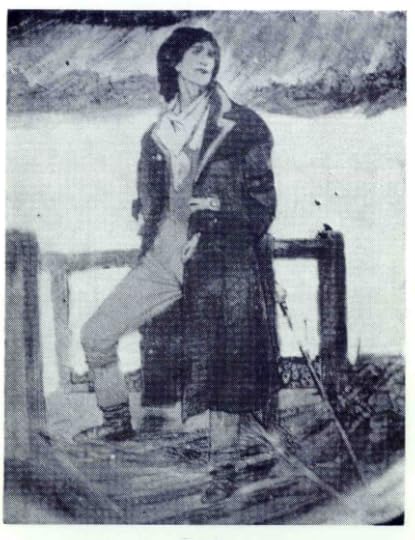 George Lyon – the Up Holland ghost?
Despite being transported to Africa for seven years for his crimes, when he returned to his home village of Up Holland he soon fell back into his criminal ways. He seems to have been an arrogant man, boasting that there was no rope that could fit his neck. He also had a way with the ladies. Two neighbouring houses in Up Holland were occupied by a mother and her daughter in each home. All four of them became pregnant around the same time. The father of all four babies was said to be George Lyon.
After a string of successful robberies with his gang of mates David Bennett and William Houghton, Lyon eventually fell victim to a sting operation. The Upholland village constable, tired of Lyon’s criminal antics, called in John McDonald, a famous ‘thief taker’ from Manchester. A thief-taker was what we might nowadays call a cross between a bounty hunter and a private detective.
McDonald disguised himself as a pedlar, and using his knowledge of criminal slang, became friendly with Lyon, who soon fell to boasting of his criminal exploits. McDonald offered to buy some silver Lyon had recently stolen and paid him in marked bank notes.
Lyon had fallen straight into the trap and was soon arrested, and along with his two partners in crime, hanged at Lancaster on 22 April 1815. The grim job of carting the dead criminals back to Up Holland for burial fell to the landlord of the Old Dog Inn, Simon Washington who later swore he would never do anything like that again, as he was convinced the Devil had followed him every step of the way home.
He was also followed by crowds numbering in the thousands who squeezed into the churchyard to watch his burial. His grave still stands opposite the White Lion, though the name of his daughter Nanny Lyon is all that is visible on the flat stone.[ix]
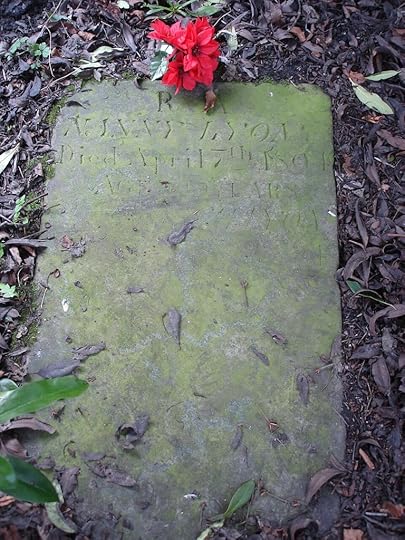 Grave of George (and daughter Nanny) Lyon
Given the proximity of Lyon’s tomb to the haunted chamber, and the romantic legends that inevitably became attached to the profligate thief, it’s understandable that some of the inhabitants of Up Holland were convinced that the ghostly goings on in the house by the cemetery were caused by the restless spirit of George Lyon, perhaps still guarding a stash of long forgotten treasure.
The Unseen Agency
Others suggested that the ‘unseen agency’ was none other than Mrs Winstanley’s late husband. The Daily Mirror reported that before his death, Mr Winstanley had threatened to come back as a ghost to prevent anyone else becoming the new head of the house.[x]
One of the ghostbusting local councillors offered a different explanation for the strange occurrences. ‘Aw burlieve as ‘ow it’s a judgement,’ he told the Clarion newspaper. It was a warning from God against the evils of gambling as one of the Winstanley lads had been betting his money on the horses.[xi]
As for non-supernatural explanations for the flying stones and crashing mortar in the haunted chamber, some suggested there was an army of rats behind the walls, though rodents are not known for their stone throwing prowess. Some wondered if there was an escaped lunatic hiding in the chimney, though searches revealed nothing.[xii]
An electric battery powered device hidden in the chimney and triggered remotely was another unlikely explanation offered. Some said perhaps there were forgotten underground passages beneath the house making the walls unstable, or that passing traction engines were causing the destruction. None of these rationalisations were very plausible.
Plastered
Of course, many suspected it was all a hoax on the part of the family, or at least of the boys. It certainly seems suspicious that the poltergeist activity stopped suddenly when the room was illuminated. Perhaps the boys had a stash of stones within reach under the bed to throw around the room after dark, and maybe they used a stick hidden in the bed clothes to knock stones off the wall from a distance.
In any case, it was noted that many shops were doing extremely good business selling provisions to the masses of ghost hunters turning up every day, and during evening hours the pubs were doing a roaring trade. In fact, some wondered if one of the pub landlords was in on the hoax as they were the ones who benefitted most from the influx of thirsty haunted house tourists. One landlord told the London Daily Chronicle that he hoped the ghost’s antics would continue until judgement day. The landlord of the other pub commented that he wished the ghost had a twin.[xiii]
Taking advantage of the lull in ghostly destruction, Mrs Winstanley employed a plasterer to fix up the crumbling walls of the ghostly chamber, but it wasn’t long before the spook got back to work, this time on another part of the wall. Crowds continued to come in the hundreds through September to see the haunted house.
Two men, Matthias Gaskell and Henry Heyes, found themselves in court charged with being drunk and disorderly on the night of Sunday 14 August. They had, apparently, refused police orders to move on during one of the busiest nights in the graveyard, though perhaps the pair were being made an example of, or were being made scapegoats for the police’s loss of control. Gaskell was found guilty and fined a shilling. Heyes pleaded not guilty and charges against him were eventually.[xiv]
Over the following weeks, the crowds melted away and the ghost ceased his antics. This is often how these episodes end. Nobody ever confessed to hoaxing the ghostly phenomena and the haunted house was finally demolished in 1934, taking whatever secrets it held with it.[xv]
The Skriker in Up Holland
At the time of the events of 1904, some of the older residents of Up Holland remembered similar scary episodes occurring in the very same house in the middle of the nineteenth century. On this occasion, the villagers had been terrified by a skriker, a phantom that usually takes the form of a fearsome black dog. The word skriker comes from the Lancashire dialect word for shriek or scream, and like the Irish banshee, to hear it is a sure sign of imminent death.
In 1904, Up Holland’s oldest resident, Richard Hollowell (84) told the story of the Up Holland skriker to a Wigan newspaper. When Richard was a young man, the village was disturbed every night by a ‘weird and blood-curdling din’ after the sun had set. The ‘unearthly moan’ seemed to be coming from the vicinity of the house by the cemetery, or rather one of the pubs, though it was just a private residence at this time.
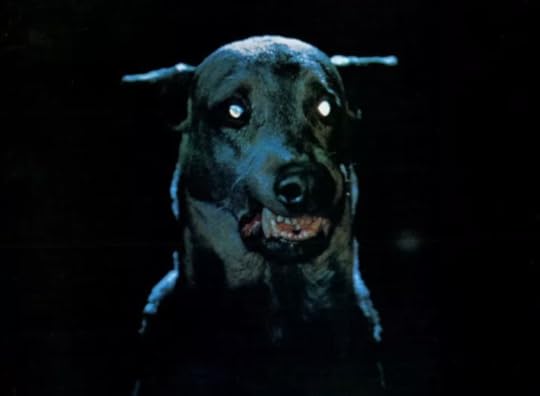 The Skriker probably looks a bit like Zoltan Hound of Dracula
Nobody knew what the skriker looked like, but it was enough to hear its ghostly cries echoing round the gravestones and the ruined priory. The deathly wailing terrified the locals who stayed off the streets after dark for fear that the skriker’s fearsome howl was meant for their ears.
One old lady, though, had had enough. She decided to confront the skriker – whatever it was – that had been disturbing village’s peace. She left her house after dark and followed the howling until she came to the houses overlooking the graveyard. As she looked up, in the starlight she saw the man who lived in one of the houses standing by the bedroom window with a curious looking horn pressed to his lips. The dismal din that the villagers took to be a portentous hellhound was actually a man blowing a horn.
The next day the old woman confronted the man and informed him that the game was up. ‘If you will go out of the country,’ she told him, ‘I shall say no more about it.’ The man did indeed leave the country and was never seen again.[xvi]
This, in any case, is how old Richard Hollowell remembered events. Of course, as an octogenarian, he’s earned the right to embellish his anecdote as everyone does, but the fact that other elderly residents of Up Holland mentioned something similar suggests that the core of his memory is true.
But it turns out that this small Lancashire village has yet more mischievous spirits up its sleeve…
Epilogue: The Spectral Funeral Procession
Winters were harsh in Up Holland in the early nineteenth century, and coal was expensive. Freezing to death was a real and all too familiar danger. But as well as this dismal prospect, there was also a new terror haunting the village: a ghostly funeral possession in which the bearers and the mourners were all dressed in white. Even the coffin they carried between the gravestones in the churchyard was white in colour. This was attested to many a person leaving the pub after dark, and this strange sight must have been uncanny indeed.
Eventually, some brave souls decided to investigate and hid near the churchyard as night fell. Sure enough, the ghostly funeral procession carrying the white coffin made its way slowly between the gravestones. Instead of running, though, the brave young men approached the figures in white who immediately dropped the coffin and ran for the hills. To their surprise, the white coffin did not contain a corpse on its journey to its final resting place. It was full of coal.
It turns out, so the newspaper reports inform us, that times were so hard that a gang of men had taken to stealing coal, but rather than risk carrying it through the street, they hit upon the ruse of pretending to be a ghostly funeral procession…[xvii]
I can’t help thinking that if you’re going to steal coal, dressing all in white is the last thing you’d want to do…
In any case, the small village of Up Holland in Lancashire has a fantastic tradition of ghost hoaxing that lasted for a century.
For more ghost hunts, ghost hoaxes and ghost panics, but with a festive theme, see my latest book Phantoms of Christmas Past.
Phantoms of Christmas Past
[i] ‘A Lancashire bogey’, Clarion, 26 August 1904, p.1
[ii] ‘The haunted house at Upholland’, Wigan Observer and Daily Advertiser, 20 August 1904, p.8
[iii] ‘The Upholland Ghost’, Norfolk News, 27 August 1904, p.6
[iv] ‘Haunted, strange manifestations at Upholland’, Manchester Evening News, 15 August 1904, p.7; ‘The haunted house at Upholland’, Wigan Observer and Daily Advertiser, 20 August 1904, p.8
[v] ‘Police watch a ghost’, Daily Mirror, 20 August 1904, p.4
[vi] ‘The Upholland Ghost’, Wigan Examiner, 17 August 1904, p.3
[vii] ‘The Upholland Ghost’, Wigan Examiner, 17 August 1904, p.3
[viii] ‘The haunted house at Upholland’, Wigan Observer and Daily Advertiser, 20 August 1904, p.8
[ix] Allan Miller (1964) ‘Geroge Lyon: Highwayman’, Historic Society of Lancashire & Cheshire Journal, vol.116 pp.235-241. Available at: https://www.hslc.org.uk/wp-content/uploads/2017/05/116-12-Miller.pdf
[x] ‘Police watch a ghost’, Daily Mirror, 20 August 1904, p.4
[xi] ‘A Lancashire bogey’, Clarion, 26 August 1904, p.1
[xii] ‘Haunted, strange manifestations at Upholland’, Manchester Evening News, 15 August 1904, p.7;
[xiii] ‘Ghost resumes work’, London Daily Chronicle, 29 July 1904, p.1
[xiv] ‘The Upholland Ghost’, Wigan Examiner, 27 August 1904, p.8; ‘The Upholland Ghost: a sequel’, Liverpool Daily Post, 10 September 1904, p.3
[xv] Andrew Miller, (2004) ‘The Ghosts of Upholland’, Past Forward, no 36 pp.6-8. Available at: file:///D:/Blog/Upholland%20ghost/mil...
[xvi] ‘The skriker in Upholland’, Wigan Observer and Daily Advertiser, 7 September 1904, p.5
[xvii] ‘The Ghosts of Upholland’, Dundee Courier, 23 March 1912, p.8