The Naked Truth about the Huastecs
There’s a sprawling region along Mexico’s northern Gulf Coast called La Huasteca, comprising parts of seven states – Tamaulipas, San Luis Potosí, Veracruz, Puebla, Hidalgo and small sections of Querétaro and Guanajuato. It’s a lush, beautiful area of tropical lowlands, with raging rivers, plunging waterfalls, and massive cave systems. Ecotourism has been growing in the region in the past few decades, with well-known destinations including El Sótano de las Golondrinas (The Cave of Swallows). It’s also the Indigenous homeland of the Téenek, often still referred to as the Huastecs.
The Téenek are in fact the only Mayan group not located on or near the Yucatán peninsula. As happened often in the history of this hemisphere, the Europeans would trundle around, meet an Indigenous group, ask for the names of the neighboring Indigenous groups, and place those names into their chronicles, ensuring their historical impact. Yet often such names given by other groups (exonyms) meant things like ‘barbarians’ or ‘idiots’ or ‘savages,’ in comparison to the groups’ true names in their own languages (endonyms) which often meant ‘the people.’ Such is the case with the term Huastec, which the Nahuatl-speaking Mexica (Aztecs) and other peoples of central Mexico gave to the Téenek… because in Nahuatl it means ‘naked’ (a fact I learned at the Museo Regional Huasteco). In their steamy jungle lowlands, the Téenek did indeed live nude or top-free more often than not, which contrasted with the central Mexican societies’ regimented dress codes and need for clothing in their cooler, elevated clime. Most people (even most Mexicans) don’t know the etymology of the term, so it’s amusing to refer to this vast region of the country as, essentially, The Naked Region, or The Region Where People Barely Wear Clothes.
Appropriately, one of the region’s most important artifacts is a nude statue known as “El Adolescente de Tamuín,” roughly the Teen from Tamuín (this post’s feature photo above: source). The limestone sculpture, now housed at the Museo Nacional de Antropología in Mexico City, includes inscriptions along the proud young man’s front and back referring to the life cycles of humans and of corn. Another famous instance of a nude Téenek man comes from Nahuatl oral history. There is a tale told of a Huastec ‘tohuenyo’ (outsider or foreigner) who appeared at a market in the highlands of Tula selling chilies while nude. The sight of his ‘chili’ enamored the local princess, who became consumed with desire for him, to the extent that her father the king arranged their marriage, etc., but it turned out the chili vendor was the trickster god Tezcatlipoca in disguise. Chilies have long been stand-ins for penises in Indigenous stories and jokes.
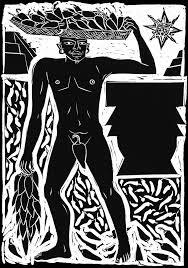 Illustration of El Tohuenyo by Joel Rendón and Alejandra Ríos Silva. Source.
Another interesting connection to nudity in the Huasteca region relates to one of the area’s attractions: the Edward James Sculpture Garden at Las Pozas, located near Xilitla. James was a British socialite and poet motivated by his love for orchids to buy land in the region in the late 1940s. After the landscape’s destruction due to a rare ice storm in 1962, he designed an oneiric “surrealist” garden, adding his whimsical architectural structures to the tropical abundance. It was often the local workers, speakers of Téenek and Nahuatl, who actually executed the reality of his vision, building the molds to shape the concrete following the general idea of what he would describe to them. According to a local guide who used to play with his childhood friends in the gardens before they became a park, James’ workers were required to sign a form stating that they would not be scandalized by his frequent lack of clothing. One wonders if any of the laborers decided to work clothesfree as well!


One of the structures in Las Pozas is a temazcal decorated as a turtle. The temazcal is a widespread kind of round Mesoamerican sweat lodge made of clay or stone, like a sauna, in which participants usually would have been nude. Temazcal events have become very popular among Mexican naturist groups over the past few decades.

It’s tempting to end this post by declaring La Huasteca to be an up-and-coming nudist travel destination… but, appropriate as that would be, it simply is not true (at least not yet). That said, if you’re interested in a nudist ecotourism adventure in La Huasteca, send me a message at nudescribe dot gmail dot com or on Twitter @ nudescribe, and I’ll be happy to make a recommendation. For more about nudity and nudism in Mexico, check out some of my previous posts such as my interview with Mexican naturist leader Héctor Martínez, a look at naturism and nude protest in Veracruz, and an analysis of the nude scene in Alfonso Cuarón’s film Roma.