Writing an Honest Biography or Autobiography
At the WWWA conference in Amarillo in 1983, famous western biographer J. Evetts Haley recalled reading Thirty-One Years on the Plains and in the Mountains when he was a boy. The author, Captain William F. Drannan, claimed to be an adopted son of Kit Carson. Stories of trapping beaver, hunting buffalo, and chasing wild horses all over the West immediately enthralled ten-year-old Haley.” Much later, as an adult, Haley discovered the book to be a “monumental fraud from the standpoint of history.”
Ten-time Spur Award winner Johnny T. Boggs had a similar experience. When he was young, his father read Quentin Reynolds’s Custer’s Last Stand to him. Boggs was convinced that the narrative was the “greatest book ever written.” If you ask him, he can tell you the ending of the book, close to verbatim: “Two bullets hit Autie at the same time … He reaches for his brother Tom. And they die as they had lived—together.” An older and wiser Johnny Boggs realized that war correspondent Quentin Reynolds unfortunately made up—in Boggs’s words—”a lot of crap.”
Yet, both Haley and Boggs later reflect that their earliest biography experiences were memorable—and life changing. Haley admitted that this one book shaped his youthful character, a true story that fascinated him with the “possibilities of the West.” As for Johnny Boggs, Custer’s Last Stand, flawed as it was, helped influence his journey as a successful journalist and fiction writer, one who researches history and setting to help create captivating books set within accurate context.
And there’s the rub. Not just nonfiction writers—biographers and other historians—but all western writers are inspired by true events and have a responsibility to write authentically when it comes to context. But there is another revelation regarding Haley’s and Boggs’s words. A desire for escapism is the real reason many folks read western books. An allure to reading biography and autobiography, especially, is about losing ourselves in someone else’s life. And we don’t want to discover later that the main character and his or her narrative are phony. The narratives must be, more than anything else, honest.
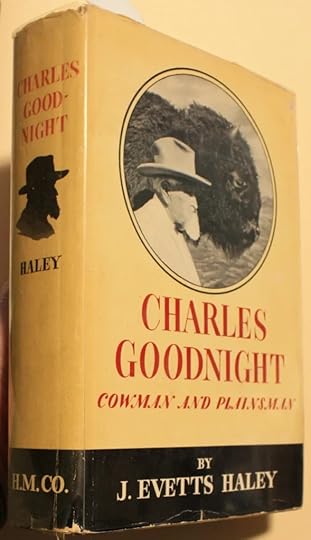
Those who love reading biographies often identify with the main character. I submit that the writers are often smitten with their subjects as well. As a biographer, an author may have an emotional connection, at some level, with whom he or she is going to research and write. During his Owen Wister Award recipient speech in 1983, Haley also told WWA members that he chose Charles Goodnight as a biographical subject because he made the “goodest” impression and moved him deeply. After meeting Goodnight— “that dominant western character, the greatest of America’s trail driver and the greatest of open range cowmen”—Haley described being left with an ambition to write the cattleman’s story, “‘a burning fire’ that sometimes you just have something to tell.” Obviously, Haley was taken with Charles Goodnight, and perhaps one could argue overly so, in his Charles Goodnight, Cowman and Plainsman(1936).
With that said, a biography (and autobiography) must be unbiased. Authors must present the subject—unvarnished—or the book may not be taken seriously. Well-known western historian and another Owen Wister award-winner, Robert Utley said in an interview:
I believe it especially important to bring that mindset to bear on people or institutions that have been buried in legend and romanticism and have spawned polarized public images. The challenge is to strip away the layers of error and myth to get as close as possible to the underlying reality. Rarely are people or institutions (composed of people) all good or all bad. Finding the balance between the poles is a historian’s (and biographer’s) duty. [Texas Monthly, November 2002]
When I wrote The Pink Dress, A Memoir of a Reluctant Beauty Queen, I had to step back and view myself as a character, a historical figure during America’s Counterculture. I had to strip away MY biases and present the story accurately, even if I didn’t like who I was at a moment in my life. I had no agenda but to tell a historic narrative (because I’m old)! Yet, bringing in people to my narrative, who had an impact on my life’s decisions, triggered emotional reflection. I couldn’t lie. This was me!
So, what should a biography do? How about enlighten and entertain? I would also add contribute. If writing about a famous person, biographers should research new evidence. They should present unusual or relatively unknown information—and document it. Look at all the Billy the Kid, George Custer, and Wyatt Earp books. In one quick survey, I counted thirteen books on Billy the Kid (including one by Robert Utley), seventeen books on George Custer, and a whopping twenty-three books on Wyatt Earp. Which biographies are tired repeats, and which books offer something new to the western reading audience?
If not the first biography about an individual, the author should write the narrative differently—provide a new twist with fresh, but accurate, information. On the other hand, if the subject is unknown, look for the value of the story and sell it to your audience. Otherwise, why should people read the biography? The point is, you wouldn’t be writing about a person unless that person had a relevant narrative. So, find the story!
To that purpose, how does one uncover a story? Sometimes it just pops up in the most unlikely place. During a visit to the Charles and Mary Ann Goodnight Ranch House Museum in the Texas Panhandle, I inquired if there were any books on Mary Ann Goodnight. The docent in charge quipped, “No one has written a biography on Molly Goodnight, and besides, there is only a smidgeon of information!” She squeezed her index finger and thumb together. When she added, “No one would want to read anything about Molly anyway,” the back of my neck prickled. I determined I would find the story. And, sure enough, there is a good one, and Mary Ann Goodnight’s biography, The Breath of a Bison, should be out late 2026 or spring 2027 from the University of Oklahoma Press.
Working the story often begins effortlessly, but don’t let easy-access resources fool you, the researcher. As an example, one can certainly find information in online frontier newspapers. But as western biographer Bill Markley told me recently, concerning conflicting newspaper reports in his research, you can’t believe everything you read in papers. I strongly suggest, don’t believe anything you read. Find a second or third source that supports newspaper information. Remember, papers were often corporately owned and politically controlled. Still, memberships to www.newspapers.com and www.genealogybank.com are worth the money. Chroniclingamerica.loc.gov is free as well as various regional sites, such as www.coloradovirtuallibrary.org.
Often states facilitate online research that can offer important contemporaneous observations. Keep in mind that during the Depression, federally employed interviewers canvassed pioneers across the country, collecting and transcribing oral histories, most all available online in various state archives. As examples, check out the University of Oklahoma Library’s online Indian-Pioneer papers and Wyoming State Archives’ oral history database with access to interviews. The online Portal to Texas History offers oral histories, documents, and newspapers.
Other useful online research may come from www.Ancestry.com (genealogy) and www.Fold3.com (military/war records). With Ancestry, accept information with skepticism. Still, a researcher can make connections to his or her subject’s descendants that may result in the discovery of significant family documents, old journals, photos, and passed-down stories. Because of connections like these, I was able to find a treasure trove of Goodnight letters that had been stashed in the eaves of an old barn. In addition to print resources, family anecdotes, flawed as they often are, almost always have a mustard seed of truth that can be researched. Be sure you do!
The biographer must also walk the story and taste it. Get out of your comfy office chair and travel the subject’s life narrative. I even walked the story for my autobiography, returning to El Paso multiple times. With Frank Little, I traveled his journey in ten states, investigating small libraries and historical societies along the way. I interviewed descendants of people who knew my uncle (the libraries knew who these folks were). I looked at the natural surroundings and tried to place photos of old structures where new ones had been built. I stood where Frank stepped into a knife fight on the hump of Tiger Hill in Drumright, Oklahoma, and later in the middle of Wyoming Street in Butte, Montana, where he was abducted and murdered. My walk took me six years, and only then did I begin to write. And this leads me to my last point about researching for a biography.
Biographers, who churn out books quickly, often fail in attaining comprehensive research. No matter if a biography takes six years or three years or two years to research and write, ultimately you, the writer, want to produce a biography that matters, that contributes. J. Evetts Haley said that “if you ‘pop off on radio’ (think podcast today) or ‘get caught on TV’, what you say is gone almost forever. But if you write it down and then have it printed,” then “whether you want to or not, it’s possibly for eternity because it is on the record, and you can’t call it back.” Keep that in mind.
What if you, the biographer, do not find the story you thought existed? Perhaps you predetermined a theme and selected research that supported your supposition, and these other pesky details keep interfering with your narrative thread? Rethink the process. Think of your research journey as an adventure in discovery. Well-known biographer David McCollough, in an interview piece regarding his writing John Adams, stated, “The more you know, the more you want to know…thinking is just as important as the research—think about what is not there.” Intellectual curiosity matters, and so does honesty. Take the time to research the entire story and document it.
In the 2002 interview, Utley states, “In evaluating the thought, decisions, and actions of people, I place great value on the test of plausibility: Given the evidence, is this likely to have happened?” Utley bails out the biographer. If you cannot prove an assertion to be correct or incorrect, there is a wonderful plethora of adverbs that can bail you out, words like possibly, perhaps, likely, and maybe. If you are down to two conflicting accounts, present them both. Let the reader come to his or her own conclusions. It would be dishonest to make that judgement for the reader.
If all else fails, do not force a story and do not be afraid to walk away.
In his John Adams interview, McCollough provides more thoughtful tips for the biographer. First, write to the ear and not just the eye. Use your computer’s “Read Aloud” function to listen to your text at intervals. Pay attention to syntax, word choice, etc. Your ear should catch errors.
Learn how to edit yourself. Southwestern biographer Leon Metz once asked his mentor C. L. “Doc” Sonnichsen, another biographer and University of Texas at El Paso professor, to review his work. “Leon,” Sonnichsen said, “You can say ‘done went’ and get away with it sometimes, but you can’t write ‘done went’ and ever expect people to read it.” Metz, a voracious reader as a boy, had performed miserably in language arts in school. He was a terrible speller and wrote as he spoke when he began his early career. Because of his editor and mentor, Metz learned to edit himself even as he became a better writer. In 1996, the WWA presented Metz a Spur Award for his biography on lawman John Selman, one of his many excellent biographies. Find a knowledgeable mentor.
Beginnings matter. Consider using a prologue that teases a main event in your subject’s life. Use chapter openings (factual, of course!) that make the reader want to read more.
Don’t tell me, show me. Every good writer should know this. Biographers need not write in linear, academic narratives. Consider your audience. Appealing nonfiction does not read like a textbook. Your writing also should have voice. Just because your writing is nonfiction does not mean you can’t incorporate imagery, flashbacks, and foreshadowing. It doesn’t hurt to go to a western fiction writing workshop where you can get ideas about how to make your manuscript more interesting, even structurally. And no, this is not creative nonfiction writing that I am describing—it’s effective writing.
With that said, McCollough reminds us to capture character with a minimum of strokes. Words do matter. Write with precision.
And finally, get up and dance; don’t tap your foot first. Like fiction writers, get the audience’s attention from the get-go. Dive into your subject with energy.
Above all, be honest. Leon Metz told an El Paso Times interviewer in 2010 that when he was a boy, he loved The Saga of Billy the Kid by Walter Noble Burns. It never occurred to him then that people would lie in print, but, Metz stated, “I found it out later, when I learned more about the story.” And he also remembered the lesson.
J. Evetts Haley stated, “There’s an obligation for the written and to the writer. When you put it in writing, it ought to be right.” That’s the first rule of good biography and other nonfiction.
Don’t settle for less.
The post Writing an Honest Biography or Autobiography appeared first on Jane Little Botkin.