Review #3 of 2025: The Mars Trilogy by Kim Stanley Robinson
It’s been a while since I blogged. Life has been in the way a little bit. Yet with the recent controversies about science funding at US universities. I want to bring up a series of books that I read as a teenager, and recently revisited this year: the Mars Trilogy by Kim Stanley Robinson (KSR), which I think tackles the question of the political role of the scientist with aplomb.
1. Red Mars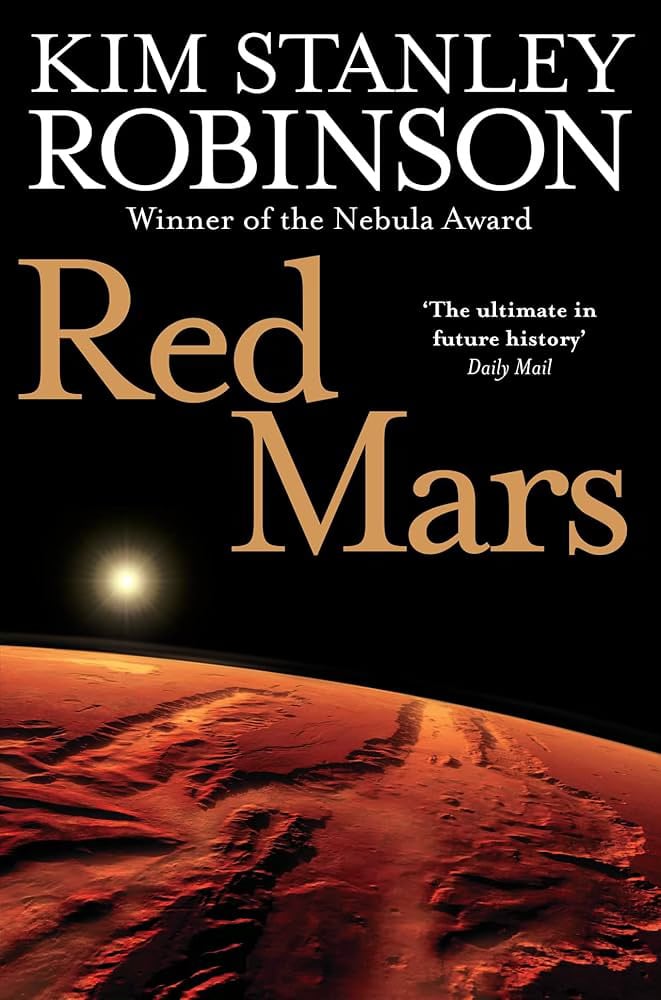
Out of all the books in my childhood, this looms the largest. This book is almost the entire reason for me wanting to go to MIT (become an astronaut so I could bring life to dead planet like Sax), and my interest in political philosophy (so I could figure out who was right between John, Arkady, and Frank). Just as KSR shows Mars here as a canvas that people use to paint their idealized image of society, society that will really truly be constructed by ideology, rather than history, I used this book as a template for my own life trajectory: a way of prescribing meaning to an otherwise empty scientific materialism by coopting some elements of ecoism (which I should have always known I liked, but anyway). I also recently discovered that one of my favorite board games, Terraforming Mars is heavily inspired by this book, which was also cool.
Deus Ex Vita is a reader-supported publication. To receive new posts and support my work, consider becoming a free or paid subscriber.
It's funny coming back to this and seeing what worked and what didn't. The science fiction elements are very obviously unbelievable. We can barely launch people into space these days, much less send millions of times more mass than we've ever sent to space far out of Earth's gravity well to Mars (I know that most of the delta G is from the surface to LEO but still). Aging won't be cured by simply repairing damaged DNA, and terraforming is likely to be a much slower process than as depicted in the book, if it's even physically possible at all.
The geopolitics is a little bit better. The overpopulation crisis on Earth that drives much of the plot is solving itself right now, but the hegemony of transnational corporations (a big element of the board game too) is happening before our eyes. Knowing a bit more about the other cultures (Arabs and Swiss mainly) depicted in this book also allowed their adaptions to the Red Planet to carry more weight for me.
And of course the personal is still fantastic. The love triangle between John, Frank, and Maya. The enigma of what Frank actually wants out of Mars (even though we get two POV sections from him). The solid dependency of Nadia, the fiery revolutionary fervor of Arkady, and the conflict between desire for death (Ann CLAYbourne) and life (Saxifrage Russell), all were much more interesting to me this time around. And how each of these characters reflects their own emotions on the landscape of Mars (which I know much better because of the game). And perhaps that this reflects my own philosophical shift too: away from materialism and towards something more interested in life itself.
2. Green Mars
If Red Mars was the book that made me want to be an astronaut, Green Mars is what made me want to become a biologist. There is just something so magical about turning a dead planet alive (not only through the introduction of plants, but also culture). Maybe what really will follow in the death-throes of rationality is a kind of Viriditas, or worshipping of life, that we see come to life in the :Greens” in this book.
In terms of plot, this book follows our protagonists from Red Mars (the first hundred) after they have fled underground following the failed revolution of 2061, as well as some of their children: the first natives of Mars. The plot spans the course of 60 years, and is all over the place. One part focuses on terraforming, another on a political conference to decide the fate of Mars, and still another on the quiet semi-retirement of one of the expedition leaders around the shore of the expanding Hellas Sea.
The characters were hit or miss for me. I really connected with Sax Russell, who is a scientist like myself. Sax is pretty autistically interested in science and the natural world, until a traumatic brain injury causes a radical shift in his personality and he grows interested in other humans. Nirgal, one of the native martians, and Art, a diplomat sent by one of the "good" transnational corporations I also liked reading about, but the female characters (Maya and Ann) were a huge miss for me. I found Maya to be a horrible, self-absorbed person, and found it hard to relate to Ann's obsession with maintaining Mars in a pristine, but dead state.
In terms of themes, a couple things stuck out to me. Firstly, science is political. This is very obvious in the novel, as the terraforming efforts are a scientific endeavor, but also a thorny political problem whose resolution very much depends on scientific feasibility. This is no less true in our world: the debates about global warming, pollution, veganism, etc. are all political as well as scientific questions. By refusing to engage on the level of the political, as if it is somehow “beneath” them (or worse, like we see below with many current academics, considering social issues "solved") scientists are shooting themselves and their interests in the foot.
Secondly, Robinson wants to highlight the effect that geography has on culture. We get extremely long (and often boring) descriptions of Martian geography to help us place the adaptions that various immigrant cultures are making as they come to Mars. No culture is unchanged, and this is at least partially because of the unique geographical (and other physical) quirks of the planet.
Finally, as some of our characters enter their ~15th decade, Green Mars brings into question the continuity of our identity and its dependence on memory. Are we still the same person that we were 20, 30, 100 years ago? At what point do memories become indistinguishable from facts we could have read in a textbook?
3. Blue Mars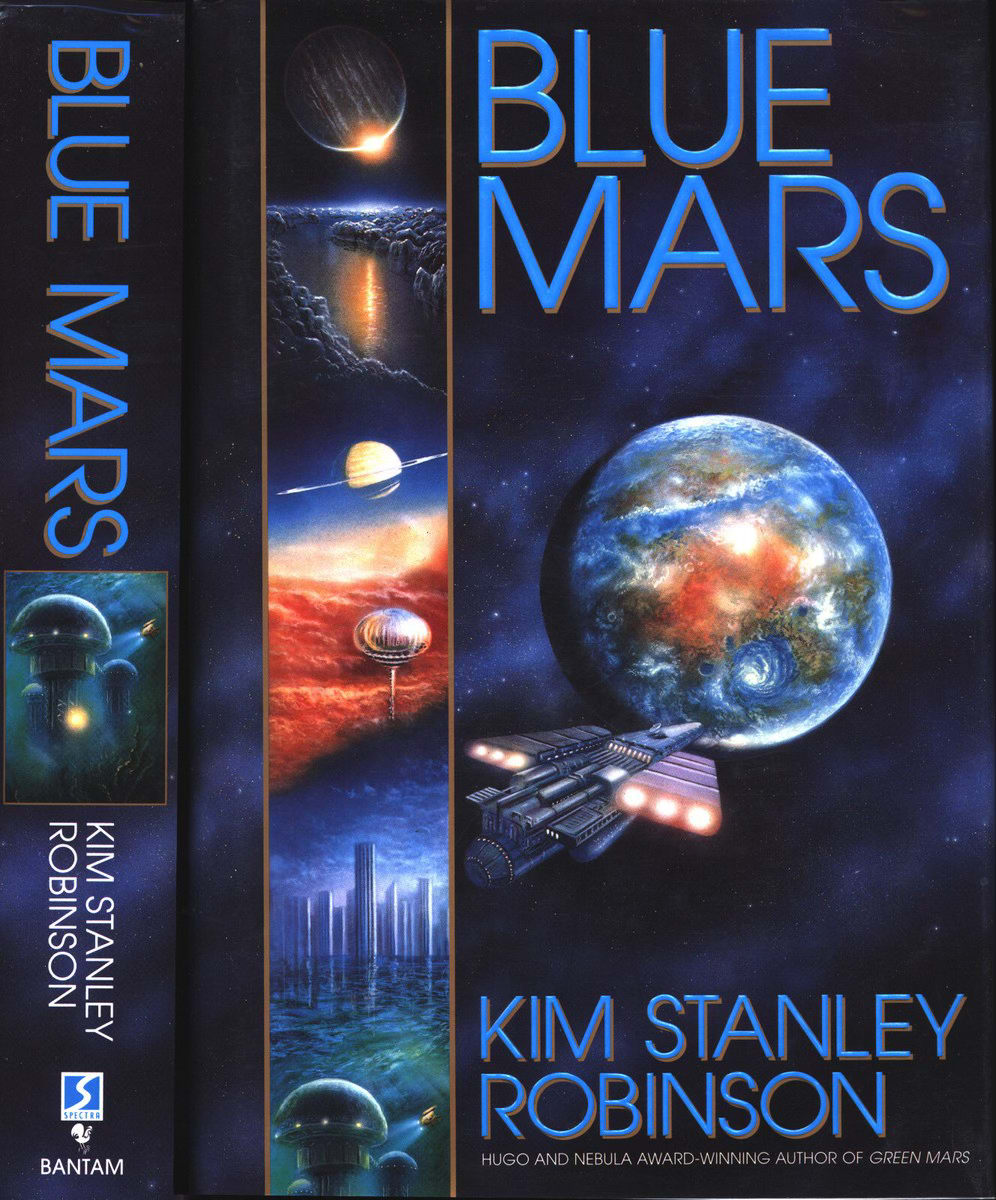
This was my favorite book growing up as a kid, but I found this entry on re-read in the series to be hopelessly fragmented and meandering in its focus. Much of the plot of the book is concerned with the formation of a new government for Mars (a vaguely socialist federation with strict limits on immigration from earth). There's some exploration of colonization of the outer solar system, but it is also hopelessly myopic and bohemian: there's no true political or cultural diversity in any of the colonies that are visited. On a personal level, very few of the first hundred have survived, and the ones that have have basically completed their character arcs. There's some interesting stuff with dealing with memory but other than that I found this book rather forgettable on a character level.
ConclusionsSo why does a series of books written about space colonization in the 90s still matter? We live in a society that is, for better or worse, driven in large part by scientific progress and research. Many of the big questions of our time: climate change, artificial intelligence, the obesity crisis, the fertility crisis, etc. are not only political, but also scientific questions. To ignore the input of scientists on these issues, like many want to do, seems incredibly myopic. At the same time, the training that we get as scientists (or at least the training that I have received) does not create people who are really able to participate in the political process. Gell-Mann amnesia is very real in academia: not just about the hot-button topics like race and gender, but also made-up shit like "learning styles", the efficiency of renewable energy, and a general understanding of politics and human psychology. Combine this with a massive ego because of success in one specific area, and you have the idiot savants that Nassim Taleb likes to harp on who cannot make political compromises or think outside the box. What Robinson is highlighting with his trilogy about colonizing Mars, perhaps the ultimate scientific endeavor, is that unless this changes, the science is not going to get done properly in the real world.
As Miguel Unamuno once said, perhaps apocryphally, vencer no es convencer (to defeat is not to convince). The strain of liberal (and perhaps now woke) thought that currently dominates universities is not going to be able to beat the world into submission to its ideas, it has to learn how to participate in the political process and convince people (and perhaps be convinced in turn).
For me on a personal level this series of books has helped to clarify what a future spiritual belief system might look like for me and the world. I’ve always struggled with the anthropocentrism of Christianity: perhaps something like Viriditas combined with Nietzchian vitalism could expand on the weak points I see in the Christian system.
Deus Ex Vita is a reader-supported publication. To receive new posts and support my work, consider becoming a free or paid subscriber.
I blog about language learning, biology, the science and art of learning, and many other things. If you feel inclined, please subscribe or consider buying me a coffee.
Josh