The A.I.-Resistant Classroom, Part I: Nothing New Under the Sun
Entering my twenty-first year of teaching, I consider myself something of an “old-timer.” My former students have become my colleagues, I have the mandatory beginning-of-the-year videos memorized, and whenever the PD presenter touts a “fresh, new idea,” I can remember when the exact same idea was rolled out—just with a different name.
There’s a verse in the Bible that says, “What has been will be again. What has been done will be done again. There is nothing new under the sun” (Ecclesiastes 1:9), and that is so true. Educational trends come and go. But you have to be a bit of an old-timer—like me—to realize it.
Let me give you the most recent example: This year, my home state enacted a law where cell phones will be banned from the beginning of the school day to the end. I applaud this. For years, I have seen the effect of cell phones in the classroom, and wishy-washy school policies coupled with weak enforcement has made them omnipresent in most classrooms.
I love my students, and they are capable of so much. But I am also a realist. If I put a digital distraction device in front of them that can instantly hook up to all of their friends, family, and interests, what hope do I have of ever capturing their attention? Furthermore, with their computing capabilities, smartphones provided an easy way to cheat.
Yet fifteen years ago when some teachers voiced legitimate concerns about this new technology’s impact in the classroom, the educational community at large roared us down. “Just let students use it as a tool! Incorporate it into your lessons! You can’t fight it!”
In fact, any teacher who was insistent on banning cell phones (like me) seemed like a “fogie,” and the “cool, progressive” approach was to “incorporate cell phones into lessons.” Someone even once had the temerity to suggest the way to overcome the distraction was to “make lessons more engaging than what’s on the students’ phone.”
Side note: I’ve noticed two pronounced flaws in the educational community:
A) We feel like we have to be innovative (to a fault), and we often throw-out time-tested strategies in favor of the latest fad.
B) We love a bandwagon, and anyone not on that bandwagon is just outdated, obsolete, and an old grump.
Now fifteen years later, adults have realized the extremely harmful effect cell phones have had on teenagers—and not just their education, but also on their personal relationships and their mental health. (Read The Anxious Generation by Jonathan Haidt if you don’t believe me.) Suddenly the bandwagon has shifted—almost overnight. “Cell phones are awful! Ban them at once! Save the children!”
But I must ask: Where was this reaction fifteen years ago?
I am beyond thrilled that the educational world is taking a stand against cell phones in the classroom, but I am also seeing that we have not learned our lesson. The same old story is repeating itself.
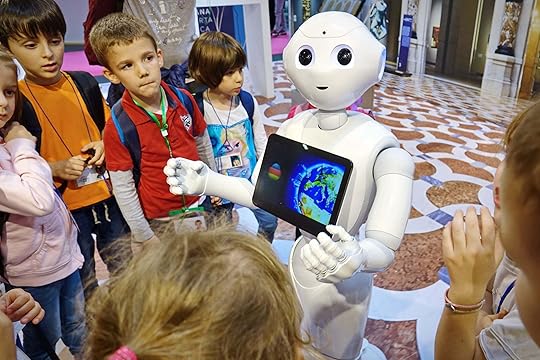
Flash forward to modern day. A.I. has arrived on the scene. This is not a digital distraction per se—it’s worse. It is a tool that can do students’ work for them. It provides prefabricated opinions, often backed by dubious (or in some cases, imaginary) sources. It contains bias and factual errors. But the biggest complaint I have against it: A.I. can do students’ reading, writing—and, therefore, their thinking—for them. And many of them are happy to outsource these processes that are vital to education.
Teachers have legitimate concerns about A.I. presence in the classroom. Yet what is the message being shouted from the rooftops? “Just let students use it as a tool! Incorporate it into your lessons! You can’t fight it!” Where have I heard this before? The same cycle is beginning again.
As teachers, we must avoid the trap of being trendy.
We must avoid the trap of embracing technology simply for technology’s sake.
We must thoughtfully consider what impact any technology will have on our students—and frankly, ourselves.
If students are using A.I. to write papers and teachers are using A.I. to grade them, at what point does education become meaningless? If writing becomes simply typing a good prompt into a chatbot, what is the point of self-expression? At what point does the ability to think for oneself become obsolete?
It’s time for us to rethink education—and its purpose.
This is why I am building an A.I.-resistant classroom. I’ve been told that it’s impossible to completely “A.I.-proof” my classroom, but I accept the challenge to resist it as much as possible. I want my students to use their own thoughts, write their own words, make their own mistakes, and become better human beings in the process.
Just like my thoughts on cell phones fifteen years ago, my stance on A.I. is not the popular opinion, and I expect there will be backlash. But in every instance, I must do what I believe is best for students.
If you want to join me on this journey, I welcome you! If not, I also welcome your input. I will be sharing some practical strategies (and free resources) I use in my own classroom.
If you disagree with my approach, I welcome your input as well. We can compare notes throughout the process. Feel free to comment on this post here on our website or on our Facebook page: https://www.facebook.com/profile.php?...
In my next blog post, I am going to explore some of the specific reasons I am building an A.I.-resistant classroom.
In the meantime, I encourage you to read this important article about the impact A.I. has already had on reading: https://www.civilbeat.org/2025/08/ai-can-make-reading-books-feel-obsolete-and-students-have-a-lot-to-lose/
Matt Miller, educational A.I. enthusiast, has also issued a warning about Google Classroom’s A.I. integration: https://www.linkedin.com/posts/ditchthattextbook_google-for-edu-definitely-made-a-splash-at-activity-7348742471767506944-AwQD/
I look forward to this continued conversation!
Stay creative,
Zachary