The begging bowl
During his wandering days, Atmananda encountered another avadhoota. People called him Pagal Baba (mad Baba). Nobody knew his actual name.
He was living in the suburb of a city near a flour and oil mill. This belonged to the rich man of the town. The rich man or his people never bothered Baba nor helped him in any way. They just let him be. Baba had a small dilapidated hut as his abode. He remained there through the harsh seasons and times. Baba was living outside the mill in the hut for many years before Atmananda met him..
By the way, the mill staff members who were responsible for disposing of the mill waste always gave him a bit of the waste materials free of cost. He never wanted a lot, though.
He used to collect a small portion of the ground waste products from the mill and used to make dolls and some bowls. (Usually, the waste products are used as fodder for animals.) He makes these products using waste products, some water drawn from the neighbourhood water well, some plant colours and adhesives, mixing well with the waste products and drying them in the sun.
When he had sufficient materials to sell, he would take them to the Friday village market, which seldom happened and usually happened once or twice a month.
Rugged, torn clothes, rugged, partially matted, untrimmed hair, as well as a beard, were his appearance. He didn’t have many teeth. He always smiled and chanted some illegible words as if to himself. He used to go to the village market and display his products. He hardly spoke and always communicated figures with his fingers. Even though he had kept a specific price for each, he sometimes gave them for free to the curious village children who obviously couldn’t afford them.
He also could never survive bargaining with customers. So, if someone started bargaining, he would always agree with their chosen price, even if it was often too unreasonable, as well as too low for his effort. Due to his lack of smartness, he couldn’t earn much from his ‘business’. The other merchants never liked him because he also pulled their prices down, and people flocked to him as if it were a discount sale store. They tried talking to him not to reduce prices and to stick to the prices prevailing in the market. He could do none of these. Despite the anger of his fellow traders, he still continued his chores quite unaffected and oblivious to his surroundings.
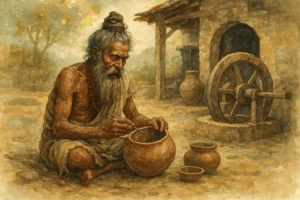
While Atmananda was walking through the village, he and his companions chanced upon this Baba, who was sitting, drying his products in the midday summer sun. There was no shade. And it was scorchingly hot on the midsummer day. They saw this strange man sitting under the red, hot sun as if he were sitting on a park bench in cool weather.
Atmananda approached him. Usually, he didn’t have any visitors except for some stray animals or children playing in the fields who came to fetch a ball that had strayed. When the shadow of Atmananda fell on him, he looked up. Seeing the monk, with a smile of familiarity and recognition (they had never met in this life before, though), without asking or speaking, he took out a bowl that he had been drying and was ready to use for Atmananda, and said, “Atma pranaam.”
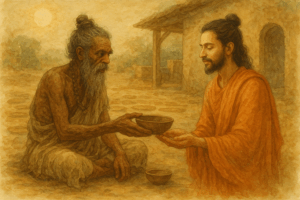
Atmananda smiled, received the bowl with both hands, and said, “Oh, brahman, thank you for your darsan.” Hearing that, he got up. Atmananda continued, “I know that I came to receive this celestial bowl, which was waiting for me. It is now accomplished. I never begged for food. I ate only the food that came to me with respect and reverence. Receiving this bowl would be my turning point. Begging would kill my remaining ego. I shall marry silence henceforth. The rest of my journey will happen as designed, in utmost silence.” Hearing this, Pagal Baba drew Atmananda close to him and gestured to him to walk with him. They moved to the shade of a tree and spoke. It went on for less than 30 minutes.
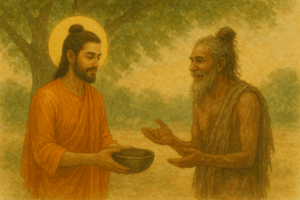
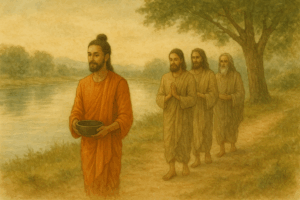
Soon, they parted. Atmananda bowed down briefly to Pagal Baba and walked towards his fellow travellers. When he reached them, he showed them the begging bowl that Pagal Baba had gifted. He said, “See this, supreme consciousness itself hiding in the cloak of a mad monk and making pots for the people who never knew or cared, to remind them that they are just perishable pots after all, and by the time they build up a life, death takes them away.”
People do not understand him, nor does he expect them to. He is soaked in bliss. He is bliss. He is ‘Mast’ or drunk with god. He doesn’t have to do anything as he has nothing to achieve or attain. He doesn’t eat or sleep. All the meagre earnings he gets from selling his products, he uses to feed stray animals or buy sweets for children. He hardly eats or drinks. If someone offered him food, out of love for them, he might consume a bit. Even though he never bathed or washed his clothes unless the seasonal rains did those chores, there is a celestial fragrance around him, which the gross world hardly notices.
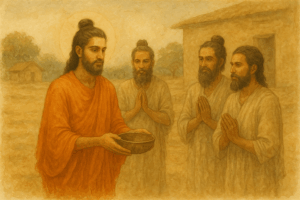
Today, he gave me a begging bowl. I came this way to receive it. He took nothing from me for it. And he said, “Dissolve. Dissolve. Dissolve” to me three times. These words were to prepare me for the next phase in my existence. Each time he commanded “Dissolve”, I sank deeper and deeper into the inherent truth, which silence represents. I became silent, and you will feel that around me.
Henceforth, his presence dissolved whatever was left in me as my identity. His actions were just a confirmation. He has nothing to do with the products that he made. He has nothing to do with anything. We are all blessed to have witnessed him. Villagers do not understand him. They bargain with Him. He allows such ignorance and is the least affected. He is Shiva. The ultimate brahman.”
When the fellow travellers asked Atmananda to tell more about the conversation he had with the Baba, he said, “Well, not all of them are important to you, but it is important for me as I am entering the next phase of my life. When I told him that the villagers should know who the Baba is, he said, “No need. If they do, they won’t leave me to be myself. I am fine with my anonymity. I was not born to be worshipped. He might as well disappear any time, too, if his job with this body is done. Perhaps he was waiting to tell me what he told me today, to transition me to another phase of my life.”
One villager told one of the team members of Atmananda that the authorities had asked him to leave the temporary shelter he had made on a raw land next to the mill. He apparently spoke that day and told the people from the government, “How do you own this land? It’s only the Lord, my Father, that owns everything. Nobody else owns anything in this world, let alone in their lives.” When we heard that, we felt that they should know that the one who is amongst them is verily Shiva himself. He obviously objected to it when Atmananda suggested that.
Atmananda continued. He also told me, “You are unlike me. You will be recognised for your calibre. You have to wander. You have to silence chaos. You will be known, perhaps even after many generations. I won’t be. You will ‘live’ with relevance and silence. I won’t be.” All were in awe. All their minds were filled with the presence of this unassuming avadhoota. They stopped at the nearby river for replenishment and continued their journey.
Some thoughts not related to this story…
Everything has a reason, relevance and time. Nothing happens a day before or after. Waiting for the right time is the wrong thing. The right time doesn’t come. We have to make our time right, every time, by being available at all times and in all situations without resistance to the flowing and changing times.The passive is dangerous. Those who watch evil and injustice and turn the other way, the indifferent and the ignorant, are the real danger of the world. Those who commit evil and deliver intolerance, as well as those who turn a blind eye, are all evil alike.