
Smooth numbers and max-entropy
Given a threshold  , a
, a  -smooth number (or -friable number) is a natural number
  whose prime factors are all at most . We use
  to denote the number of -smooth numbers up to
  . In studying the asymptotic behavior of , it is customary to write as
  (or as
  ) for some
  . For small values of
  , the behavior is straightforward: for instance if
  , then all numbers up to are automatically -smooth, so

 , the only numbers up to that are not -smooth are the multiples of primes
  between and , so



 , there is an additional correction coming from multiples of two primes between and ; a straightforward inclusion-exclusion argument (which we omit here) eventually gives

More generally, for any fixed , de Bruijn showed that

 is the Dickman function. This function is a piecewise smooth, decreasing function of , defined by the delay differential equation

 for
for  .
. The asymptotic behavior of as  is rather complicated. Very roughly speaking, it has inverse factorial behavior; there is a general upper bound
  , and a crude asymptotic

 is the Euler-Mascheroni constant and
  is defined implicitly by the equation One cannot write in closed form using elementary functions, but one can express it in terms of the Lambert
  function as
  . This is not a particularly enlightening expression, though. A more productive approach is to work with approximations. It is not hard to get the initial approximation
  for large , which can then be re-inserted back into (3) to obtain the more accurate approximation


 to
to
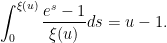
This asymptotic (2) is quite complicated, and so one does not expect there to be any simple argument that could recover it without extensive computation. However, it turns out that one can use a “maximum entropy” to get a reasonably good heuristic approximation to (2), that at least reveals the role of the mysterious function . The purpose of this blog post is to give this heuristic.
Viewing  , the task is to try to count the number of -smooth numbers of magnitude . We will propose a probabilistic model to generate -smooth numbers as follows: for each prime
  , select the prime with an independent probability
  for some coefficient
  , and then multiply all the selected primes together. This will clearly generate a random -smooth number , and by the law of large numbers, the (log-)magnitude of this number should be approximately (where we will be vague about what “
 ” means here), so to obtain a number of magnitude about , we should impose the constraint
The indicator  of the event that divides this number is a Bernoulli random variable with mean , so the Shannon entropy of this random variable is

is not too large, then Taylor expansion gives the approximation

is
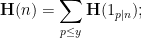

that are typically generated by this random process should be approximately

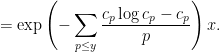
are chosen to maximize the right-hand side subject to the constraint (5).One could solve this constrained optimization problem directly using Lagrange multipliers, but we simplify things a bit by passing to a continuous limit. We take a continuous ansatz  , where
 ![{f: [0,1] \rightarrow {\bf R}}](https://i.gr-assets.com/images/S/compressed.photo.goodreads.com/hostedimages/1758024784i/37228729.png) is a smooth function. Using Mertens’ theorem, the constraint (5) then heuristically becomes and the expression (6) simplifies to So the entropy maximization problem has now been reduced to the problem of minimizing the functional
is a smooth function. Using Mertens’ theorem, the constraint (5) then heuristically becomes and the expression (6) simplifies to So the entropy maximization problem has now been reduced to the problem of minimizing the functional  subject to the constraint (7). The astute reader may notice that the integral in (8) might diverge at
  , but we shall ignore this technicality for the sake of the heuristic arguments.
This is a standard calculus of variations problem. The Euler-Lagrange equation for this problem can be easily worked out to be

 ; in other words, the optimal
  should have an exponential form
  . The constraint (7) then becomes

is precisely the mysterious quantity appearing in (2)! The formula (8) can now be evaluated as



 is the divergent constant

 is unrealistic when trying to confine to a single scale ; this comes down ultimately to the subtle differences between the Poisson and Poisson-Dirichlet processes, as discussed in this previous blog post, and is also responsible for the otherwise mysterious
  factor in Mertens’ third theorem; it also morally explains the presence of the same factor in (2). A related issue is that the law of large numbers (4) is not exact, but admits gaussian fluctuations as per the central limit theorem; morally, this is the main cause of the
  prefactor in (2).
Nevertheless, this demonstrates that the maximum entropy method can achieve a reasonably good heuristic understanding of smooth numbers. In fact we also gain some insight into the “anatomy of integers” of such numbers: the above analysis suggests that a typical -smooth number will be divisible by a given prime  with probability about
  . Thus, for
  , the probability of being divisible by is elevated by a factor of about
  over the baseline probability
  of an arbitrary (non-smooth) number being divisible by ; so (by Mertens’ theorem) a typical -smooth number is actually largely comprised of something like
  prime factors all of size about
  , with the smaller primes contributing a lower order factor. This is in marked contrast with the anatomy of a typical (non-smooth) number , which typically has
  prime factors in each hyperdyadic scale
 ![{[\exp\exp(k), \exp\exp(k+1)]}](https://i.gr-assets.com/images/S/compressed.photo.goodreads.com/hostedimages/1758024785i/37228748.png) in
in ![{[1,n]}](https://i.gr-assets.com/images/S/compressed.photo.goodreads.com/hostedimages/1758024785i/37228749.png) , as per Mertens’ theorem.
, as per Mertens’ theorem.


Terence Tao's Blog

- Terence Tao's profile
- 230 followers

