How can we repair cracks in our relationships?
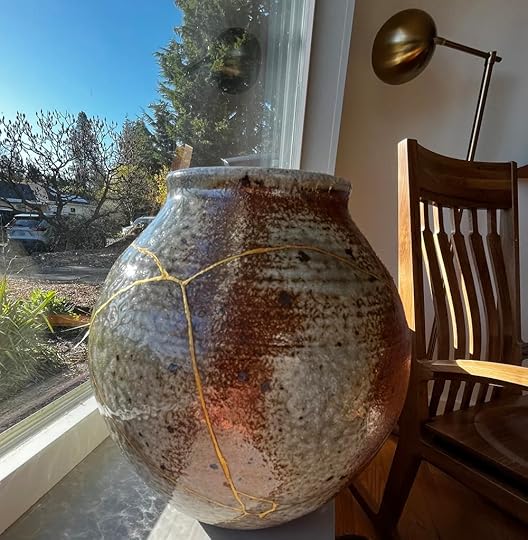
Src: daughter’s kintsugi vase
“Do all your sisters have lines?” My 4-year-old granddaughter asks me as she strokes my cheek on the deck where I am drinking coffee. We’re sharing the last of thumbprint cookies with Marionberry jam my eldest daughter gave my husband for his birthday.
I tilt my head. “Lines?” I smile. “You mean wrinkles?”
My granddaughter pats my other cheek. She nods her head yes, looking at me with those saucer-sized, blue eyes. She’s here for the weekend with lots of family and friends, visiting for the wedding celebration for our youngest daughter.
“Yes,” I said. Thinking of all my Line Sisters, with our wisdom, wrinkle-cracks around the eyes representing life experiences. Some satisfying. Some painful. All earned.
What are cracks in a relationship? And how can we honor the inevitable rifts and explore ways to repair them using the Japanese Kintsugi or golden repair approach?
what are cracks in a relationship?trailer with Céline Santini
We all have relationships that feel unrepairable at times. We grew up with the expression “time heals all wounds.” The expectation was that overtime, you'd forgive and forget. That's not really how it works. Sometimes you forgive. Sometimes you can't. And you don't always forget.
There’s a quote from a book I read recently, The Ministry of Time, a sci-fi romance by Kaliane Bradley, that even my optimist self knows to be true. “You can’t trauma-proof life, and you can’t hurt-proof relationships.”
No matter how hard we try to navigate the ebb and flow waters of a relationship, there are rocks below the surface we don’t see. We’re human, intentionally or unintentionally, we will hurt people, especially those close to us.
At the family elopement of my youngest daughter earlier this summer, I wanted to say something, not from the rearview mirror of my marriage, but from trying to remember what it felt like before I married my husband. I spoke of imagining what it was like to be in that space of the before time, with all the anticipation and hopeful expectations swirling around me. Around them. Yet, it was hard not to look in the rearview mirror as we stood in a circle around the almost newlyweds.
Marriage involves layers of intertwinedness from years of for-better-and-worse all knotted up in their unique relationship bundle, like a tree’s roots, all gnarly and beautiful at the same time.
In this month’s thought echoes podcast I interviewed Céline Santini, author of Kintsugi: Finding Strength in Imperfection. She explains that Kintsugi is an ancient Japanese art form from the 15th century involving an extremely detailed process that can last several weeks or months for repairing broken pottery. My youngest daughter, a potter, introduced me to Kintsugi when someone accidentally dropped one of her vases.
In Japanese, kin means gold and tsugi means joint—together they literally mean golden joinery. For Céline, Kintsugi is much more than art. “It's art therapy, because Kintsugi is like when you break a ball. You can either put it in the trash, or you can decide to disguise the repair. But there’s a third option. Instead of hiding the repair, you highlight the scars with pure gold. Paradoxically, the object becomes more treasured, more precious. It’s stronger for having been broken. It’s a perfect metaphor for life.”
Céline uses the Japanese golden repair technique as a form of self-care. Her approach is part art therapy, part modern psychology, and breaks down into 6 steps as she works with people physically repairing a pot and journaling about themselves:
Break: something unforeseen happens, a wrong move, a shock, and everything falls apart; you accept and make a choice to give something a second chance
Assemble: examine and assemble the pieces of the puzzle to get ready for a repair, and if you're missing a piece, look for what you might add
Wait: make sure pieces stay in place and the lacquer is allowed to breathe to dry and harden for days
Repair: clean the excess and sand to smooth the surface using your fingers to verify, apply lacquer once more which shows brilliant red veins
Reveal: when lacquer is still moist, delicately apply gold powder, let dry and polish to show the gold brilliance
Sublimate: take a step back and contemplate the repair, remember the story behind the break and accept the imperfections of the object, now more beautiful and precious once repaired
One of my favorite realizations from working through this process is that occasionally part of the repair is adding something else. When a piece of pottery is broken, a part might be missing. You can add a piece from another object. The same is true with healing a relationship, occasionally we need a different piece or perspective to help in the repair process.
“Kintsugi is a metaphor of life. It gives hope because it reminds you that your journey will be imperfect, you will always find a solution, you can gain experience from everything that you go through, and you will bounce back.”— Céline Santini how can we honor & repair inevitable rifts in our relationships?
There are cracks in a relationship, coated with an emotional lacquer, clear not red. My childhood family, like many, learned to let time pass. Instead of gold dust, we let time be sprinkled over the fresh emotional lacquer.
Over the course of my marriage, intentions have been misspoken. Silence, like the red lacquer of Kintsugi, settling a bit before the words “I’m sorry,” dust the apology into our unique pattern over 45 years of misunderstandings, mixed into the memories of love radiating beneath. Stronger. Reinforced with “I’m sorry” gold dust.
In “3 Rules from the Japanese ‘Kintsugi’ Philosophy for Lasting Love,” Mark Travers offers these insights:
Celebrate Imperfection: embrace imperfection and transience, find beauty in life’s inevitable changes
Craft Your Resilience: not just in bouncing back, but embrace the repair process and commit to working through conflicts and misunderstandings
Honor Transformation: allow each individual to evolve independently while also growing as a couple together
Therapy is big on talking through issues. But one piece of marriage advice I did share with my daughter — is knowing when not to talk too. There may be no way to hurt-proof our relationships, yet if we give them enough space, time comes along in the memories that fuse into the golden repair lines in our lives.
***
Later in the weekend, everyone’s all dressed up at the wedding celebration in an urban winery nearby. The little kids donning tattoos (a few adults too). Someone at the party started taking pictures. All my sisters stood in a row, first by outfit color then by birth order. All five of us. The newly minted 5 Line Sisters with wrinkle-cracks on our faces and micro-cracks in our relationships, healed or healing over.
Marriages and all relationships take patience and time with inevitable fissures. Time is a salve — knowing when, if, and how to bring something up is an artful dance developed over years in friendships, in families, and in marriages. For me, Céline’s Step #3: Waiting may be the hardest, allowing time for the healing to take place.
What relationships in your life have cracks? And what might you use for emotional lacquer and gold dust to help repair them?
WOULD LOVE TO HEAR YOUR COMMENTS.
If you enjoyed learning more about the nature of our thoughts, I invite you to subscribe to thought echoes.