
Ancient Visual Language: A to Z Symbolism and Meaning
Iconography is an Ancient Visual Language and played a significant role in the Christian faith throughout the centuries. Many of us walk into a church and see the art and have no idea why a fish is hanging in the hand of a winged saint. We see a door in the background and wonder where it goes. We stand beneath a giant dome before the altar and feel our bodies elevated. This book may put to rest some of those questions and observations. It may just as easily stir up more curiosity.
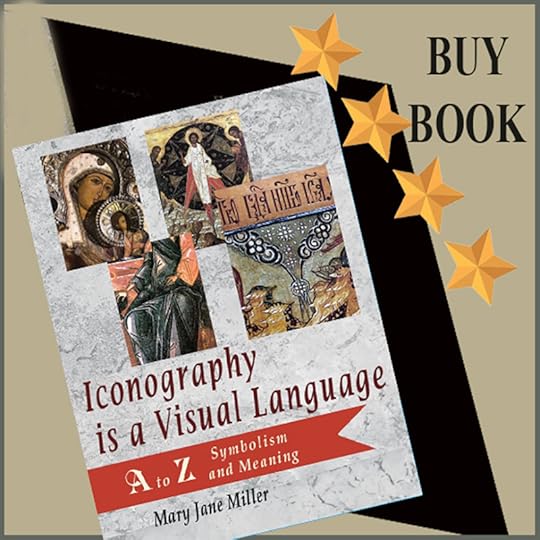
The tradition of Byzantine-style iconography has honored martyrs, saints, and mystics, both named and unnamed, who have carried forward humanity’s divine story of peace, love, goodness, light, and unity. The individual attributes of each saintly portrait are many and are crucial to interpreting the overall message. For the past 2,000 years, the basic visual form has remained consistent. There is an exhilaratingly wide area left open for interpretation and design. The entire art form is an expression of God’s creativity etched into color and hopefully will continue to grow and change for another millennium. The Visual Language A to Z alphabet has been written to honor the past and give rise to the future, to help fledgling iconographers and those who find gazing at icons hypnotic.
God’s image is reflected in Creation.We are the observers. The power of the mind, the wisdom of the soul, and the vitality of the Holy Spirit are aroused to give interpretation to what we see, think, and feel. Oneness to the divine, the transcendence of opposites, and each person’s spiritual experience enter into this book as you page through and select one letter at a time. Humanity is not divided into conflicting and irreconcilable opposites; on the contrary, we have more opportunities than ever to see commonality and expression throughout many religions. Spiritual language is unique and crosses over without hesitation. Interpretations may vary from culture to culture, in a symbolic and mythological sense; however, the divine realm has no gender, limitation, right, or wrong.
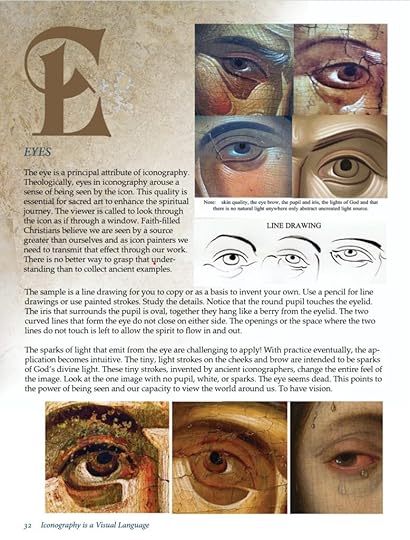
My book, Visual Language A to Z, is a courageous attempt to explain the symbols and significance found in iconography. Without ignoring the accepted visual cannons of iconography, this resource offers a fresh perspective on attributes and elements utilized throughout the history of sacred art. The concise language of icons sparks the imagination and provides new creative opportunities to contemplate the enigmatic workings of the Spirit in one’s life. I believe that simplicity is often the best way to reach the depths of our souls and connect us to our archetypal and ancestral memories.
This book focuses on the visual representation of symbols and breaks down where and when they are used or distorted one at a time. The symbols and characteristics of iconography have been passed down through devoted followers, community leaders, preachers, saints, artists, and mystics in the immediate context of historical epochs. This means that each person can and will interpret the meaning perfectly in the core of his or her being.
Ultimate spiritual truth is not the domain of the ego.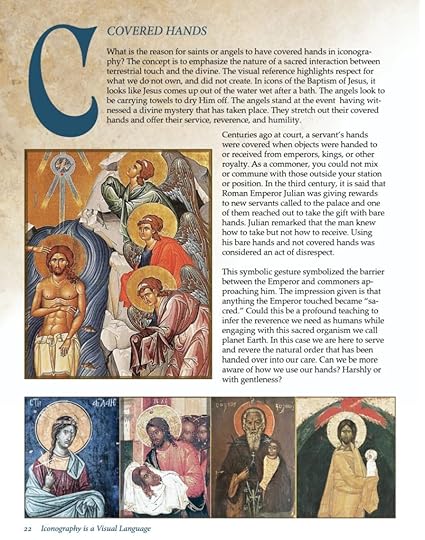
It is clearly beyond the control of the ego to unite the physical (earthly) and the spiritual (cosmic) into a cohesive whole. The encounter with sacred images has the potential to transcend space and time and to transport our consciousness to a higher, eternal realm. The Ancient Visual Language of icons can be a starting point to open our minds to possibilities beyond what we know and accept without question. As you immerse yourself in the divine images in this book, let them speak for themselves. Allow this meditative process to take you into the depths of your psyche, where spiritual truth about the power and mystery of the unseen can be revealed through image.
I have spent 30 years in the practice and discipline of discovering this Ancient Visual Language in iconography and prayer. The insights and opinions I share are mine and, to a large degree, held by many but not all. The book Iconography is a Visual Language is not meant to be scholarly or academic; it is to be received with joy and surprise. Make your own conclusions. I am simply laying out a structure.
Be the first to buy and review a great resource book, Visual Language A to Z, and see sacred art in a new way.Mary Jane Miller is a contemporary Byzantine-style iconographer with over 28 years of experience living in Mexico. Her collection of sacred art is thoughtful, unique, and unorthodox. She teaches 4 courses annually, 5-day immersion workshops throughout the US and Mexico. website
Join our Group on Facebook for Conversations about prayer and iconography.
The post Ancient Visual Language: A to Z Symbolism and Meaning appeared first on San Miguel Icons.


San Miguel Icons

Miller has developed an exquisite and distinctive voice as a writer of icons, adapting the style ...more
- Mary Jane Miller's profile
- 8 followers

