Put on This Record: hyphenated-man—Mike Watt & the Missingmen (2010)
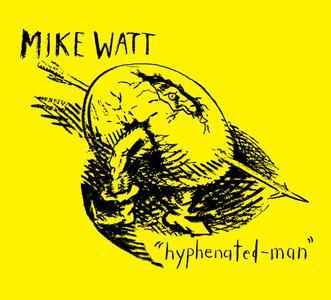
To be familiar with punk rock veteran Mike Watt is to know and appreciate his idiosyncrasies, moreover, to have learned to expect him to make those left turns that light out for the territories and sometimes veer into the weeds. The thing about left turns, however, is if you make enough of them, you end up heading in the same direction that you started.
Ever since forming the seminal ’80s punk band, the Minutemen, with his boyhood chum and dueling partner D. Boon and surfer/rhythmatist George Hurley, Watt has consistently taken the road less traveled by. The Minutemen are infamous for incorporating jazz, funk, hard core, Beat poetry—along with the kitchen sink—into their own personal strain of musical and philosophical expression. For a group that eschewed branding and easy cut-and-paste sloganeering, if it could be said that they had a motto, it was, “Punk is whatever we made it to be.”
Watt and his various co-conspirators have always viewed punk rock as a big tent sort of affair. The whole reason this type of music and scene appealed to three dudes from San Pedro, California was its lack of inherent rules. In keeping with that spirit, Watt recorded this, his third concept album, or “opera,” in 2010. The first opus, Contemplating the Engine Room, used his father’s experience on Navy submarines as a metaphor for his own life in an Econoline van, and the second, The Secondman’s Middle Stand, mapped his near-death sickness onto Dante’s The Divine Comedy. Both of these works were very personal in nature, and in the case of the last one, perhaps a little too personal at times—but, hey, nobody said punk is supposed to make you comfortable.
This time out, Watt enlisted guitarist Tom Watson and drummer Raul Morales, collectively called the Missingmen, to help create a cycle of 30 “little songs” that were inspired in part by the proto-surrealist paintings of Hieronymus Bosch. On his website, hootpage.com, Watt wrote that the punchy, ultra-lean tunes owe much to the Minutemen’s econo credo of “no filler, right to point, and distilled down to the bare nada.” Specifically, it was the documentary, We Jam Econo: The Story of the Minutemen, that finally got this restless artist to slow down and take a look back, allowing him to recognize something beautiful and utterly vital in the short form.
At the virtual needle drop, the album leaps out of your speakers/ear buds with arrow-pierced-egg-man. Clocking a mere 1:19, the song is a clarion call from the pit, a diseased chunk of meat thrown over the wall to help spread the contagion. Watt’s bass is greased up and firing on all cylinders. After playing the conservative sideman with the Stooges for a few years before this—as if anything Stooge-related could be called conservative—it’s great to hear him playing, if not more aggressively, then more dynamically.
Interestingly enough, the bass was the last piece of this particular puzzle to be added. This time out, Watt wrote on D. Boon’s Fender Telecaster, showed the Missingmen how the songs went, then retreated to later respond to what they had come up with. If he didn’t “chimp” (or “write about” in Pedro-speak) this unorthodox method, I would have never guessed that this music was anything but organically grown. It sounds like three guys jamming in a sweaty-ass shed and hollerin’ about 16th century religious art from the Netherlands. As one does.
The tendency to play “spot the influenced influence” as is hard to resist as Watt’s music has touched so many fellow artists over the years, just as playing within an ever-widening sphere of musicians has continued to color his own work. On bird-in-the-helmet-man, I hear echoes of Albert Bouchard and early Patti Smith-infected BÖC, while belly-stabbed-man’s “gut kicked – hard / truth hits – hard / emotions gush – but no word hole” is a Pop Group Amnesty Report from the depths of hell.
If I had to call a break-out single for “alternative” radio play (as if there were anything resembling a valid record and/or radio industry anymore) it would have to be the Trees Outside the Academy-era Thurston Mooresque hollowed-out-man with its pleasant droning melody, relentless drive, and totally fucked-up lyrics. “Now the hat that’s worn is like a horse track / pairs of peckers promenadin’ ’round a sack / a swollen bagpipe waitin’ for the ear-knife / castrate hack,” makes a perfect Sonic flip side to Sister’sTuff Gnarl, a connection made more overt when one considers the cover on Watt’s own Ball-Hog or Tugboat record.
The song that most evokes the spirit of Pedro for me is, appropriately enough, finger-pointing-man. Here, Watt’s lyrics sound like they could have been torn from his own Spiels Of A Minuteman folio. “Conviction’s like some affliction / without the clout of some doubt / it’s fuckin’ nonsense / ignorin’ content / and letting’ the mouth just spout.”
The sharp angularity of Tom Watson’s chording juxtaposed with the singsong delivery of funnel-capped-man, brings to mind San Francisco’s own Deerhoof, in fact, the first time I saw Raul Morales play, I was reminded of the ’Hoof’s Greg Saunier—if not stylistically, through their respective jazz-inflected approaches—in the giddy zeal that they both seem to take in playing drums.
Over the years, Watt’s vocal delivery has become more like his bass playing, a distinctive and singular expression of his muse. Printing out the hyphenated-man lyrics from the hootpage may help you find your way inside Watt’s vision, or you can just let the Missingmen’s churning accompaniment propel you headlong down their peculiar rabbit hole.
Using one of Bosch’s less fantastical icons as an avatar, Watt lays out the impetus for the opera in own-horn-blowing-man, while keeping one eye out for any hint of lurking solipsism. “Go figure the trigger / to really holler, fuckin’ holler / and hoist yeah, foist / expression from repression / not badge-buffin’ or baggin’ wind / but to get out what’s stuck within.”