September 2025 Book round-up
Since many of you do not follow me on Goodreads, I thought I would share the books I read this month, and what I thought of them! More below
Searching for Caleb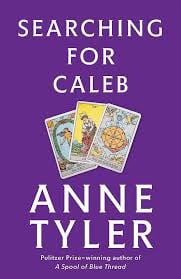
I picked this book up at the ‘Book Thing’ for free because the girl I was dating at the time recommended I read some Anne Tyler due to the fact that she sets her books in Baltimore, and I had said earlier I was starving for some fiction were set in this city in which I live that has such a negative reputation in fiction. Partially because I stopped seeing that girl, partially because this book is not my usual cup of tea, it took me nearly three months to finish this book. Searching for Caleb is a very slow book in which not much explicit plot really happens, but rather the family relations between the dysfunctional Pecks are explored in-depth. The plot which does happen is centered on the search for the eldest Peck’s younger brother Caleb, who ran away from Baltimore nearly fifty years ago, and the chaotic marriage of Justine and Duncan, who are cousins and both Pecks.
I got what I wanted out of the book: an exploration of the Roland Park/JHU neighborhood of Baltimore as it was 50 years ago. In terms of theme, I got a bit more than I had hoped for as well. The advantage of Slice of Life is that we get to spend a lot of time with characters doing fairly normal things, without earth-shattering events that would tell us unrealistic things about their character. Much of the dsyfunction in the Peck family seems to stem from an inability to healthily grapple with change, but rather to run away at the first sign of difficulty. We see this quite literally in the character of Duncan, who can’t seem to stay put, causing his wife and daughter quite a bit of suffering. But the other Pecks suffer from this as well, the titular Caleb, but also the family as a whole, who by the novel’s end, seem to have retreated from the world, rather than confront the fact that they don’t live in the Belle Epoque anymore.
Not sure if I will be reading more Anne Tyler but this was worth a read.
4/5 Stars
Embattled Rebel: Jefferson Davis as Commander in Chief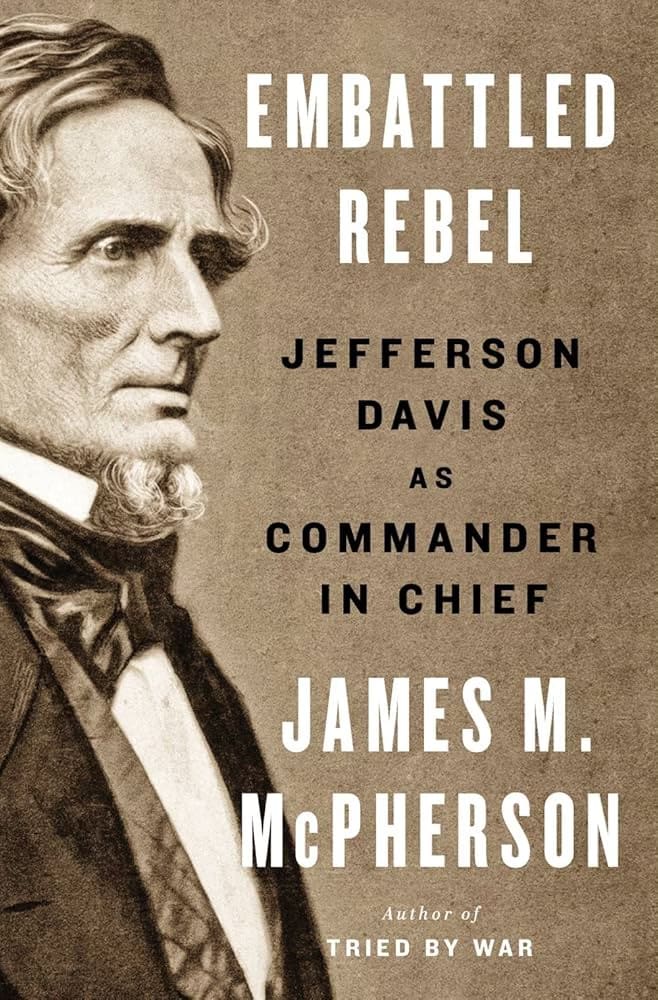
I picked this up because it was staring me in the face every time I went to the library, and James McPherson, of Battle Cry of Freedom fame, is one of my favorite historians. Honestly, you can skip this book. Just read Battle Cry of Freedom. This was a very time-skippy rehash of the Civil War from the perspective of the Davis Administration, with some analysis of Davis’ strategy and tactics. Compared to Battle Cry of Freedom, which was a much more thorough book, this book felt a little rushed and slap-dash, although it did give me a little more insight into Davis’ relationship with his generals, namely Lee and Joe Johnston.
McPherson tries to be kind to Davis, and in some ways my opinion of him changed quite a bit as a result of this book. Davis, who I had thought was quite prideful, actually took a bunch of Ls, especially with regards to the extreme defensive mindedness of Joe Johnston. However, his West Point nepotism, combined with an unclear idea of grand strategy doomed his tenure as commander-in-chief. Contrast this to Lincoln, who gradually got rid of the the incompetent generals in the Army, and who had a very clear idea of the Grand Strategy necessary to win the war, and it’s pretty clear who comes out on top.
3/5 stars
El Camino de Los Reyes (The Way of Kings)I review this book more in-depth above, but in short, it was overwritten and poorly done, if quite readable and entertaining.
1.5/5 stars
Groundwork of the Metaphysics of Morals
Read this for philosophy book club in September/August of 2025.
I had been thinking about Kant to some degree or another since 2019 because one of my college teammates and friends, Matt Kearney, was really into his philosophy. I watched a couple YouTube videos on him at the time (one about Kingdom of Heaven, which I still remember), and remember loving the idea of the categorical imperative, but not understanding the motivation behind it.
Reading this for philosophy book club helped to clarify the motivation for why Kant formulated the categorical imperative in the first place. Kant’s whole philosophy is really about moral freedom. This is not really freedom in the colloquial sense, because the categorical imperative is pretty restrictive, but freedom from particular life circumstances that may bias or impede your moral judgement. In order to be a truly moral law, according to Kant, a law has to be universal, which means it cannot be affected by interest that may come from particular circumstances.
I can’t say I really understood the whole chain of reasoning clearly (hoping for some enlightenment from Amanda), but I find this philosophy admirable in certain sense, but very foolish in another. It’s pretty impossible to live like Kant would want us to: reason is not the pure and unbiased master that Kant seems to think it is, and I also unfortunately think that a lot of morality is extremely contingent, and would be difficult to writer a moral law describing (a very Buddhist idea perhaps).
4/5 stars
Vera, or Faith
This was a Logan rec. Short, a very digestible, I read it in about 2 days. Vera follows Vera, who is a 10 year old half-Jewish, half-Korean American being raised by her Russian/Jewish Dad and WASP stepmom (who she refers to as Anne mom to distinguish her from her “real” mom) in Manhattan. For a ten year-old, Vera is extremely smart and observant, but because she is still a child socially and in terms of her understanding of the world, we get a very unique and hilarious perspective on current American issues of immigration, wealth, and education in a world very similar to our own but turned up to 11. Highly recommend, and will definitely be reading more of Shteyngart.
5/5 stars
Los Magos (The Magicians)
This is one of my favorite books ever, and it was time for a reread (or I suppose a relisten, in Spanish).
The Magicians follows Quentin Coldwater, a very depressed and very privileged teenager who gets the equivalent of a Hogwarts letter when he goes for his Princeton interview. However, unlike Hogwarts, where Harry and Ron spend pretty much the entire series goofing off, and somehow are nearly as competent as bookworm Hermione, Quentin has to grind to get good at magic, and very soon is sinking back into old habits. In Grossman’s world magic is not an escape from mundane problems, but an amplifier of them. The Magicians is a story about trying and failing to use magic to escape from yourself and your own existential meaninglessness. Yes the main character is an asshole, but assholary is merely a crutch, like magic, for him to avoid addressing the very real underlying causes of his unhappiness.
I could talk for hours about The Magicians and despite not enjoying it much the first time, it has really grown on me on a subsequent rereads.
5/5 stars
Tehanu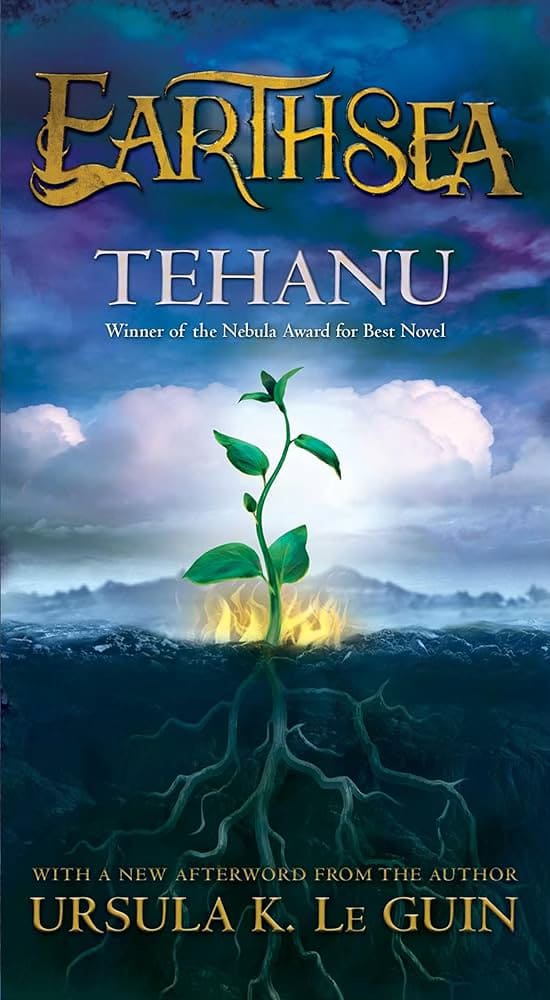
You seemed, in your power, as free as man can be. But at what cost? What made you free? And I... I was made, moulded like clay, by the will of the women serving the Old Powers, or serving the men who made all services and ways and places, I no longer know which. Then I went free, with you, for a moment, and with Ogion. But it was not my freedom. Only it gave me a choice; and I chose. I chose to mould myself like clay to the use of a farm and a farmer and our children. I made myself a vessel. I know its shape. But not the clay. Life danced me. I know the dances. But I don’t know who the dancer is.
This was a bit different from the other Earthsea books, although I can see an affinity between this novel and the Tombs of Atuan. If The Farthest Shore was the transition between adulthood and old age for the youthful Ged of The Wizard of Earthsea, Tehanu is about that same transition for Tenar, the protagonist of Atuan. This was a book about motherhood, but not necessarily the motherhood of self-sacrifice that is so often presented in modern literature, those years of rice and salt, as Kim Stanley Robinson might stay. This is a book about the part of motherhood where when one has to let go of one’s children, and allow them to be their own independent people. The question for Tenar, and also for Ged, in this book is how one finds meaning in life after this emptying out.
I’m very glad that there’s a few more books in this series, as Tehanu brought up almost as many questions as it answered. I also really need to read “The Language of the Night”, Le Guin’s book of essays on fantasy, which I think will help clarify some of the more mythic aspects of this book.
4/5 stars
I blog about language learning, biology, the science and art of learning, and many other things. If you feel inclined, please subscribe or consider buying me a coffee.
Josh