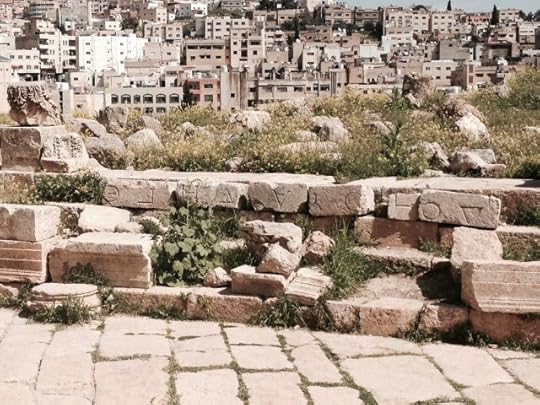
“The Pompeii of the Middle East”
It’s impossible to appreciate just how vast the Roman empire was— at least, not until you’ve traveled to its furthest reaches. I’ve been to Rome a couple times, and it’s an absolutely amazing place. The city is layered in history, with ancient ruins on literally every corner, and a person can’t help but be overwhelmed. But then, it always sparked a completely different kind of wonder whenever I stumbled across ancient Roman ruins in some distant parts of England, Africa, or Asia.
At the height of its power, the Roman Empire really did stretch this far, spanning the width and the breadth of the Mediterranean Sea, from Constantinople to Carthage. But the thing is, it’s not as if the Romans just magically built all of their legendary cities from scratch. Some of the places I’ve had the good fortune to visit had been around for hundreds, or even thousands of years, before the Romans came along and absorbed them. Back then, conquering these places involved a fairly simple strategy of demolishing the existing landmarks to make room for their own monuments, temples and and coliseums.
A few years ago, the traveling circus that pays my bills had me flying through the Kingdom of Jordan every few months. The rotations were on a fixed schedule, more or less, so I got to passing the time during layovers by exploring the capital city in a series of day trips. Eventually, after I’d seen all the top-tier highlights in Amman, like the Temple of Hercules and IKEA, I started exploring a little further afield.
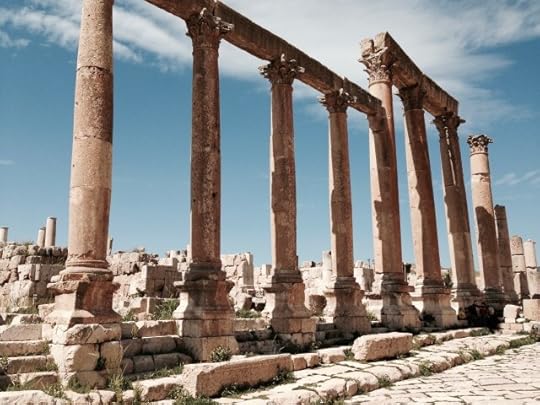
The ruined city of Jerash is about an hour’s drive north of Amman, and it’s the country’s second-most popular tourist attraction behind Petra. This area has been continuously occupied for over 6000 years, with the oldest archaeological finds dating back to the Neolithic era— long before anybody in Italy could even imagine the Roman Empire. Still, the city’s most prosperous era came under Roman rule, and Jerash’s archeological site is considered to be one of the empire’s best-preserved provincial towns.
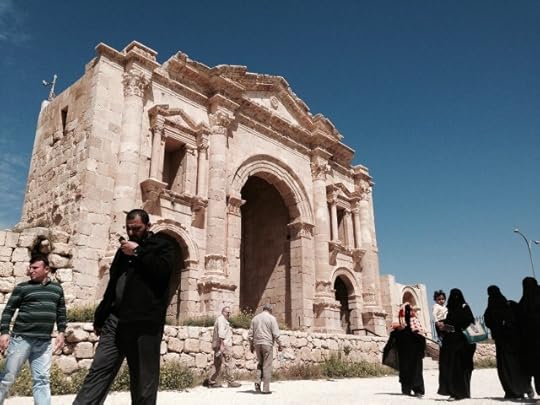
Now, one of the best things about exploring Roman ruins outside of Italy is having the freedom to explore at your own pace. Going where you want, when you want, with considerably fewer restrictions and off-limits areas. Of course, you’re always welcome to hire a guide— during my trip, there was no shortage of local kids who were willing to help out— but at the same time, there’s something to be said for taking a slower pace and just wandering through history. In Jerash, the visit starts beneath the shadow of Hadrian’s Arch, built in 129 AD to commemorate the Emperor’s visit. From there, you can wander through the paved Oval Plaza, and on to the remains of the massive Hippodrome sports arena.

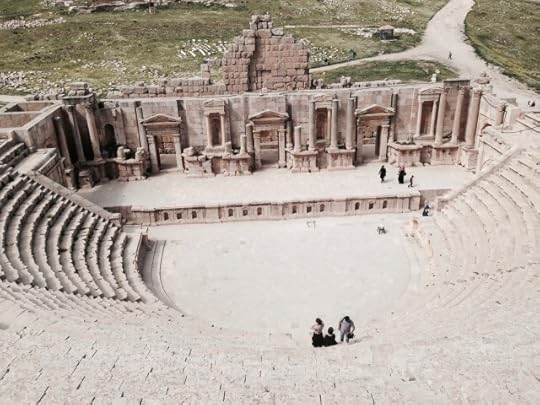
After several hours of aimless drifting, letting the dust of past centuries build up beneath my sandals, I eventually got around to visiting the South Theater. Climbing those dizzying steps probably would’ve gotten me escorted out of any Roman ruins back in Italy, but in Jordan, it was just another part of the tourist experience. In that ancient open-air amphitheater, which is apparently still used for cultural events today, engraved Greek characters have marked each row of seats for the past two thousand years. From my perch at the very top, with a perfectly clear view of center stage below, it was easy to close my eyes and imagine that I was back in ancient times, surrounded by thousands of people, eagerly waiting the start of a performance.
Although the city of Jerash was largely destroyed in 749 AD by a series of earthquakes, parts of the most important temples and monuments somehow survived. Today, Jerash’s archaeological park is one of the best-preserved Greco-Roman cities, welcoming several hundred thousand visitors each year— and earning it the title of “The Pompeii of the Middle East.”