The Hostages, a Dead Actress and a Bouquet of Red Roses
I’m back to citing more observations by author Ingrid Fetell Lee in her book Joyful: The Surprising Power of Ordinary Things to Create Extraordinary Happiness.
Lee says that we need more play in our lives. Why? Because it is the only known activity that humans engage in solely because it produces joy.
And she describes JOY simply as: an intense, momentary experience of positive emotion – a high energy form of happiness. And it can be recognized by signs like smiling, laughing and a feeling of wanting to jump up and down.

Stuart Brown is a man in his 80’s who founded the National Institute for Play. He says that when we play, our awareness of time diminishes and our self-consciousness fades. “Play allows us to let go of everyday worries and be absorbed in the joy of the moment.”
I wonder: How else can we increase joy?
We can do this by implementing actions that induce a blissful state of mind – even if we feel they may be frivolous.
This past week many of us cried intense tears of unbridled joy as we witnessed Israeli hostages reuniting with their families. I wanted to extend that warm positivity into my own personal space. I started by critically eyeing my kitchen shelves looking for inspiration and landed on the black and white checkered vase I had bought for $3.94 at a local thrift shop the week before.
Minutes later, I dashed out the door, into the garage, backed out my car and drove with intense focus to my local garden shop. I was on a mission: to buy a bouquet of red roses to fill the vase – reminding myself of the delightful feeling I got every time I saw one more returned hostage being eagerly embraced by his loved ones.
Flowers, says Lee, have dynamic energy that signifies a kind of uncontainable verve, a life force that can’t help but find its way out. Flowers bring an element of dynamism into the static nature of our homes. It connects us to vibrancy in a way our leather couches and upholstered dining room chairs simply cannot. 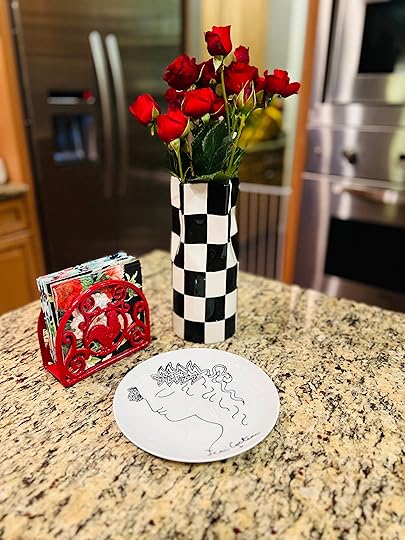
And I didn’t stop there.
The “sudden” death of Diane Keaton, age 79, brought more tears, but not happy ones. However, I recognized that I also wanted in some small way to honor her accomplishments and the delight she brought to so many of us in the roles she played.
So I carried my vase filled with roses to the small side table next to my couch and every night this past week I watched a movie with Diane Keaton in the cast.
Annie Hall
Something’s Gotta Give
The First Wives Club
Father of the Bride Part l and ll
I marveled at how the movie Annie Hall was so far ahead of its time.
I laughed with wild abandon as I sat munching pistachios, sipping my Pinot Noir and watching a romance flower and other romances die.
And when it came to Father of the Bride, the tears flowed once again as I witnessed the intensity of the relationship between father and daughter as his young woman embarks on adulthood.
And why am I so fascinated with Diane Keaton? Because even though she is a remarkable actress, she is both grounded and transparent.
She spoke openly about her being bulimic for four years while in her 20’s – posting how much she could actually eat in one sitting. Even in my own book documenting my dance with this relentless disorder, I couldn’t be that open.
The other thing that impressed me so much about Keaton was that as iconic and talented as she was, stardom never went to her head. As she said, “I’m a regular person – I get up in the morning and my first thought is I need to feed the dog.”
Regular person? Never married, but had serious relationships with the male powerhouses of her time:
Jack Nicholson,
Woody Allen,
Al Pacino and
Warren Beatty.
Pretty impressive.
Keep Preserving Your Bloom and I’ll keep buying those roses,