My Bookshelf Aesthetic: Why I Keep Murakami, Morrison, and Thoreau Next to My Penguin Classics

Occasionally, I’ll watch a YouTube video about personal library tours. It’s kind of fun to see what books other people surround themselves with. Since I’m writing these handy-dandy little blogs, I thought I’d do a written version. Here’s a sneak peek at the physical books I have at home. I have many more on my Kindle.
I don’t keep many physical books since I don’t have a lot of space and I hate clutter. Once I’ve bought some new books that I don’t have room for, I’ll unhaul a few that I’m unlikely to reread or that I ended up DNFing because I couldn’t get into them. I have one main bookcase of four shelves and a smaller end table with two shelves, and that’s the extent of my personal library of physical books.
Even with the limited space, I find there’s nothing quite like looking at a fully-stocked bookshelf. For me, a bookcase is more than just a storage unit. My collection of books is a self-portrait painted in paper and ink. As anyone can tell by looking at my shelves, you can see that I’m an eclectic reader. I read mainly classics. In my world, Charles Dickens gets his own shelf. No joke. I also have a lot more contemporary favorites and some new authors I’m discovering. My bookshelves are a curious and contradictory mix that reveals how I love to jump between the stark and the surreal.
I have BA and MA degrees in English, and like most English majors, I spent years steeped in the classics. In fact, for a long time I read nothing else. It was Oprah’s Book Club that prompted me to read closer to my own century. I’ve read many of the books from Oprah’s Book Club, and I’ve enjoyed most of them. I discovered one of my favorite authors, Abraham Verghese, through his wonderful novel The Covenant of Water, which was an Oprah’s Book Club pick. After discovering some more modern-day favorites, I went in the opposite direction and read only more modern works. I’m pleased to say that now I strike a balance where I read some newer authors and some classic authors.
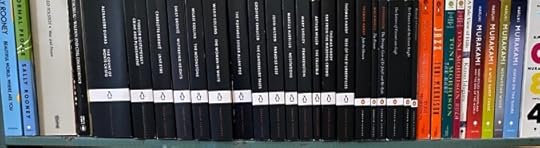 The bottom shelf of my bookcase.
 There are times when I wish that my shelves were a little more organized than they are. The books are organized, just in a way that suits the limited space I have. You can see my collection of newer black Penguin classics. I also have a few of the orange classics for the Toni Morrison novels. Many of the books I have on my shelves are special to me, not because they were expensive (you can see that all of the ones pictured are paperbacks), but because many of them have been with me since my university days and they have emotional resonance. The older black Penguin edition of Thoreau belonged to my uncle.
The Penguin Black Classics line up in their iconic spines next to the vibrant, modern covers of Haruki Murakami. Nearby, the deep American voices of Toni Morrison and Henry David Thoreau anchor the collection, inviting both a journey into the past and a meditation on the present. The Penguin Classics are foundational texts for students of literature. Here are some of my favorites: Frankenstein, Crime and Punishment, the works of Poe, Dr. Jekyll and Mr. Hyde, and a few Hardys, among others. The only book on this shelf I haven’t read is The Count of Monte Cristo, and I have that high on my TBR list.
If the classics represent tradition, then Toni Morrison and Haruki Murakami represent the power of more contemporary voices to push the boundaries of realism. Toni Morrison is a foundational author for me in so many ways. Her lush language and powerful focus on trauma and identity helped to shape who I wanted to be as a writer, and I used to spend hours copying out passages from her books in my spiral-bound notebook as I tried to understand how to craft poetry in prose.
I adore Haruki Murakami. I love that he’s willing to let his imagination soar. In an interview, Murakami said that he never puts any limits on his imagination when he’s writing. He’s one of the few authors who is never boring. He offers a road to the surreal and the deeply strange, and his novels often blend pop culture, jazz, existential dread, mystery, and humor. I mean, Colonel Sanders? That’s funny.
I love Thoreau, and we see so much of his message today in the minimalist movement as well as our trek back toward nature and simpler living. I’ve always seen Thoreau as the quiet rebel on my shelf, whispering that perhaps I should leave aside material considerations, honor what is truly important to me, and live deliberately. Thoreau reminds me to value simplicity, self-reliance, and independent thought over accumulation and societal noise.
Sally Rooney is hit and miss for me, quite honestly. I liked Normal People but not Beautiful World, Where Are You? The two books will likely be donated at some point. Nothing against Rooney. I’m just not sure I’d leave her shelf space when mine is so limited and there are other books I’d rather keep close.
My shelf space is carefully curated, so when I look at my bookcases, I only see books that bring me joy. The books I surround myself with are a conversation between the past, the present, and the existential. Over the years, I’ve learned that I don’t have to choose between a deep dive into classic literature and a late-night journey with a missing cat. Both are essential for well-rounded readers.
We’ll take a look at another one of my shelves soon.
Categories: Book Recommendations, Book Reviews, Books, ReadingTags: Best Penguin Classics, Book Recommendations, books, Bookshelf Aesthetic, Literary Canon and Contemporary Writers, Must-read Classics and Modern Fiction, reading, what to read next