Becoming The White Masai
While reading The White Masai several years ago, I was shocked by the author’s decision to leave her home in Germany to marry a Masai man and acclimate to his culture and way of life. Honestly, I questioned her sanity.
The Masai’s way of life represents simplicityUltimate minimalists, the Masai are part of the land and animals and connected to the earth in ways we in the modern world no longer are. They build with dung and mud, sleep on goat-skins, and drink blood and milk. They spend their time outside under the sky, entering their homes mostly to cook and sleep. They walk miles to visit friends in nearby villages and collect water carried on the backs of donkeys.
They generally have no TVs, no books, no chairs, no toilets, no lights. The children play games with sticks and rocks in the dirt, the men light fires from dust, and the women bead beautiful jewelry for their husbands.
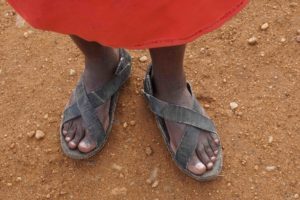
Trading shoes with Daniel, my Masai guide.
Daniel doesn’t like my flip-flops, “the thorns will push right through the bottoms,” he says. His sandals, made from old rubber tires, are the only shoes he’s worn for the past seven years. “They will last another seven,” he tells me.
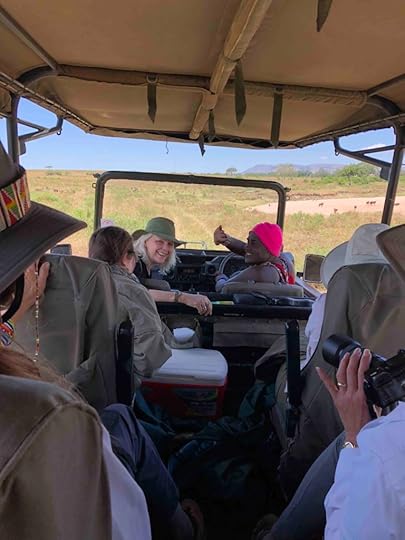 Daniel and me co-guiding my group on safari in the Masai Mara.MASAI ARE GREAT GUIDES.
Daniel works as a safari guide in the Masai Mara, Kenya’s most popular wildlife park. He grew up on this land. As part of his initiation into warrior status, he lived with his peers for three years in the bush, sleeping under stars and eating plants and occasionally meat. He learned life-long survival skills, including protecting himself from lions, elephants, and buffalo.
Listen to Daniel Sing the Lion Warrior SongIt is truly amazing!
He is the best wildlife spotter I’ve hired during the 18 years I’ve been leading safaris to Africa. From miles away, he sees lions that I can barely spot through my binoculars. He knows what an animal is about to do. He maneuvers his truck away from the pack of safari vehicles suffocating each other around a wildlife sighting, correctly anticipating when the animal will move away to drink water, climb a tree, or try to hunt.
Of all the indigenous tribes in the world, the Masai have a reputation for holding onto their culture despite the government’s desire to change them.
I show Daniel photos of America, and he tells me he has no interest in going there. “Four-lane roads and tall buildings,” is how he describes my country.
I’m drawn to Daniel. It’s a soul attraction. A connection to the minimalist side of me that is forever intimately tied to the natural world. I no longer question the decision of the author of The White Masai to exchange her world for theirs (although spoiler alert – it didn’t work out).
The post Becoming The White Masai appeared first on Saving Wild.