“What Was the Plan, Again?” My Contribution to the Design Debate 2025
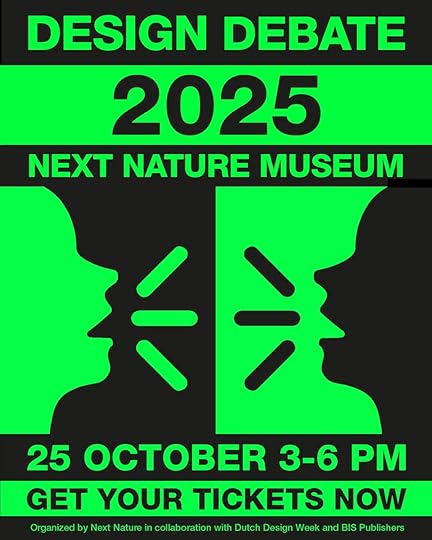
(This short statement was written for Next Nature’s Design Debate 2025, which took place during Dutch Design Week on October 25, 2025, at the Evoluon in Eindhoven. I debated with Richard van der Laken – who joined remotely – and Hendrik-Jan Grievink on the prompt “When Design Must Do”.)
“What Design Must Do”. Oh boy… If there is one political philosophy I can call my own, it is anti-authoritarianism, so the verb must doesn’t really belong to my vocabulary. That said, I’ll try to provide an answer anyway. Design must mitigate the effects of the climate emergency, must make AI adoption safe and worthwhile, must revert platform enshittification, must take a side on wars and genocides. But what happens if design doesn’t do any of that? Not much, I’d say.
As no one seemed interested in verifying the claims designers and design writers made ten, fifteen or twenty years ago, I doubt anyone will do so for today’s. The issue has to do with reminiscence: design culture suffers from short-term memory loss. Somehow it makes sense, for a field so obsessed with the new that it can’t be too bothered with the old, especially the not-so-old, which lacks both the allure of wisdom and the thrill of rediscovery.
Yet, our not-so-old, recent past sheds light on an utterly transformed design culture. According to Fast Company, design thinking – the goose that laid the golden eggs – is now on its deathbed. In 2017, design guru John Maeda argued that “if you want to survive in design, you better learn to code”. Less than a decade later, NVIDIA CEO Jensen Huang declares “the death of coding”. Things that were unthinkable five years ago unfold before our very eyes: Tim Cook, CEO of Apple, presents a tacky, 24-carat-gold gift to President Trump. Designers barely comment.
Novelist E. M. Forster told us that “we must be willing to let go of the life we have planned, so as to have the life that is waiting for us”. But how can we let go, if we don’t even remember the plan? That is why we need to exercise memory, which is essentially a form of attention, in order to spot difference within apparent sameness, and sameness within what appears different.
Take, for instance, that audacious idea of distributing designerly sleeping bags to homeless people. Did it lead to anything? It did, and it’s still going on! We need to notice and remember — and not just to ridicule unmet expectations and thus comfort ourselves in our cynicism, but to be surprised. Perhaps this is how we might find a spark of possibility in a present that feels endless, and thus hopeless.
Thank you