Jim Talks Books with Michael Geczi
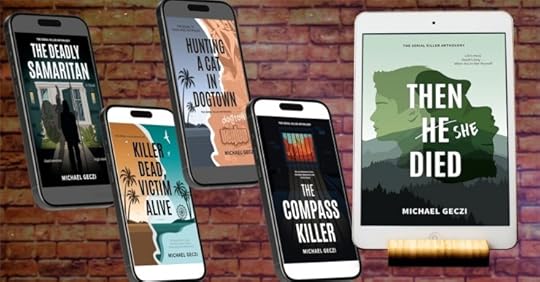
This month, I got to chat with Michael Geczi, prolific author of suspense thrillers that pack an emotional and cerebral punch. Michael is offering a discounted bundle of stories in the Serial Killer Anthology.
 Michael Geczi
Can you tell us about your latest book and what readers can expect from it?
“The Serial Killer Anthology” is a compilation of five serial-killer related novels. In theory, they are standalones, although two of the stories have the same characters and some of the characters also appear in a third book. Readers can expect twists and turns, and surprising and thought-provoking endings. They also can expect very little to no actual violence. The stories are about what’s going on inside the heads of the characters: from victims to suspects to law enforcement to other citizens. The serial killings and the geographies provide the playing field, but when I wrote the stories, I was interested in motivation, thoughts, clues and internal struggles — and not the violence.
Sounds compelling–I love character-driven fiction, but the emotional rubber-banding is exacerbated when lives are on the line! Is there a book from the Serial Killer Anthology that stands out for you?
I’m very fond of the fifth one, “Then She Died,” because my motivation was to experiment a bit with structure, in particular the expected roles of the protagonist and the antagonist and how readers might feel about them. I also was interested in making sure there was a period of relative normalcy in between the incidents in the first act and the tension at the conclusion.
But at the same time, I knew the ending needed to be really special. I’ve been told it is.
Interesting. Sounds like you went into the story with a solid outcome in mind.
Well, sort of. I’m a pantser who grasps onto one or two of the thousands of characters who flow through my brain every day. Something about them needs to be unique, maybe even flawed, but they usually have real emotions (even if they don’t surface until later). Then I need a geography: as it turns out, it’s usually somewhere where I’ve lived — I want the environment to play a role in the story. So … Southern California, Arizona, New Jersey, Chicago, Massachusetts.
With a couple of potential twists and turns in my pocket, I start painting the outside of a house. I try to get the primer down first, even and smooth — and then I start layering in plot points and crises. I break some rules because I like to get the first 25% at close to complete before proceeding. And close to finished means I have the characters right, the inciting incident right, but have left room to plug in new information as I write the rest of the book. I then switch my brain to the structure of the other 75% and write 500-word chapters/scenes for the rest of the book so I know the flow will work.
At that point, I go back to the beginning and put the additional coats of paint onto the primer until I know it is done. Part of that, obviously, is taking the 500-word snippets and building them out fully.
And have great fun with an ending that has elements of my original thinking, but surprises me as well.
So, was this “special ending” the creative spark for “Then She Died?” Is that where the drive to create the book originated?
Not exactly. The initial idea for “Then She Died” was simple — “what would happen if I made the antagonist likeable and the protagonist unlikeable?” Original idea, but not the final.
And therein lies the joy of pantsing. You land in places you never expect. So, I imagine your characters experience the same?
Sure. Take Will Post. Emotional and psychological episodes are nothing new for him. He’s got a lifetime of experience. More than anyone would want or believe.
But he doesn’t have any experience dealing with his recent killing of three people, and that’s his newest challenge, along with haunting hallucinations and delusions. His solution: hit the road, get out of Chicago, and hide and figure things out in the Berkshire Mountains in Western Massachusetts.
For a year, it works out well. He lives as a recluse, stays out of sight, and develops a new routine. Then he meets Val. They fall in love, move in together, and share a near-perfect life for several years … until she gets sick.
The episodes return, and Post inexplicitly decides to return to Chicago. Perhaps he can learn how to forgive himself and even heal. Chicago is no panacea, however. Chicago PD Detective Tanner Osborn is looking into the three killings, now ignored cold cases, determined to learn more.
Post faces other issues, as well, some dating back to his heartbreaking childhood, new ones tied to his return to Chicago, and others signaling a significant and intensifying psychological break. And then there’s the voice in his head providing specific – and often conflicting – instructions.
“Then She Died” is a fast-moving and deeply penetrating look at the highs and lows surrounding life, love, death … and the always-important truism that actions – conscious and unconscious – have consequences.
Is that a central theme in the book?
Absolutely. Decisions have consequences. Forgiveness is a destination. Even the most damaged are capable of love.
Sounds layered and deep. Are there any Easter Eggs in the story that readers should look out for?
Yes. Good luck finding them.
Ha. Fair enough!
I will say that I want readers to be entertained, and leave them thinking. I definitely want them to read the other books. I’m currently working on the third book in my “The Revenge, Unhinged” series. “Pointless” and “Soulless” are the first books in that series, and I am working hard on the third.
—
Check out The Serial Killer Anthology bundle today! Learn more about Michael and his books at his website and newsletter. You can also follow him on X, LinkedIn, Facebook, Threads, and Bluesky.