Behind the Screens: Tuesday Author Interview
Every Tuesday, get to know a bit about the stories behind the books you love, and discover your next favourite novel.
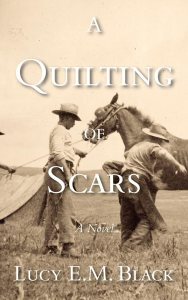
Zilla: As a fellow Canadian, I was excited to see Lucy E.M. Black’s novel A Quilting of Scars , which tells a story of 19th century small-town Ontario, and the very human quality of the struggles arising from the restrictions and silences of that time—and some that persist to our day. I’m delighted to have her here to talk about her book. Lucy, can you introduce it to us?
Lucy: A Quilting of Scars is a poignant exploration of forbidden love, abuse, and murder, brought to life through a cast of relatable yet uniquely original characters. Set against the backdrop of a rural community bound by rigid moral codes, the narrative follows Larkin Beattie as he navigates the complexities of a lonely existence filled with repressed sexuality and deep-seated guilt. With a deftly crafted sense of time and place, Larkin’s story unfolds as a thoughtful meditation on aging and remorse. As he reflects on pivotal moments from his past, the narrative delves into the hypocrisy of the church, the profound grief that has shaped his life, and the suffocating fear that grips queer youth in a society quick to judge. Through Larkin’s eyes, readers experience the strictures and rhythms of farming life in the not-so-distant past, revealing how societal expectations can stifle personal truth. A Quilting of Scars resonates with timeless relevance, evoking a deep emotional response that transcends the era in which it is set. It is a powerful reminder of the enduring struggle for acceptance and the scars that love can leave behind.
Zilla : What was the moment that sparked this book?
Lucy: This novel began in an antique store when I fell in love with a reproduction poster from May 1874.
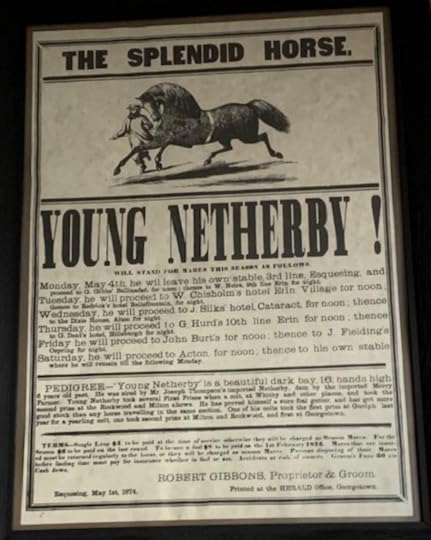
The splendid horse, young Netherby, was available as a proven foal-getter at $4 a single leap. I was charmed by the poster but also intrigued by the idea of a farmer advertising his horse’s services in this way. I began to wonder about the farmer and gradually Larkin’s story revealed itself and the novel unspooled.
Zilla : There’s something very special about characters who come to you, instead of being created by you. Can you tell me more about Larkin?
Lucy: Larkin is a character that I have quite fallen in love with. He embodies a number of characteristics belonging to family members and farm folk that I have known. He also represents those vulnerable young people I have encountered over the course of my career as an educator. The secrets that are kept throughout the story changed Larkin’s life and left him isolated and lonely. And so, as the novel took shape and I came to know Larkin and his best friend Paul, it became important to me to tell their story – which is a love story of sorts and a celebration of male friendship. The setting is placed at the end of the 19th century when small-town Ontario was still very much under the influence of Victorian ideology. This is a period of tremendous growth and potential with huge advances in science and technology and yet the social mores, if you will, were much slower to change. So much of our society has changed in the last hundred years but what is so clear to me is how desperately we still need acceptance and unconditional love without judgement.
Zilla : It sounds like the story emerged from your own life and those lives around you. Did you need to do any research for it beyond living?
Lucy: The book takes place during a period of Ontario history that I know well and have explored in other novels. Aspects of this book that required a deeper research dive included the early treatment of breast cancer, prostitution in Collingwood, coroner’s inquests, and rural farm practices including branding, castration, and cattle drives.
Zilla: Thanks for sharing your story and your process. We’re looking forward to reading! Where can the Night Beats community find you and your book?
Lucy: My books are sold at independent book stores, Chapters, Indigo and Amazon. I write a monthly newsletter, a website, and post regularly on facebook (lucyEMBlack) and Instagram (lucyemblack).