How can we make hope contagious?
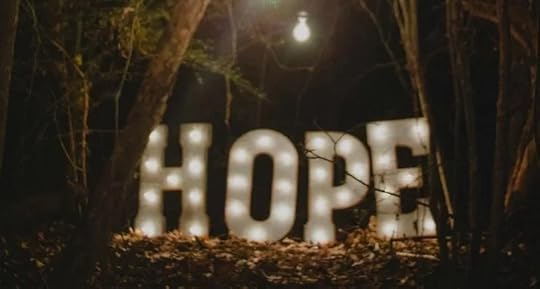
Src: Ron Smith Unsplash
Riding on a windy flight delayed out of Dubrovnik, Croatia, to London, fingers crossed hoping we’d make our connection back to the States.
Last night, my husband and I stayed at a small hotel, five minutes’ walking distance from the airport. We had a leisurely breakfast at a nearby bistro. Both buildings, so close to the airport, they needed special government permission to operate. My weather app showed gusty winds right about the time we were set to take off. We’d missed an epic downpour flying a week ago, but it seemed another storm was brewing as the blue-grey storm clouds hovered overhead.
Queueing up for our flight, there wasn’t a jetway, so people waited outside. The winds picked up as passengers held onto their hats and bags. Once on board, all buckled in, the captain announced we had a delay because our type of airplane wasn’t approved to take off with this kind of wind.
An hour later, while still gaining altitide, the plane lurched. Then dropped. A woman farther up screeched a bit. People grabbed hold of their armrests. My eyebrows raised. I smiled at my husband across the aisle. “That was something.” You could hear nervous laughter as the captain steadied the plane.
Maybe the pilot would make up time, and we’d still make our connecting flight.
What is hope? How is it different from optimism, toxic positivity, or hopium? Can we make hope contagious?
trailer with Play Josh Davis & Greg Prosmushkin
what is hope, and how is it different from optimism, toxic positivity, or hopium?Dubrovnik air traffic control managed to thread the needle for our flight with limited runways due to the high winds, but we missed our connecting flight waiting for Mother Nature to take a beat. Took some time, lots of steps between terminals, and two airline guys to get it sorted before receiving hotel and dinner vouchers with hundreds of other passengers.
Once in our London hotel outside Heathrow Airport, I’m catching up on email and the news before our long flight home. I’m saddened to learn that Jane Goodall died at 91-years-old in Los Angeles, California.
My favorite quote revealed Jane’s sense of humor and her grit, Jane Goodall’s Thoughts for a Report: Hope Isn’t Just Wishful Thinking. “That’s why I’m traveling 300 days a year. It’s no good just talking about what should be done. We’ve got to flipping well do it.”
My first post on Twitter (years ago from a now-deleted account) happened to be on World Optimist Day. A friend had loaned me Jane Goodall’s 2021 book, with a passage that still resonates with me today.
“Optimism says ‘everything will be fine.’ Pessimism says ‘nothing will work out.’ Hope, on the other hand, is the dogged determination to do what is in our power to make things work out”— Jane Goodall
Seemed fitting to post on World Optimist Day as a nuance for all of us optimists. Jane doesn’t see hope as foolish or empty, but the juice to help carry on and work toward a better world. Not the toxic positivity or the false hope of “hopium.” Jane advocated for, and invites each of us to focus on what is in our power. Hope may not be a strategy, but it certainly fuels strategies.
During this month’s thought echoes podcast with psychologist and neurologist Josh Davis, and executive coach and entrepreneur Greg Prosmushkin, we had a lively conversation about the importance of understanding other people’s perspectives. In their book, The Difference That Makes the Difference: NLP and the Science of Change, Josh and Greg offer practical advice including how to de-escalate conflict and improve trust (even in tense relationships) using a simple concept (although not necessarily simple to apply): assume good intentions.
As Josh and Greg explain in their book, “At the heart of NLP (neurolinguistic programming) is a process for understanding what makes people tick— yourself and others. When we understand how we and others think, feel, and act in key situations, we have the raw material with which to make change happen, often quickly and profoundly.”
As Greg shared during the podcast, “Presuppose that everybody has a good reason, good intent for what they're doing. Most people are not sociopaths … They're serving some kind of an internal need, and if we can find out what that need is, we can change the way we interact with them.”
He gave an example of a hypochondriac, where his initial reaction was to be annoyed with all their complaining. Then once he dug deeper, trying to understand his “map of reality,” he realized they were lonely and felt powerless. Instead of feeding into the sympathy spiral, he looked for other ways to help that person exert some control in their lives.
Assuming good intentions enables us to shift our perspective to trying to understand why someone is doing what they are doing or not doing (including ourselves).
can we make hope contagious?When I woke up in our layover-hotel in London, I’m thinking how could we make Jane Goodall’s hope contagious? Go viral in a good way. Since COVID, contagious swings towards infection. As in, are you still contagious? Better keep away from direct contact for awhile. Before COVID, I’d think of contagious as in smiles and laughter.
During our podcast conversation, Josh shared:
“This thought echoes idea. It’s really interesting. There is research to show that the beliefs you arrive with in a situation are going to influence not just your own behavior, but then, through your behavior, how other people are going to react to you.”— Josh Davis
Jane’s vision of hope encourages persistent action, figuring out a way. It’s emotionly-inspired, like lighting a fire. Hope is a spark.
That’s the vision Jane had for her Roots & Shoots program for kids - their mission: to empower young people to affect positive change in their communities. She encouraged them to stand up for what they believe in.
They use a 4-step formula. How might we as adults use this framework to spread hope in our own communities?”
Get Engaged: learn about issues in your community
Observe: if unsure of what issue you want to address, try brainstorming
Take Action: pick something and set up a plan
Celebrate: your project is complete, time to celebrate!
Hope in action looks different in every culture — from classrooms to countries.
***
During our two-week vacation through Croatia and Greece, my brother-in-law arranged local tours by historians. Hearing about the Croatian War of Independence in the 1990s by day and staying on the Adriatic Sea by night. The rental owner describing images of soldiers and horses on their generational family property just decades before. His 80-year-old mother sweeping fallen olives on the patio in the morning, wearing a Tupac hip-hop t-shirt and offering us homemade pastries.
When in Athens we were greeted with signs saying: “welcome to the birthplace of democracy,” and our Acropolis tour guide reminding us of how democracy expanded from landowners and step by step expanded to include all adults. Everyone eventually got to vote. Everyone was expected to vote.
It was hard not to compare the enabling of democracy a half world away with what’s happening with the grand American democratic experiment back at home. Our tour guides drew parallels between previous wars in Europe and the world today, especially with what they see happening in the US.
During these polarizing times, finding a way to talk to each other at times seems impossible, yet, Josh and Greg's book gave me hope and ideas to try. And as Jane Goodall advocates, maintaining hope is a choice, an active choice to move things — whatever strikes you — in a more positive direction.
“It’s important to take action and realize that we can make a difference, and this will encourage others to take action. Then we realize we are not alone and our cumulative actions truly make an even greater difference. That is how we spread the light. And this, of course, makes us all ever more hopeful.”— Jane Goodall
WOULD LOVE TO HEAR YOUR COMMENTS.
If you enjoyed learning more about the nature of our thoughts, I invite you to subscribe to thought echoes.