Book Review: Gravity Let Me Go by Trent Dalton
How will you ever know how the story ends, if you let the story go?
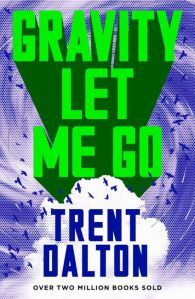
Noah Cork has just published the scoop of a lifetime: the white-hot true crime book of the cold-blooded killer who slipped an unfolding murder mystery into his mailbox. But if this is his moment of triumph, then why is the tin roof being ripped from the walls of his reality? Why are skeletons standing upright in his closet? Why do people want to run him over in the street? And why does his wife keep writing a cryptic message across the bathroom mirror? As a severe storm cell heads towards Brisbane, Noah is hurtling headfirst into a swirling storm of secrets. He must now cling for dear life to the only story that ever really mattered. He must hold on to the truth. He must hold on to the story. He must hold on to love.
Dark, gritty, hilarious and unexpected, Gravity Let Me Go is Trent Dalton’s deeply personal exploration of marriage and ambition; truth-telling and truth-omitting; self-deception and self-preservation. It’s a novel about the stories we want to tell the world and those we shouldn’t, and how the stories we keep locked away are so often the stories that come to define us.
It’s the story of a murder.
It’s the story of a marriage.
It’s the story of a lifetime.
Published by HarperCollins Publishers Australia
Released September 2025
 My Thoughts:
Gravity Let Me Go is the much hyped and media saturated latest release of Queensland’s own home-grown boy wonder, Trent Dalton. We love him here. We love him so much he’s stitched into the very identity of Queensland, a state that has now been immortalised by the stroke of his pen and a television series adaptation of his phenomenally successful first novel, Boy Swallows Universe. Queensland, specifically Brisbane, is a location he returns to over and over. Lola in the Mirror was set in the heart of Brisbane, and he’s done it again, with Gravity Let Me Go set in a fictionalised Brisbane suburb that could be any number of Brisbane suburbs – I’m quite sure the ‘which suburb is it’ game will be played at many a book club discussion about this book. In fact, it’s already kicked off in my own book club chat group. But do we love Trent Dalton so much that we can forgive him a bad book? For me, Lola in the Mirror was fairly average, and I still remained true. But this, Gravity Let Me Go, well, this might be one of the stupidest books I’ve ever read.
Initially, when we meet Noah Cork, he has just released a true crime book inside six months, in fact, the book has been released while the police investigation is still ongoing. His life is somewhat chaotic: he’s been working non-stop on this book that was born out of a clue left in his letterbox, barely scraping by financially as a freelance journalist whose leads have all dried up on account of a story he wrote which well and truly burnt all of his bridges, he’s arguing with his wife every night, his daughters are teenagers (that’s enough in itself), and he’s seeing things, hearing things, kind of losing it, and something is really wrong with one of his testicles. Are you tired yet? The writing is at once very snappy and busy, chaotic like Noah himself. Introspection intermingled with dialogue make this a book you have to pay close attention to.
For a good part of the story, Dalton seems to circle around the morality of true crime reporting. True crime is big business, entertainment wise. Just go to the main menu of any streaming service and you can take your pick of documentaries and podcasts. True crime is a steady presence in the non-fiction lists, worldwide. I found this an interesting angle and was intrigued on where Dalton was going to go with this. There are sections in the narrative where he digs deep and highlights how dehumanising true crime reporting can be. “I used to see her looking down on me before she kissed me goodnight. Now all I see are her bones.” This, flung at him by the daughter of the victim whose murder he has based his book upon. And even with this though, our sympathies are tugged away from us by the portrayal of the victim’s family: the husband is a cheating alcoholic, the son a satanic meth head, the daughter is mentally unstable. It’s like, how sad, this woman has been murdered, but it’s okay to muckrake her life and spread it out for all to see because her family are a bunch of weirdos anyway. It felt like the moral objections that Dalton was raising were only being done so his character could form a rebuttal. Journalism is full of ethical landmines, I know this, it was my first career, and I was initially thrilled at seeing it poked at in this way. I had listened to an interview prior to the release of the book where Dalton spoke about these themes, but this was not to be the main topic of the book.
In amongst the chaos of how we meet Noah, his wife Rita stops speaking after accompanying their youngest daughter on a school excursion. No explanation, nothing happened, she just stops talking. Doctors diagnose selective mutism and joke that she’s giving Noah a silent f*ck you. Except it persists. Rita speaks to no one, not her daughters, her parents, neighbours, no one. She supposedly has a job three days a week, so I suppose she just turned up to work and said nothing as well, although Dalton doesn’t go into that. This storyline bothered me. A lot. We hear so much about what an amazing, special person Rita is. She’s the best mother, she’s there for all the neighbours, she’s a brilliant wife. But we learn all this about her from the other characters. All we get, in the present time with Rita, is a woman who is refusing to speak, which in turn is causing emotional damage to her daughters, the youngest of which develops a separation anxiety and refuses to go to school. Refusing to speak to someone you are married to because you’ve had enough of his obsession with chasing the story is not a building block for empathy. It’s a form of abuse, a toxic power play within a relationship, and to extend that to children was a plotline I couldn’t get behind. This may have affected my overall reading experience in the end, because this is something I have strong feelings about and a zero tolerance for.
Ultimately, Gravity Let Me Go was not the book for me. I still wouldn’t be able to tell you what it was really about, plot wise. I didn’t like Noah, particularly once he divulged what he had done to his parents’ marriage as a thirteen-year-old budding journalist. If anything, that served the purpose of showing him as a true hack, beyond redemption. Is this a crime story with a dash of Twin Peaks? A fantasy about storms and a superwoman? Or is it a good old fashioned love story? Dalton keeps reiterating that it is a story about marriage. I don’t know. It’s a bit of everything but not enough of one true thing to hold it together. This book just made me tired, to be honest, and I was glad to finally reach the end of it.