2025 Training in Review
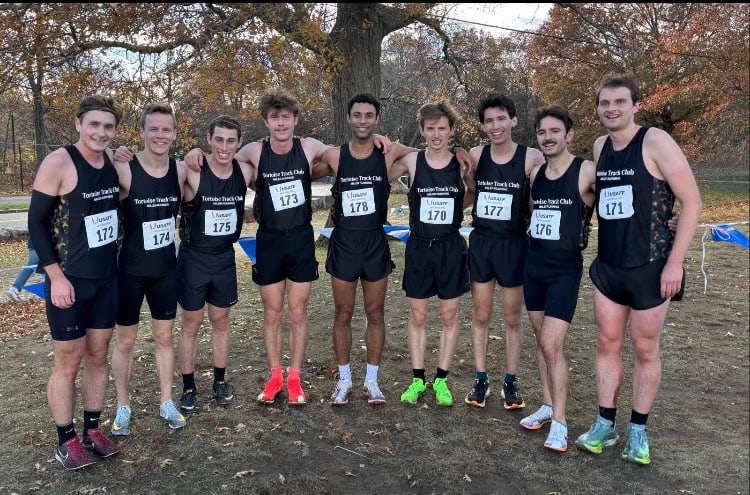 Tortoise Track Club Franklin Park 8k: Had a blast racing on my old college course
 With my birthday last Wednesday, and my traditional run out of the way (it was 28 miles this year), my 2025 for racing has pretty much all wrapped up. This year was pretty disappointing in terms of results: I’m still 10 minutes off my marathon PR, and none of my other races distances were particularly successful either (except for swimming which we’ll get to). This is not particularly surprising, as I injured myself multiple times by overrunning, and had multiple periods of very low endurance volume when life completely overwhelmed me. Despite lackluster results, I had a really fun time training this year: I joined a master’s swim club, started a small workout group in Baltimore, got back to my usual local run clubs (Tribe, NBLORG), and did a lot of miles with various MIT and Hopkins alumni. I also had a bit of an intellectual breakthrough here on Substack when I came across the writings of , , and and realized that I had been approaching the sport in the complete wrong way since ceasing to be an NCAA runner in 2021.
Going into 2026 I’m excited to put the ideas of these three greats into practice: loads easy of volume, submax testing, and completely axing intensity until I’m ready for it. More on that in a bit.
Training and Racing in 2025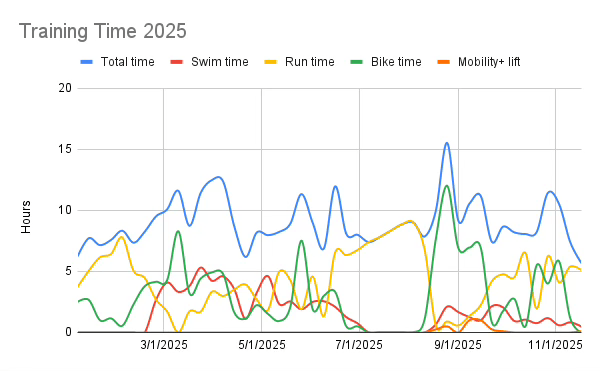 My training hours in 2025
I came into 2025 in not the greatest of places. I had been training for all of 2024 for the Chicago marathon, but a few weeks before came down with both COVID and a hip-flexor issue. Due to these problems I basically didn’t do any exercise October of 2024 and didn’t start running again until December 2025. Unfortunately because of the way that race signups work I had signed up the Boston Marathon in April and agreed to be part of a year-long race series with Under Armor here in Baltimore. This was a series of 6 races, about one a month, ranging from the mile to the marathon. Due to one of these races interfering with the MIT alumni meet, I also planned to go Boston for a XC 8k sometime during the fall. Add a couple triathlons to this and I was racing 1-2 times every single month from January onwards. Of course things weren’t going to work out very well.
Throughout the winter starting in December 2024, my coach had me gradually build up running mileage while easing off a little on the cross training. We also added fairly intense interval workouts pretty early, although these were quite low volume. Things seemed to be going okay until late February when the rapid mileage buildup and lack of strength and mobility work caused me to start to break down after the Maryland Club Challenge 10 miler on Feb 21st. I ended up having some pretty severe posterior tib issues, which I luckily was able to work through with Zach Kaminski at PT. During this time I ramped my bike and swim volume massively, and was able to come back pretty okay for the Boston Marathon and run a 2:48 off very little running.
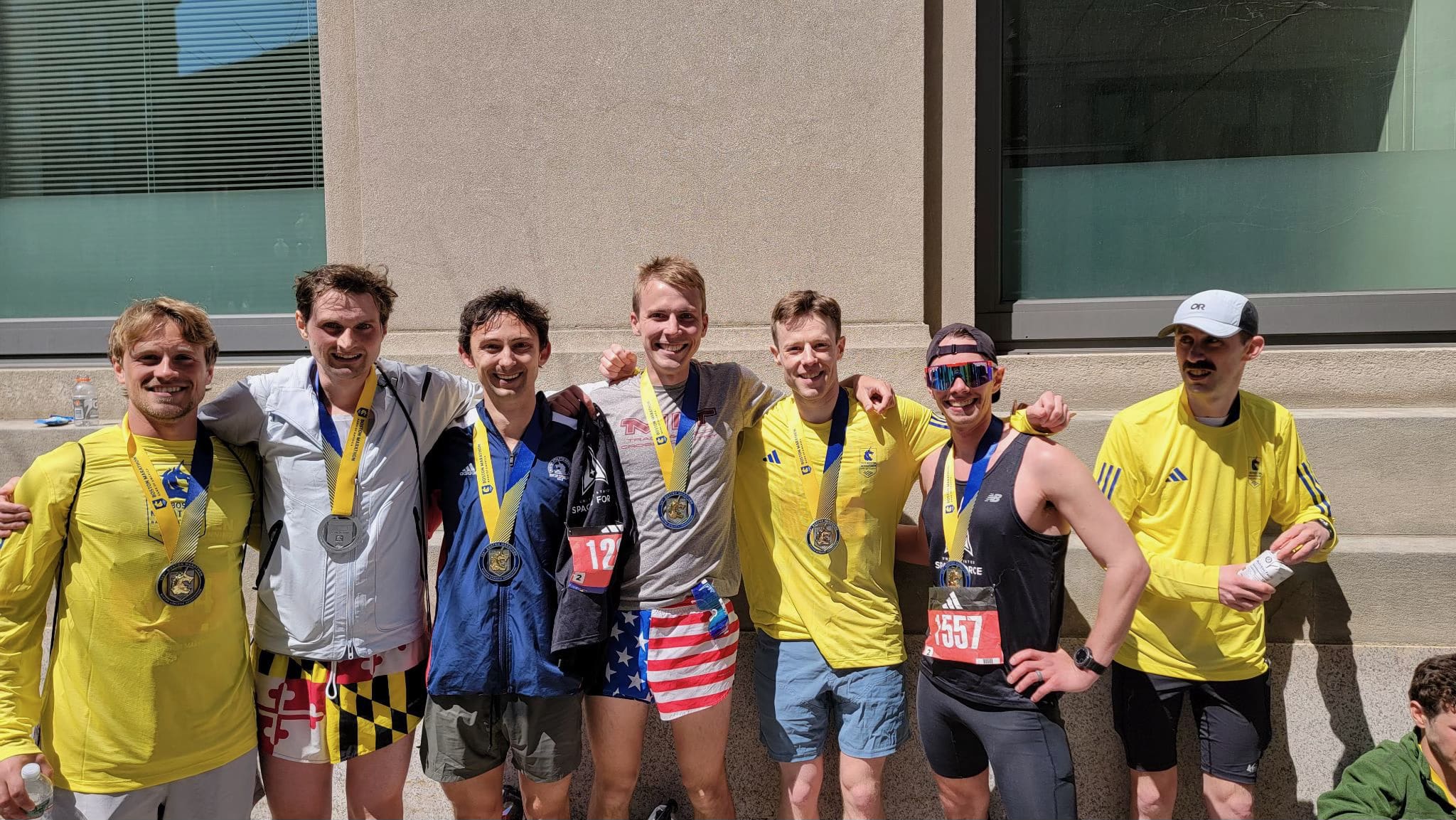
I didn’t do a whole lot of training in May, something to do with recovering from Boston and with a girl. However, after things didn’t work out around the beginning of June, I decided to rededicate myself to training completely. Quickly after that you can see a massive, linear ramping in running time until late August, in which I got injured again with the same posterior tib issue. I had also (again) foolishly given up cross training during this time, meaning getting back in the pool especially was quite a bit more difficult than it should have been1. With the help of Zach again I was luckily able to recover pretty quickly and start ramping back up for the Baltimore marathon. It was around this time that I really had begun to regularly listen to Gordo, Iñaki, and Alan, and started to want to incorporate a lot of the best practices they discussed with training. Unfortunately, I was already working with a coach who didn’t really share their training philosophy. Although things had been a bit difficult with my coach for most of 2025 due to my various injuries, this was where things really started to get grating as I no longer really believed in the training. I did my best to work in both worlds: doing the workouts that my coach prescribed, but taking extra off/easy days when my HRV was depressed, trying to take two very easy days in a row, and rebalancing my macros away from carbs and towards fat. I’m not sure if this was the right decision or not: it didn’t make sense to me to switch training plans in the middle of a season, but once I had decided that I didn’t believe in my coach’s training anymore, it felt a little bit like we were wasting each other’s time.
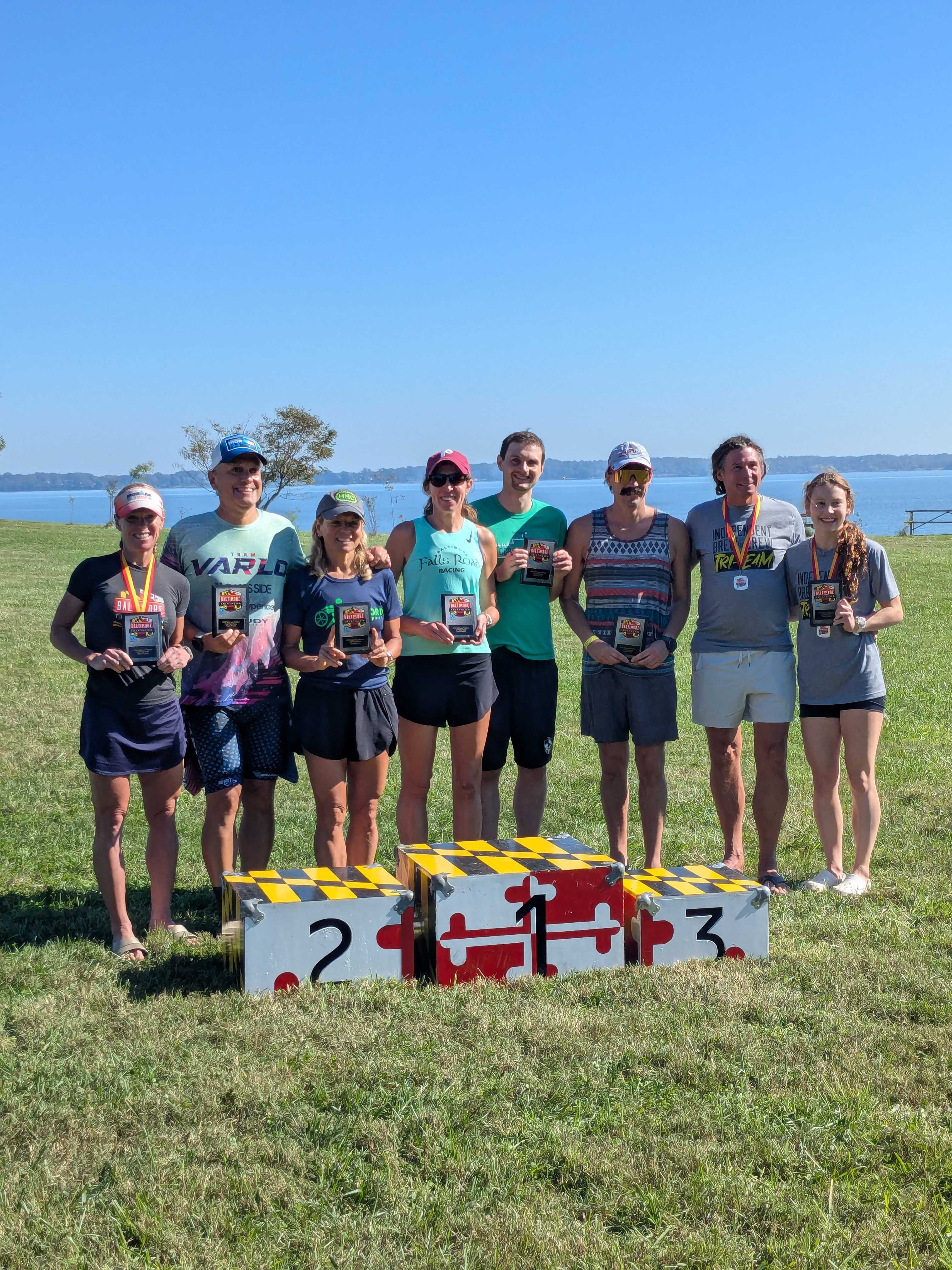
During the build to the Baltimore marathon I had a very successful swim race as part of a mixed triathlon relay at the Baltimore tri. Our goal as a team was to beat Zach for the full race. I got him on the swim, swimming a 10:04 for what was probably ~700m, but we quickly lost him on the bike.
My weeks during this time looked approximately like this
Mon: Easy run +master’s swim
Tue: AM bike
Wednesday: workout (tempo or Vo2) +master’s swim
Thursday: off
Friday: easy spin or bike (45 min) + 30 min swim
Saturday: Long run or ride (2-4 hours)
Sunday: Easy 60 min
I could have probably used more volume total and made the Wednesday workout significantly easier, but it wasn’t a bad plan, especially when I decided to axe any Vo2 workout that was given to me. During this time I started a regular workout group with a couple other guys in Baltimore: Jeff, Ross, and Adam. This was a great part of my week, and I’ll have to figure out how to incorporate it in the New Year when I’m not running so hard.
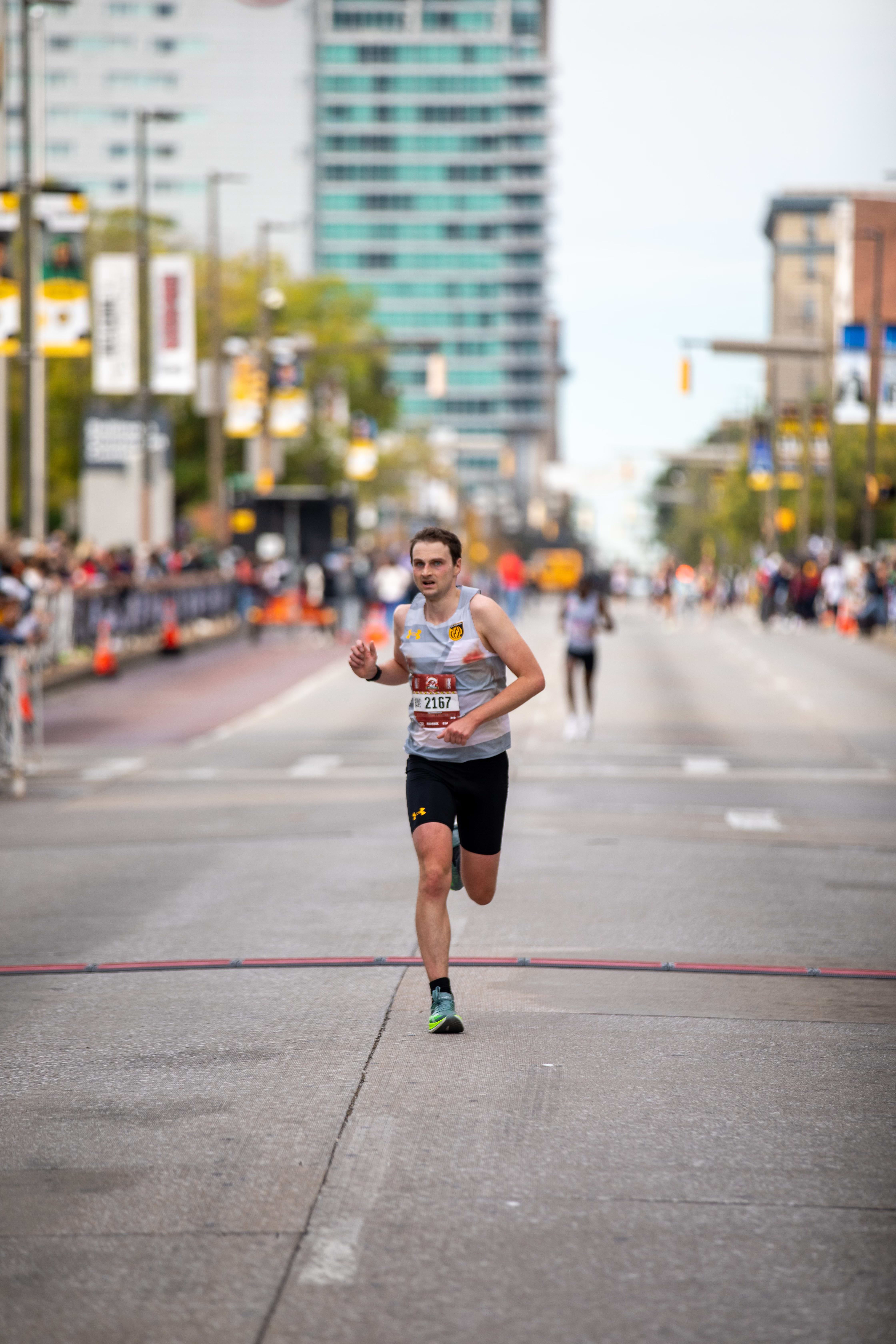
The Baltimore marathon itself went pretty well after this. I split 1:22/1:22 on a pretty challenging course and managed to close in a 5:14 mile.
After the marathon I had two more events to complete: the USATF 8k in Franklin Park and my birthday run, which was my age in miles. The week structure looked pretty similar to before, but I started following my coach’s plan completely, and replaced the long run with an extra workout on grass. During this time master’s swim shut down because of pool renovations, so my swimming frequency reduced quite markedly. I still managed to make it once a week to the school pool, and my speed seems to be maintained by this frequency, although I am not improving, and each session is a little uncomfortable.
The actual 8k itself went okay. It’s difficult to compare my time to college, as the easy stadium loop that we used to do for the first mile at Franklin Park is under construction. The replacement “Wilderness” loop is fairly hilly, so this probably added 10-20 seconds to my time. The course was also extremely muddy and we couldn’t wear spikes because of a long asphalt section: grip in my super-shoes was somewhat of a problem. That said my 27:13 still beats some of my worse 8ks from college, so I’ll take it.
The birthday run went very well. I ran the first eight with Jeff, Adam, and Ross, and then a few in the middle with my med student friend Emma. The last fourteen were on my favorite trail in Baltimore, Gwynn’s Falls, which was also amazing.
Since Wednesday I have been off, although I am beginning to exercise again because my life begins to fall apart when I don’t.
Lessons Learned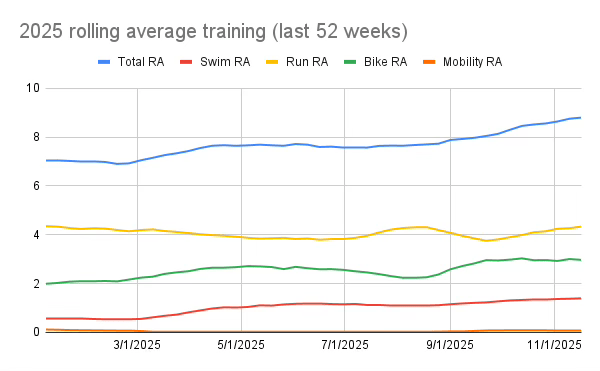 You can see where I slowly started to absorb what Alan, Iñaki and Gordo were saying
 I have to be careful with run volume. Both injuries this year (or really the same injury twice) were because I ramped run volume too much too fast. As a run focused athlete, I do need to increase my run volume, but this is best done over time and gradually. 40-50 miles a week, or around 5-6 hours is probably a safe spot to build from.
Too many races are really bad. I signed up for way too much stuff in 2025 and paid for it. It’s fine to have a lot of races lined up, but I need to learn how to pull back and train through things, rather than treat every race as a race.
I have no problem with the mental side of racing. In fact, related to the last point, I think I’m, if anything, too good at pushing myself. At the Franklin Park USATF 8k I set a new max heart rate (208) and was at or near 200 bpm for almost the whole race. This is a very good thing in some ways, but it also means I have to learn to hold myself back except when it really counts. If I’m being honest with myself I’ve never had real problem competing but rather controlling myself in non-race situations.
I need to coach myself, at least somewhat. Maybe because one of my inspirations is Lionel Sanders, and maybe because I’ve wanted to try a cycle primarily composed of truly easy running for a long time, but I’m not sure working with a coach is the right thing for me right now.
Plan for next yearI am no longer working with my old coach. We tried to work together for almost two years, but I think a difference in training philosophies and my desire to have control over my own training made the relationship difficult. I think it’s important that I have some oversight on what I’m doing, so I’m trying to recruit my high-school friend Zack (different from Zach the PT) take a look at what I have planned. I would also certainly appreciate any advice that commentariat has as well. What follows is my rough plan for 2026.
1. Get to a consistent 10-12 hrs/week of Aerobic training + 2-3 sessions a week gym time or strengthening in general, almost all of it Z1, with some 200s or easy tempo mixed in. Do this for 7-8 months, and then do a short marathon build for Chicago in the fall. Let Zack plan the workouts for this period. After the marathon I’ll do a short Vo2 block for a fast 10k and then ease back into easy volume. The important thing is to not build volume too fast: make the goal at first to just beat my 52-week rolling average each week.
2. Two of these days should be very easy, preferably back-to-back. A good block for these is Thursday-Friday or Sunday-Monday, depending on how my week is going. I don’t think a full off day is usually very good for me every week. Easy bike or ruck would be much more productive for my mental health. Take extra easy days as needed based on HRV.
3. The plan will be very run focused but capped at 40-50 miles a week. Can slowly push up from this over time, but 50 seems to be a safe cap, at least for the first 4-6 months.
4. Make sure I swim and bike at least two times a week.
5. Key submax tests (do each of these every 2-3 weeks)
a. 130/140/150/160 (heart rate) for 10 minutes around druid lake
b. 120/130/140/150 (heart rate) max wattage on bike
c. 400m/y steady swim
d. 10k 200s/200s, best average on fast! (or 15-30s hill sprints).
6. Every 4-8 weeks take a down week as needed.
7. Example week
a. Monday: easy spin + tribe in the PM
b. Tuesday submax test run + PM swim + gym session
c. Wednesday: 90 minute run with 45 minute tempo (at LT1) + pylos
d. Thursday: EZ spin (30 min)
e. Friday: EZ swim (30 min)
f. Saturday: Long run (3 hours Z1)
g. Sunday 60 minute swim + 60 minute run + gym session
h. Weekly total: ~11 hrs+ gym
8. Where am I going to get more time?
a. Eat on bike
b. Cut down screen time
c. Double up reading/immersion time with bike
9. Key dates
a. Time off begins 11/20/25
b. Unstructured training begins: sometime in December
c. Structured training begins: 1/5/2026
d. Boston Marathon (4/20/2026 15 weeks after structured training, train through this. Treat the race as a harder effort long run)
e. Chicago marathon (10/11/2026, 25 weeks after Boston)
f. USATF NE 10k in mid-November. This gives me an opportunity to use the marathon fitness for a quick Vo2 block.
Even though the Chicago marathon is the goal race for this year, I plan to not completely go to the well so I can continue to train without taking excessive time off. The real goal is fitness when I am 35 or 45.
1
I blog about language learning, biology, the science and art of learning, and many other things. If you feel inclined, please subscribe or consider buying me a coffee.
Josh
Even one swim a week would have made a huge difference in terms of swim maintenance